
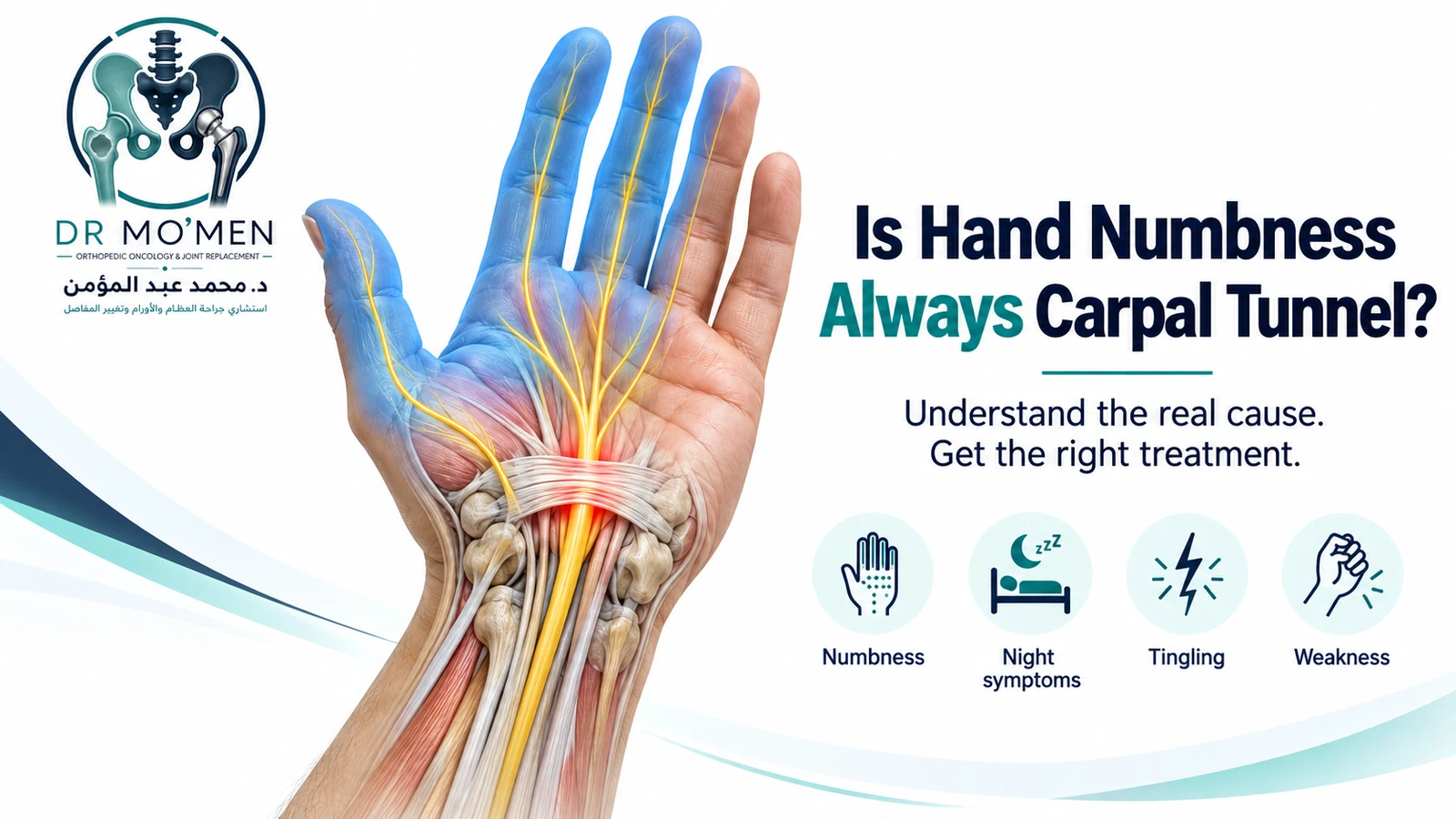
Waking at night with a numb or tingling hand is commonly associated with carpal tunnel syndrome, but not every numb hand is caused by the carpal tunnel.
The location of numbness, whether symptoms occur at night, the presence of neck or elbow pain, hand weakness, and the pattern of affected fingers can help determine where the nerve is being compressed.
Carpal tunnel syndrome results from compression of the median nerve at the wrist. Similar symptoms, however, can occur with cervical radiculopathy, ulnar nerve compression, peripheral neuropathy, and other upper-limb conditions. The key question is not only “Do I have carpal tunnel syndrome?” but also “Where is the nerve problem actually coming from?”
What Is Carpal Tunnel Syndrome?
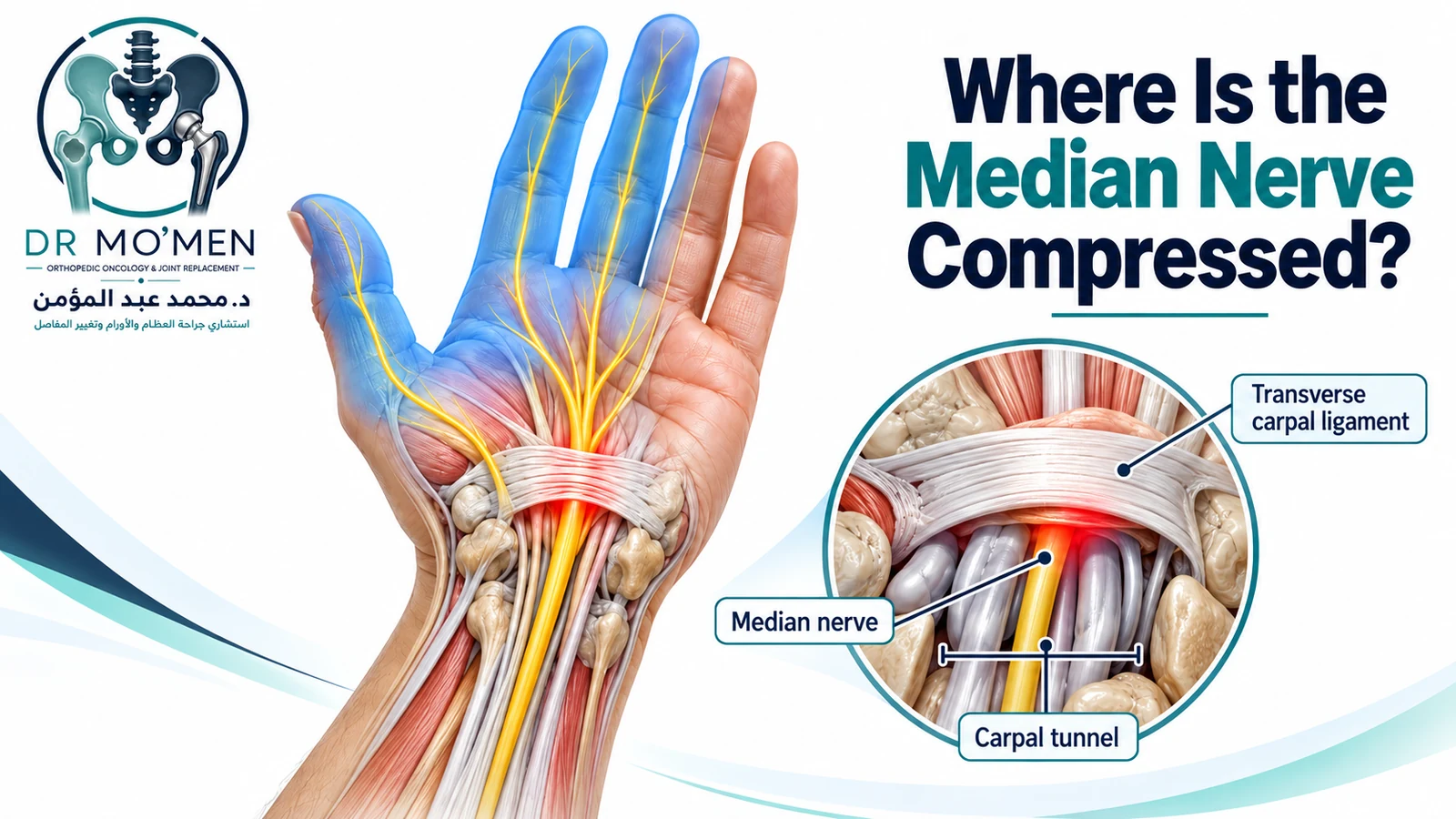
The carpal tunnel is a confined passage at the wrist containing the median nerve and the flexor tendons. Its roof is formed by the transverse carpal ligament. Carpal tunnel syndrome develops when pressure within this space compresses the median nerve. Early compression may cause intermittent tingling or numbness. More significant or prolonged compression can lead to persistent sensory changes, weakness, loss of dexterity, and thenar muscle wasting.
Which Fingers Does Carpal Tunnel Syndrome Affect?
The classic digital sensory distribution is the thumb, index finger, middle finger, and radial half of the ring finger. The little finger and the ulnar half of the ring finger are generally spared because they are supplied primarily by the ulnar nerve. This distribution is an important clue, but it should not be used as a stand-alone diagnostic test.
The skin over the thenar eminence may also retain sensation because the palmar cutaneous branch of the median nerve usually travels outside the carpal tunnel. A symptom pattern that clearly involves the little finger, the whole arm, or the neck should prompt consideration of alternative or additional causes.

Is All Hand Numbness Carpal Tunnel Syndrome?
No. Hand numbness has several possible causes, and distinguishing them is important before treatment is selected. Carpal tunnel syndrome is a wrist-level median-nerve problem, while similar symptoms can arise from the neck, elbow, more generalized neuropathy, or other hand and wrist conditions.
Carpal Tunnel vs Cervical Radiculopathy
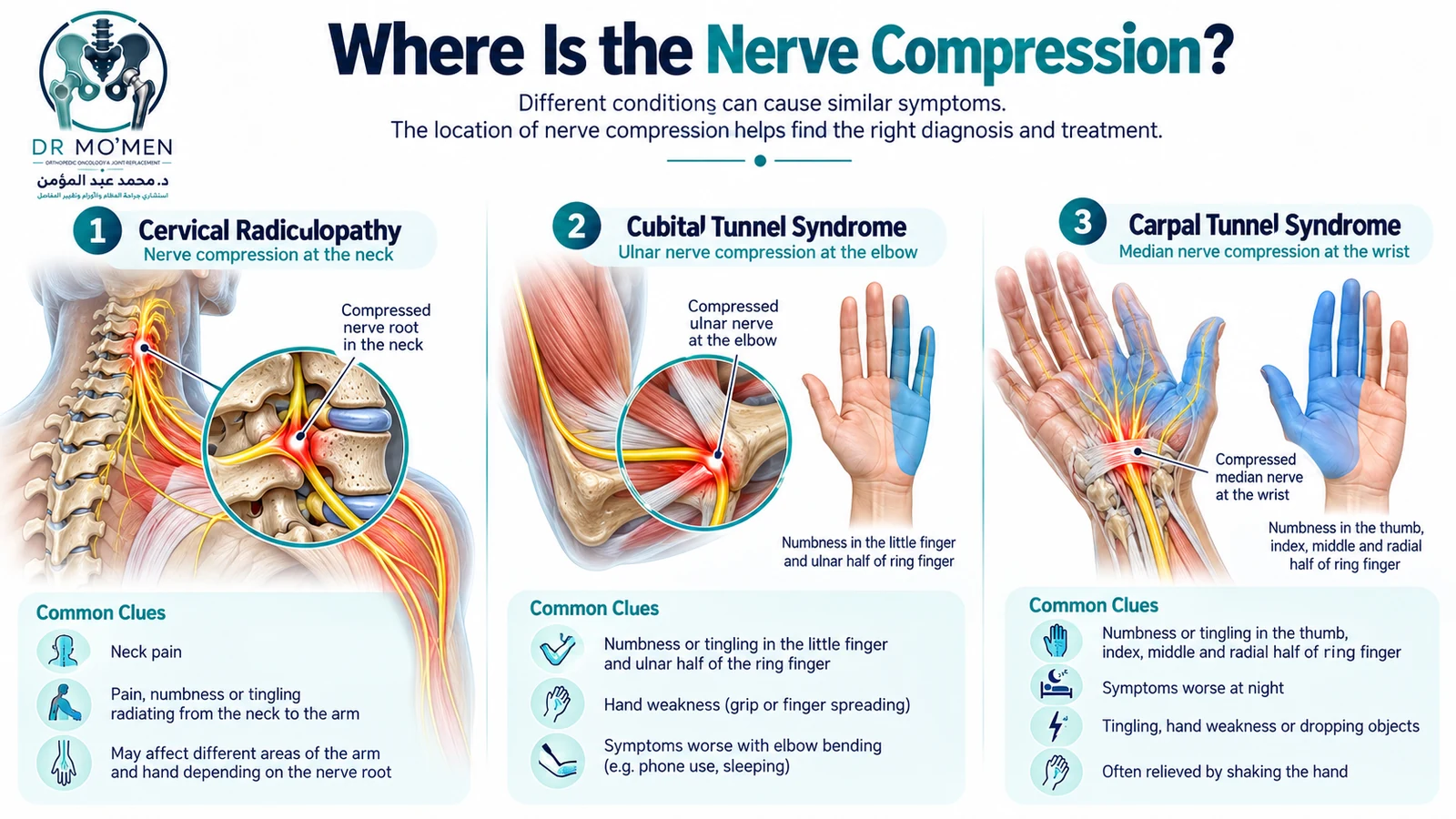
A nerve root in the neck may become irritated or compressed because of cervical disc or degenerative disease. Clues that may suggest a cervical source include neck pain, pain radiating toward the shoulder or arm, symptoms extending beyond a typical median-nerve pattern, or weakness involving muscles that cannot be explained by isolated median nerve compression. Some patients can have pathology at more than one anatomical level.
Carpal Tunnel vs Cubital Tunnel Syndrome
Cubital tunnel syndrome involves the ulnar nerve, most commonly around the elbow. Ulnar nerve compression characteristically causes numbness or tingling in the little finger and the ulnar half of the ring finger, which differs from the classic median-nerve digital pattern of carpal tunnel syndrome.
Peripheral Neuropathy and Other Causes
Generalized peripheral neuropathy can cause numbness and tingling, particularly when symptoms involve both hands and/or the feet. Diabetes is one possible association. Wrist arthritis, thumb arthritis, tendon disorders, prior injury, and space-occupying lesions may also produce symptoms that patients initially describe simply as hand pain or numbness.
| Condition | Typical clue | Common sensory pattern |
|---|---|---|
| Carpal tunnel syndrome | Night symptoms; median nerve compressed at the wrist | Thumb, index, middle, radial half of ring finger |
| Cubital tunnel syndrome | Ulnar nerve irritation around the elbow; often worse with elbow flexion | Little finger and ulnar half of ring finger |
| Cervical radiculopathy | Neck/arm symptoms and a root-level motor or sensory pattern | Varies with the affected cervical nerve root |
What Symptoms Suggest Carpal Tunnel Syndrome?
- Pins and needles or numbness in the median-nerve digital distribution.
- Symptoms that are worse at night or wake you from sleep.
- Tingling while driving, holding a phone, or maintaining certain wrist positions.
- A tendency to shake or move the hand to obtain temporary relief.
- Reduced dexterity, weak pinch or grip, or dropping objects in more advanced cases.
Warning Signs of More Advanced Nerve Compression
- Persistent rather than intermittent numbness.
- Progressive hand or thumb weakness.
- Difficulty manipulating small objects.
- Frequent dropping of objects.
- Visible wasting around the base of the thumb.
- Symptoms that continue despite appropriate conservative treatment.
Long-standing severe median-nerve compression may not recover completely after decompression, so progressive weakness or muscle wasting deserves timely clinical assessment.
Why Does Carpal Tunnel Syndrome Develop?
Often there is no single identifiable cause. Factors that may contribute include anatomical crowding within the tunnel and conditions that affect the tissues surrounding the nerve. Associations include pregnancy, diabetes, inflammatory disorders, obesity, previous wrist injury, and some occupational or repetitive hand exposures. An association does not prove that a specific activity directly caused the condition.
How Is Carpal Tunnel Syndrome Diagnosed?
Diagnosis begins with a focused history and clinical examination. The clinician evaluates which fingers are affected, when symptoms occur, whether symptoms wake you at night, sensory changes, thumb and hand strength, muscle wasting, and—when appropriate—the elbow and cervical spine. Provocative clinical tests can support the diagnosis, but no single manoeuvre should be interpreted in isolation.
Do I Always Need EMG or Nerve-Conduction Testing?
No. Electrodiagnostic studies can be useful when the diagnosis is uncertain, symptoms are atypical, another neurological condition is suspected, or objective assessment of nerve dysfunction would change management. They are not automatically required for every patient with a typical clinical presentation.
Do I Need an MRI for Carpal Tunnel Syndrome?
Usually not. MRI is not a routine diagnostic test for typical carpal tunnel syndrome. The 2024 AAOS guideline provides moderate evidence against using MRI to diagnose routine CTS. Imaging can still be considered selectively when another structural problem is suspected.
How Is Carpal Tunnel Syndrome Treated?
Treatment depends on symptom severity, duration, examination findings, functional impact, and whether there is evidence of significant nerve dysfunction. The goal is to reduce symptoms, protect nerve function and choose intervention according to the individual clinical picture.
Wrist Splinting
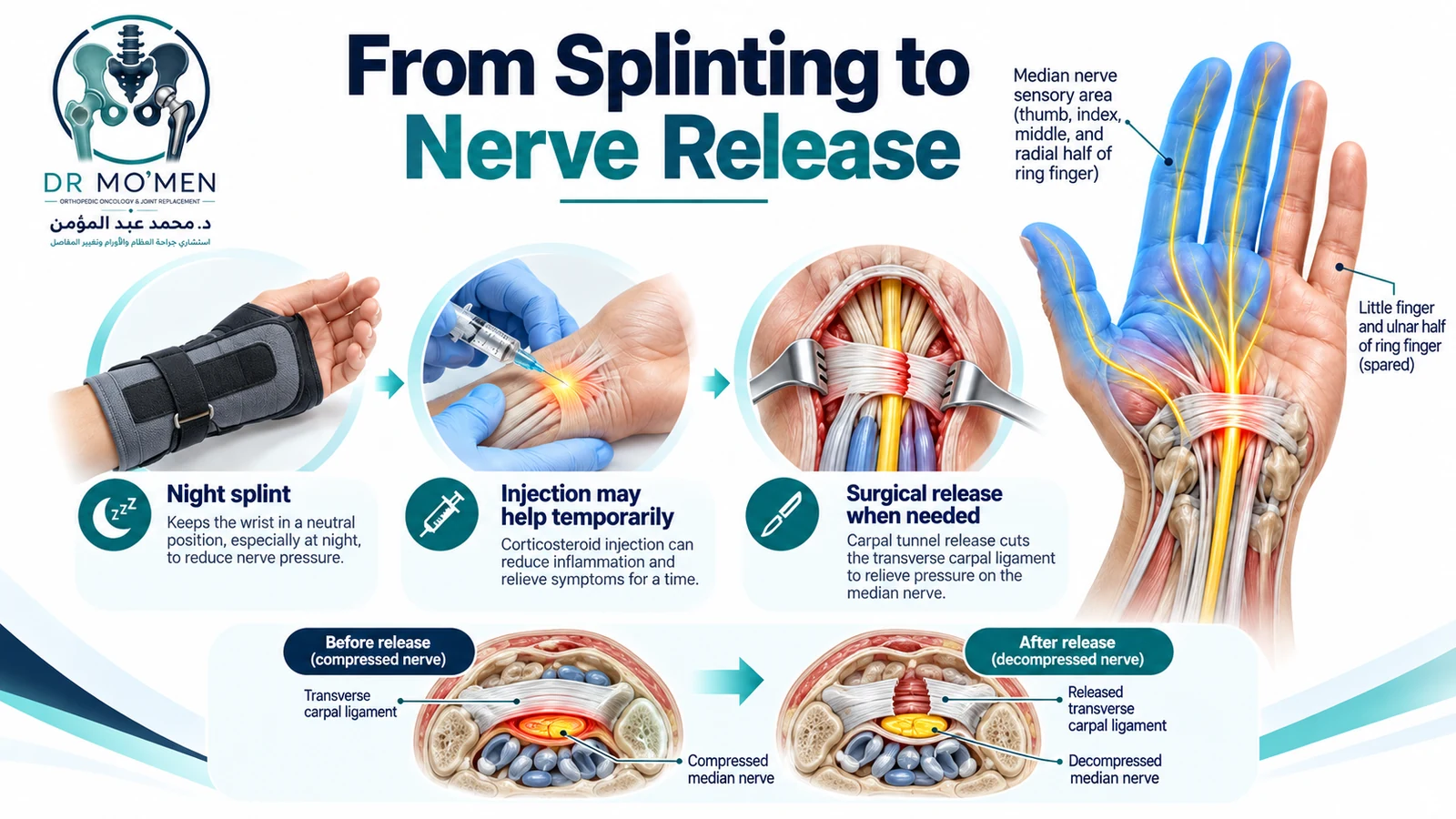
For mild or intermittent symptoms, particularly nocturnal symptoms, a neutral-position wrist splint may be considered. Avoiding prolonged wrist flexion during sleep may reduce median-nerve irritation.
Activity Modification
If specific positions or activities consistently provoke symptoms, modifying them may reduce symptom aggravation. This does not mean that every repetitive activity is proven to be the underlying cause of CTS.
Corticosteroid Injection
A corticosteroid injection may provide short-term symptom relief in selected patients. Expectations should remain realistic: the 2024 AAOS guideline states that corticosteroid injection does not provide long-term improvement in carpal tunnel syndrome.
When Is Carpal Tunnel Surgery Considered?
Carpal tunnel release may be considered when symptoms remain clinically significant despite appropriate non-operative care, or when there is concern about progressive neurological impairment. The procedure releases the transverse carpal ligament to reduce pressure on the median nerve.
Surgery may be performed through mini-open or endoscopic techniques. Current AAOS evidence indicates similar long-term patient-reported outcomes between mini-open and endoscopic release. The appropriate technique depends on the individual case, examination findings, surgeon assessment, and patient preferences.
Does Carpal Tunnel Surgery Make Numbness Disappear Immediately?
Not necessarily. Recovery depends partly on the severity and duration of nerve compression before surgery. Night symptoms may improve relatively quickly in some patients, whereas sensory recovery can take longer. If severe compression has already caused persistent numbness, weakness, or muscle wasting, neurological recovery may be incomplete.
When Should Hand Numbness Be Evaluated?
- Numbness is persistent or progressively worsening.
- Symptoms repeatedly wake you at night.
- There is weakness, loss of dexterity, or frequent dropping of objects.
- Visible muscle wasting develops around the thumb.
- Symptoms involve an unusual finger distribution.
- Neck pain accompanies arm or hand neurological symptoms.
- Symptoms persist despite an appropriate trial of conservative care.
- The diagnosis remains uncertain.
Sudden arm weakness or numbness accompanied by facial weakness, speech difficulty, severe imbalance, or other acute neurological symptoms requires urgent medical assessment and should not be assumed to be carpal tunnel syndrome.
Carpal Tunnel and Hand Numbness Assessment in Heliopolis, Cairo
For patients in Cairo, persistent or progressive hand numbness can be assessed at the Heliopolis orthopedic clinic. Bring previous nerve-conduction/EMG studies, imaging, medical reports and a list of symptoms or activities that trigger numbness. The examination may need to distinguish median nerve compression at the wrist from ulnar nerve compression, cervical nerve-root pathology and other neurological causes.
Patients outside Egypt can use the orthopedic second-opinion pathway or international-patient pathway to review existing reports and investigations before deciding whether travel for in-person assessment is appropriate. Remote review cannot replace the physical neurological examination when localization remains uncertain.
Related Hand and Wrist Topics
- Thumb-side wrist pain and De Quervain tenosynovitis
- Trigger finger and locking of the finger
- Fractures & General Orthopedics patient-education hub
Selected Evidence Sources
- AAOS 2024 Clinical Practice Guideline: Management of Carpal Tunnel Syndrome
- AAOS guideline update summary
- AAOS OrthoInfo: Carpal Tunnel Syndrome
Frequently Asked Questions
Which fingers go numb with carpal tunnel syndrome?
The thumb, index finger, middle finger, and radial half of the ring finger are the classic digital distribution. The little finger and ulnar half of the ring finger are generally spared.
Why does my hand go numb while sleeping?
Carpal tunnel syndrome is one possible cause, especially when numbness affects the median-nerve distribution and repeatedly wakes you at night. Sleep-related hand numbness is not specific to CTS, so persistent symptoms should be assessed clinically.
Can carpal tunnel syndrome come from the neck?
Carpal tunnel syndrome itself is median nerve compression at the wrist. Cervical radiculopathy can produce similar symptoms, and both problems can sometimes coexist.
Do I need an EMG before carpal tunnel treatment?
Not every patient does. Current AAOS guidance supports clinical diagnosis in appropriate adult cases without routine EMG or nerve-conduction testing. Testing remains useful when the diagnosis is uncertain or when the result could alter management.
Does a steroid injection permanently treat carpal tunnel syndrome?
Not reliably. Injection may provide short-term relief in selected patients, but the 2024 AAOS guideline does not support a long-term benefit.
Need assessment for persistent hand numbness?
For appointments or imaging/nerve-study review, contact the clinic on 01021690693.