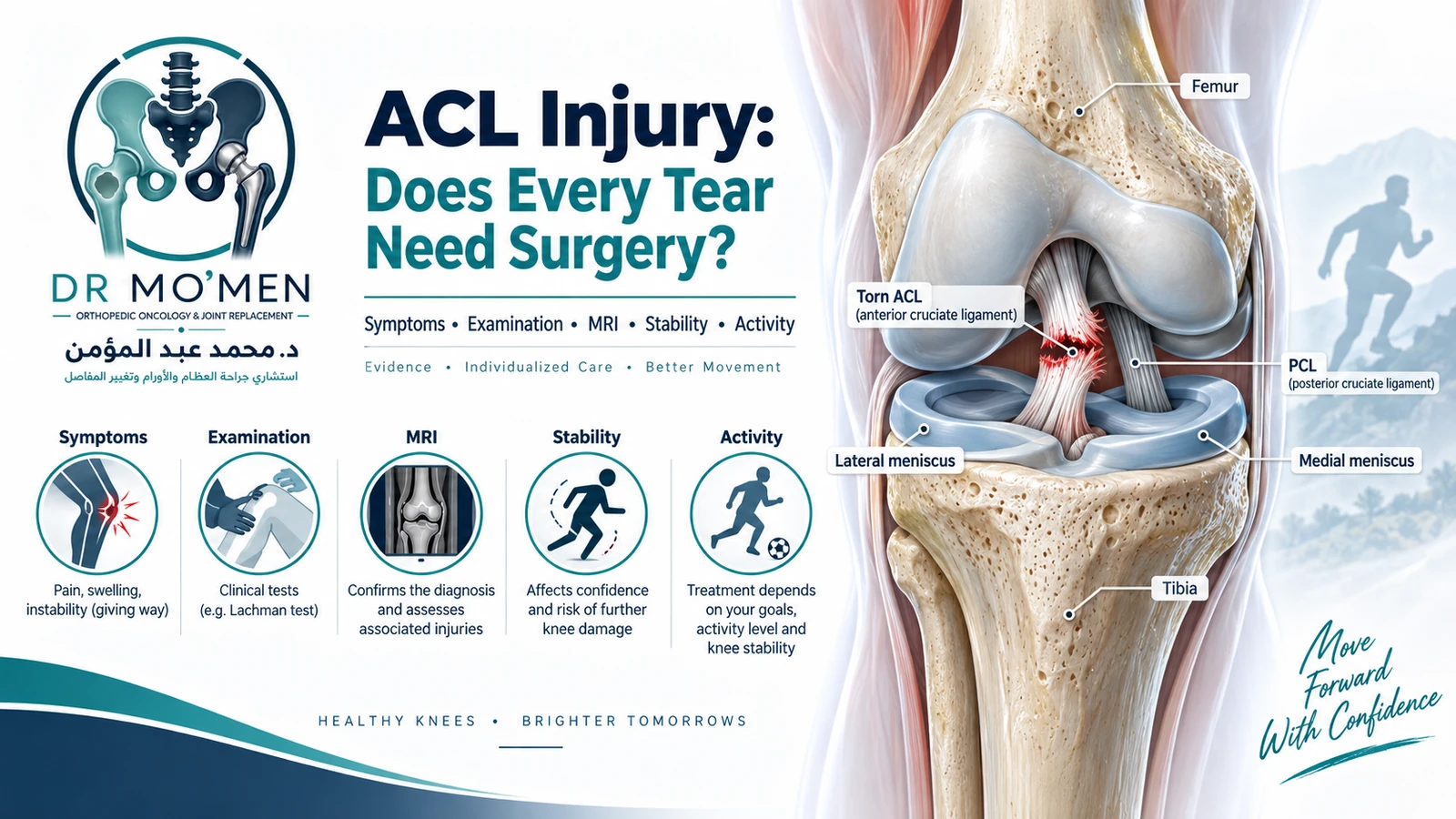
An anterior cruciate ligament (ACL) injury is one of the most important ligament injuries of the knee, particularly in football, basketball, handball, skiing, and other sports involving rapid changes of direction.
A torn ACL does not automatically mean that every patient needs surgery. Treatment depends on the degree of instability, associated meniscal or cartilage injury, age, activity demands, sporting goals, examination findings, and whether the knee repeatedly gives way during daily or athletic activity.
The first objective is therefore not simply to read an MRI report. It is to determine how the injured knee behaves clinically and what the patient needs the knee to do.
What Is the ACL?
The anterior cruciate ligament lies in the center of the knee and connects the femur to the tibia. It contributes to control of forward tibial translation and rotational stability, particularly during cutting and pivoting movements.
When the ACL is significantly injured, a patient may walk reasonably well in a straight line but feel that the knee shifts or gives way when turning, changing direction, or returning to sport.
What Are the Symptoms of an ACL Injury?
Sudden twisting injury
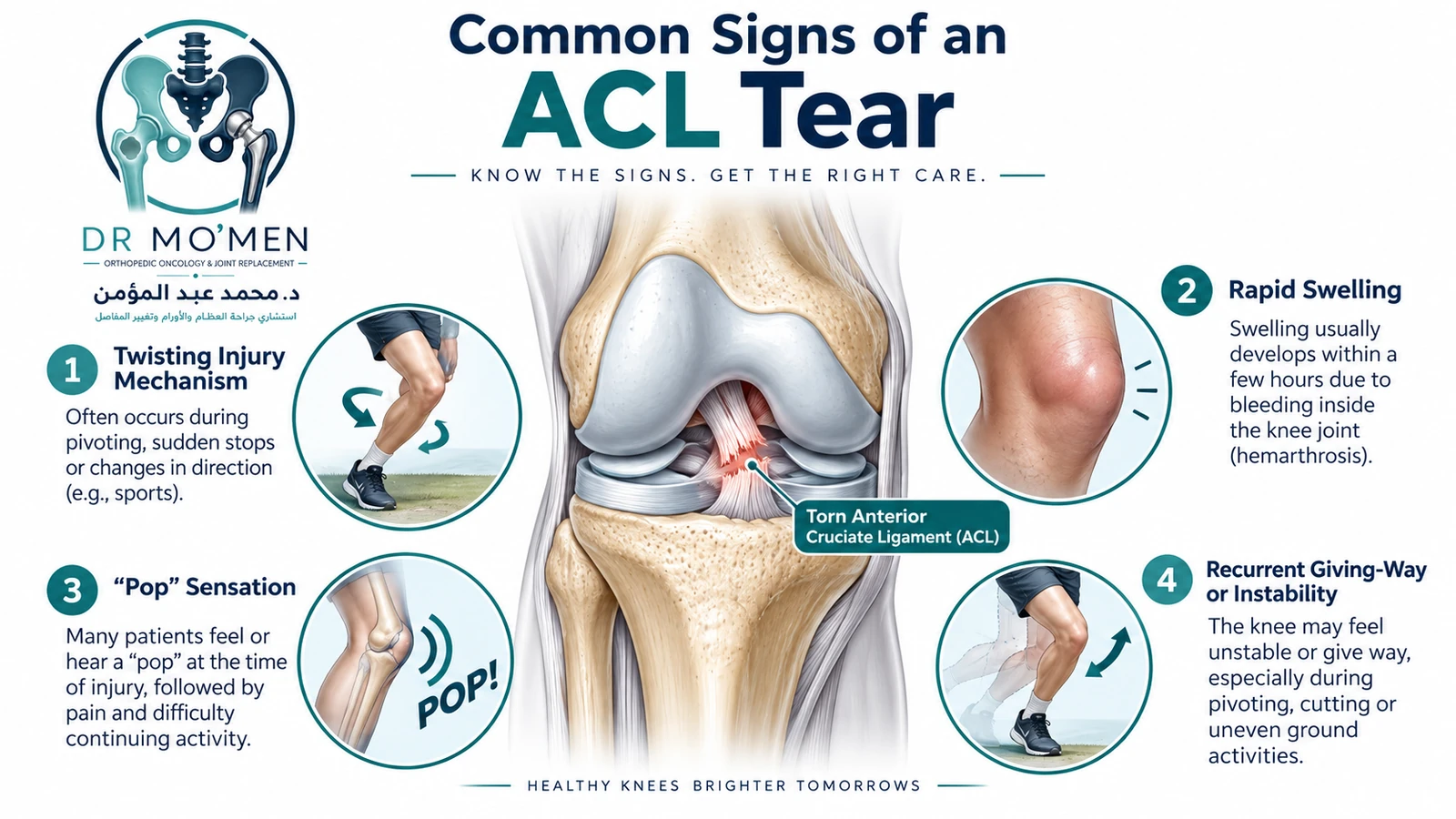
ACL tears commonly occur during a rapid change of direction, pivoting on a planted foot, awkward landing, sudden deceleration, hyperextension, or direct trauma. Many occur without direct contact.
A popping sensation
Some patients feel or hear a pop at the moment of injury. This is suggestive but not diagnostic on its own.
Rapid knee swelling
A substantial ACL injury may cause bleeding inside the joint and swelling over the first several hours. Acute swelling can also occur with patellar dislocation, meniscal injury, osteochondral injury, fracture, or other ligament injuries, so the cause should be assessed rather than assumed.
Difficulty continuing sport
Many athletes cannot continue playing because of pain, swelling, instability, or lack of confidence in the knee.
Recurrent giving way
After the acute pain settles, instability may become the dominant complaint. Patients often describe buckling, shifting, giving way, or inability to trust the knee during turning and pivoting. Repeated instability may expose the menisci and cartilage to further injury.
Loss of movement or locking
Pain and swelling can temporarily limit movement. A knee that remains mechanically locked or cannot fully straighten deserves prompt assessment because a displaced meniscal tear or another mechanical lesion may coexist.
What Causes an ACL Tear?
ACL injury is commonly associated with deceleration, knee valgus, rotation, poor neuromuscular control, landing, or cutting maneuvers. Sports frequently associated with ACL injury include football, basketball, handball, volleyball, skiing, racket sports, and gymnastics.
Partial Versus Complete ACL Tear
A partial tear means some ACL fibers remain intact. However, the MRI description does not by itself determine whether the remaining ligament is functionally competent. A complete tear indicates major disruption, but even then the treatment decision depends on symptoms, instability, associated injuries, activity requirements, and patient goals.
How Is an ACL Injury Diagnosed?
Diagnosis should combine injury history, focused examination, and appropriate imaging.
Clinical history
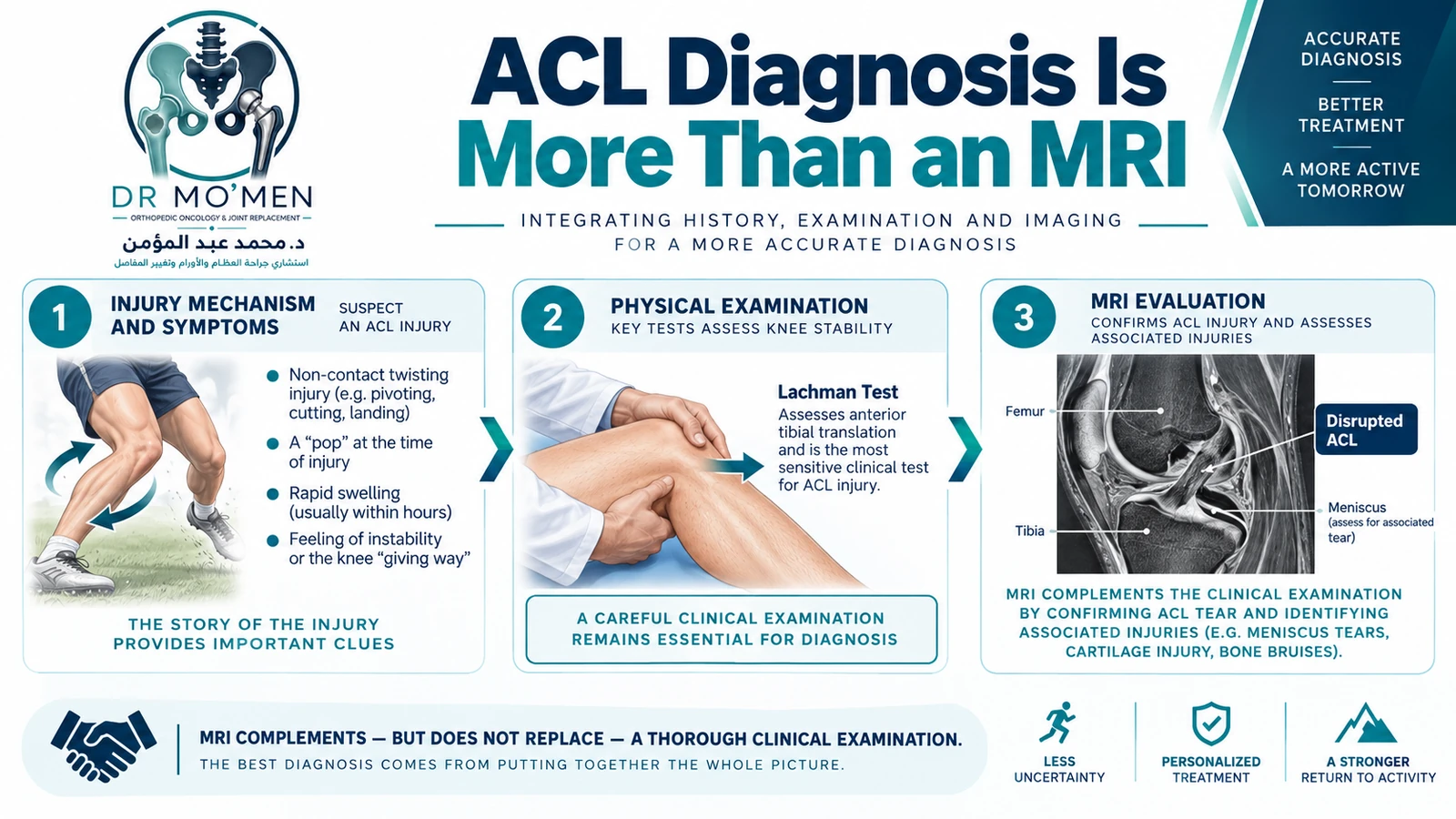
Important questions include the injury mechanism, whether a pop occurred, how quickly the knee swelled, whether the patient could continue activity, whether the knee later gives way, and what sport or work the patient wants to return to.
Physical examination
Clinical assessment may include the Lachman test, anterior drawer test, and pivot-shift test, together with assessment of the menisci, collateral ligaments, posterior cruciate ligament, range of motion, swelling, joint-line tenderness, and neurovascular status when appropriate.
The diagnosis and treatment plan should not depend on MRI alone.
Do You Need an X-Ray?
Often, yes—particularly after an acute traumatic knee injury when fracture or associated bony injury must be excluded. X-rays do not show the ACL directly but may identify fractures, avulsion injuries, alignment abnormalities, pre-existing arthritis, or other bony pathology.
What Does MRI Show?
MRI is useful for evaluating the ACL and detecting associated injuries such as meniscal tears, cartilage damage, bone bruising, collateral ligament injuries, osteochondral lesions, and joint effusion.
An MRI may report a partial or complete ACL tear, but the treatment decision still depends on clinical instability + patient activity level + associated injuries + goals + examination findings.
Two patients with apparently similar MRI findings may therefore require different treatment plans.
Can an ACL Tear Be Treated Without Surgery?
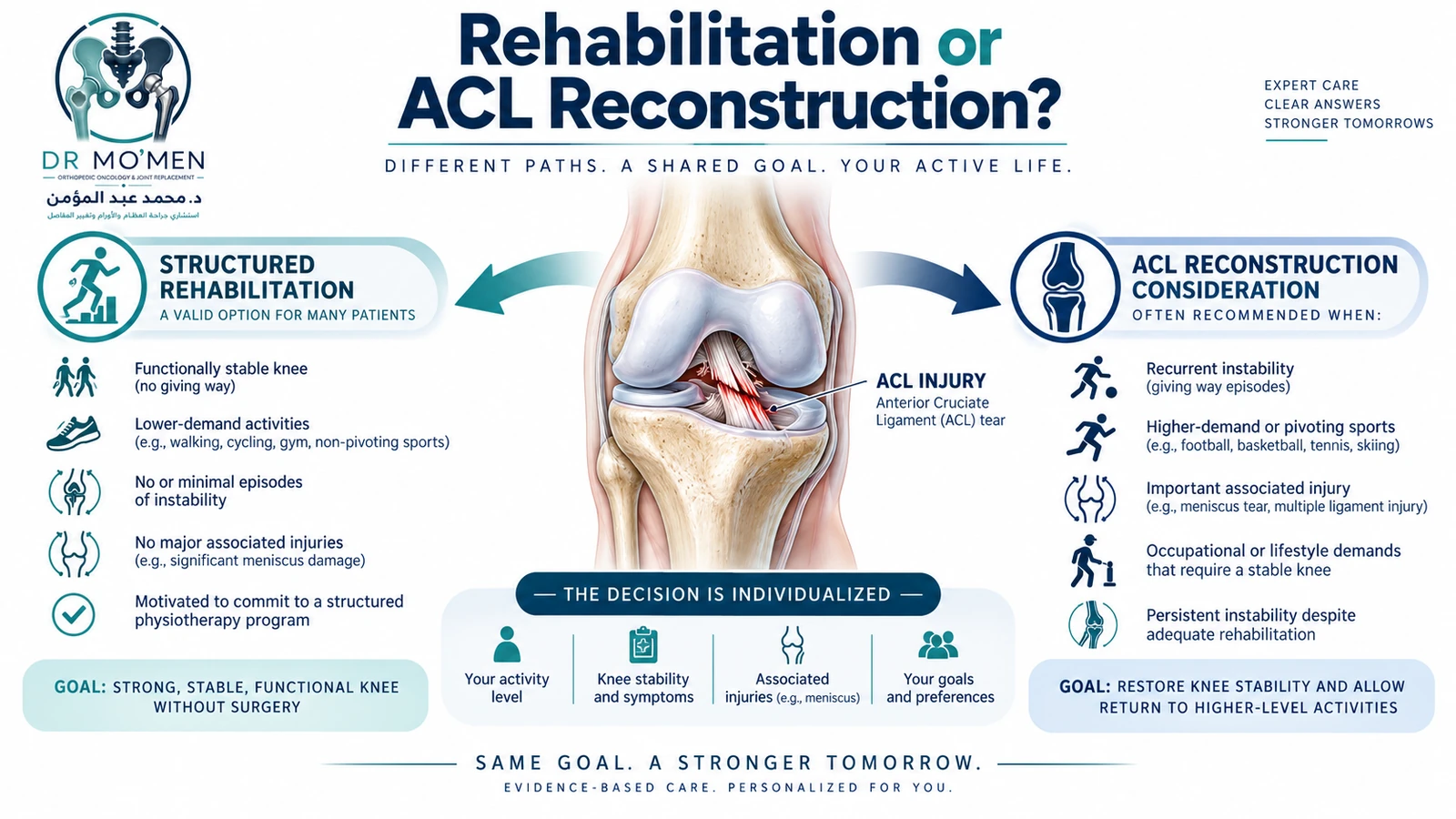
Yes, in selected patients. Non-operative management may be reasonable when the knee is sufficiently stable for the patient's activities, recurrent giving-way is absent, there are no associated injuries requiring surgery, the patient does not need high-demand pivoting activity, and structured rehabilitation restores acceptable strength and neuromuscular control.
Treatment should involve rehabilitation rather than simple rest.
What Does Non-Surgical Treatment Include?
Early management may include activity modification, appropriate pain control, ice when appropriate, compression, elevation, and temporary walking support if needed.
Rehabilitation then focuses on restoring full extension and flexion, quadriceps and hamstring strength, hip and calf strength, balance, proprioception, landing control, and progressive sport-specific movement.
When Is ACL Reconstruction More Likely to Be Appropriate?
ACL reconstruction becomes more relevant when there are recurrent giving-way episodes, symptomatic instability, a goal of returning to football or other pivoting sports, high-demand occupational requirements, associated repairable meniscal injury, combined ligament instability, or failure to regain acceptable function despite appropriate rehabilitation.
The goal of reconstruction is to restore functional stability—not simply to make the MRI look normal.
Does Every Athlete With an ACL Tear Need Surgery?
No. Sport type, competitive level, instability, associated injury, and individual goals all matter. Athletes returning to sports with frequent cutting, pivoting, rapid direction changes, and sudden deceleration are more likely to encounter functional instability with an ACL-deficient knee, making reconstruction more relevant in many—but not all—cases.
When Should ACL Reconstruction Be Performed?
Timing should be individualized. When elective reconstruction is planned, the knee should generally have good control of swelling, restored or near-restored range of motion, full or near-full extension, and reasonable quadriceps activation.
At the same time, unnecessary prolonged delay in a persistently unstable knee may increase exposure to recurrent giving-way and secondary meniscal or cartilage injury. This does not mean every ACL tear requires early surgery; it applies when reconstruction has already been judged appropriate.
What Happens During ACL Reconstruction?
A severely torn ACL is usually reconstructed using a tendon graft rather than simply sutured back together. Common graft choices include hamstring tendon autograft, bone–patellar tendon–bone autograft, quadriceps tendon autograft, and allograft in selected circumstances.
There is no single graft that is automatically best for every patient. Selection depends on age, sport, activity level, occupation, anatomy, previous surgery, and surgeon assessment.
ACL Injury and Meniscal Tears
Meniscal injuries frequently accompany ACL tears. Meniscal preservation is desirable when the tear is repairable. Depending on the tear pattern and tissue quality, treatment may involve repair, limited meniscectomy when repair is unsuitable, or observation of selected stable lesions.
The treatment plan should therefore address the whole knee, not the ACL in isolation.
What About a Locked Knee?
A mechanically locked knee after injury should be assessed promptly. Possible causes include a displaced bucket-handle meniscal tear, osteochondral fragment, loose body, or other mechanical pathology.
Recovery After ACL Reconstruction
Recovery is progressive and should not be judged only by the number of months after surgery. Rehabilitation typically progresses through swelling control, restoration of extension and flexion, strength recovery, neuromuscular control, running progression, jumping and landing, change-of-direction drills, sport-specific training, and objective return-to-sport testing.
When Can You Return to Sport?
Return to sport should not be based on time alone. Assessment may include absence of significant pain or swelling, full or near-full range of motion, quadriceps and hamstring strength, movement quality, hop testing, change-of-direction ability, psychological readiness, and sport-specific demands.
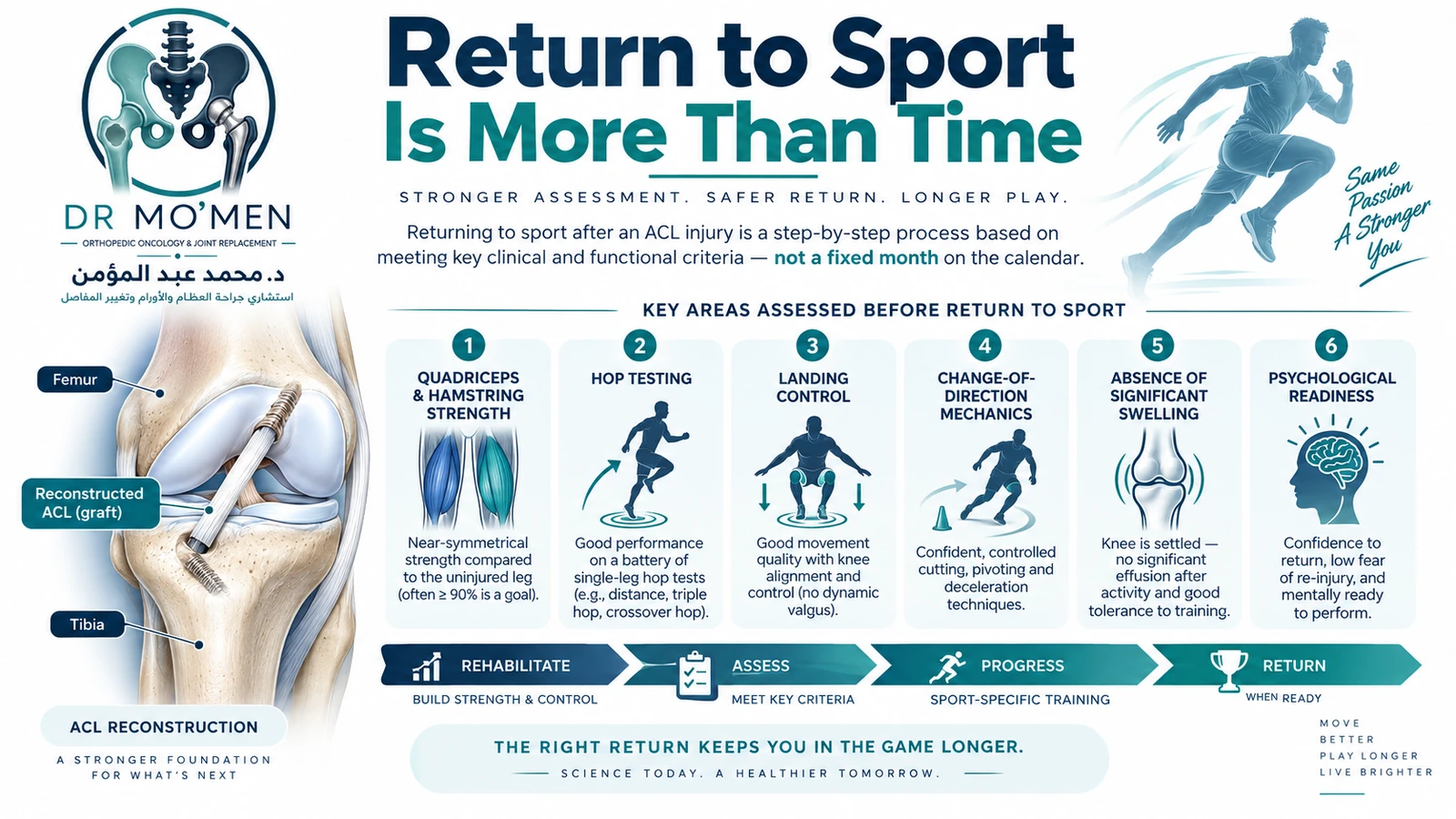
Passing a single test does not independently guarantee that reinjury will not occur.
Can the ACL Tear Again?
Yes. Possible problems after reconstruction include graft re-tear, stiffness, loss of extension, persistent instability, meniscal injury, donor-site symptoms, infection, anterior knee pain depending on graft and patient factors, and later degenerative change.
Risk-reduction rehabilitation remains important even after successful reconstruction.
What Can Reduce ACL Injury Risk?
Neuromuscular injury-prevention programs may reduce ACL injury risk in higher-risk sports. Programs commonly include landing mechanics, lower-limb alignment control, strength training, balance, agility, deceleration technique, and structured warm-up.
When Do You Need Urgent Orthopedic Assessment?
Seek prompt assessment after a knee injury when there is:
- inability to bear weight
- obvious deformity
- major swelling after trauma
- true locking of the knee
- inability to fully straighten the knee
- suspected fracture
- numbness or vascular symptoms
- severe instability
- repeated giving way
- suspected combined ligament injury
- persistent symptoms despite appropriate initial treatment
A Common Mistake: Treating the MRI Instead of the Patient
One common problem in sports-knee care is basing treatment entirely on an MRI report. A statement such as “complete ACL tear = surgery” is too simplistic.
A better decision pathway is:
History → Clinical examination → Stability → MRI and associated injuries → Activity requirements → Patient goals → Treatment plan
MRI provides important anatomical information; clinical assessment determines whether that anatomy is causing meaningful functional instability.
The Role of Dr. Mo’men in ACL and Sports-Knee Assessment
Dr. Mohammed Abdelmoemen Abuelhadid evaluates sports-related knee injuries with attention to injury mechanism, clinical ACL stability, meniscal and cartilage injury, associated ligament damage, MRI correlation, activity goals, and suitability for rehabilitation versus reconstruction.
The objective is not to recommend surgery simply because an ACL abnormality appears on MRI. Treatment should determine whether the patient can function adequately with structured rehabilitation or whether reconstruction is more appropriate because of instability, sporting demands, or associated injuries.
Sports Injuries Service:
/en/services/sports-injuries/
Second Opinion:
/en/second-opinion/
International Patients:
/en/international-patients/
Patients outside Egypt can send their MRI images and reports for an initial specialist second-opinion review before planning travel.
For appointments or X-ray/MRI review:
01021690693
If the main problem is progressive knee arthritis rather than traumatic instability, see when knee replacement may be appropriate.