
In this article
Neck pain that travels into the shoulder, arm or hand can come from a cervical nerve root rather than from the shoulder, elbow or wrist itself.
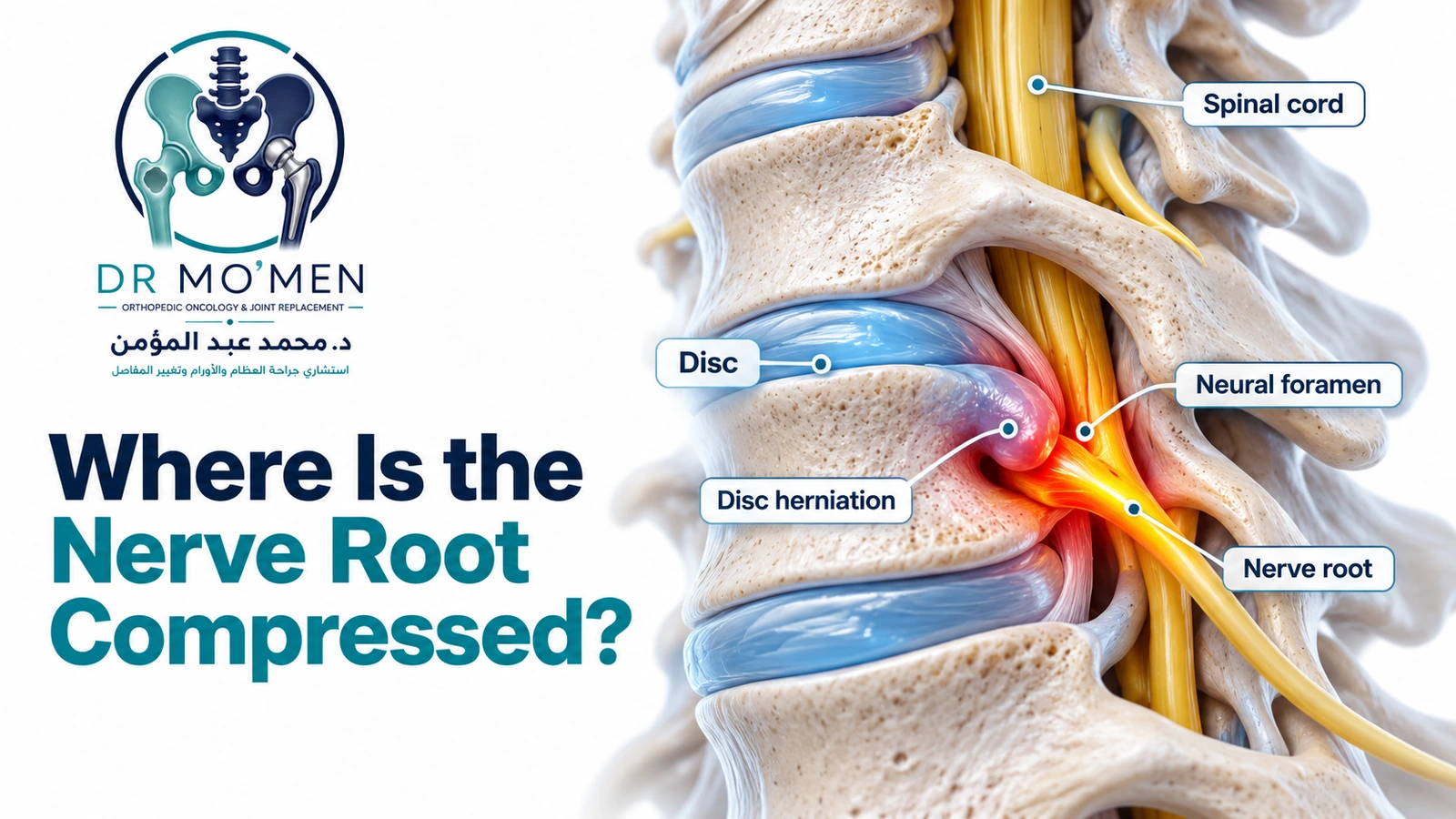
This condition is called cervical radiculopathy. It usually occurs when a nerve root leaving the cervical spine becomes irritated or compressed by a disc herniation, narrowing around the neural foramen, or degenerative changes in the neck.
Patients may describe neck pain spreading into the shoulder or arm, tingling or numbness in the hand, burning or electric-type arm pain, weakness, or symptoms that change with neck position.
Hand numbness does not automatically mean the problem is in the hand. Carpal tunnel syndrome, cubital tunnel syndrome and cervical radiculopathy can overlap. The key question is: where along the nerve pathway is the neurological problem actually occurring?
Quick Answer: What Is Cervical Radiculopathy?
Cervical radiculopathy is irritation or compression of a nerve root in the neck that can cause pain, numbness, tingling or weakness extending into the shoulder, arm or hand. Diagnosis usually combines the symptom pattern with neurological examination. MRI and electrodiagnostic testing are used selectively rather than automatically in every patient.
What Causes Cervical Radiculopathy?
Cervical disc herniation
A cervical intervertebral disc can bulge or herniate toward a nerve root. The resulting inflammation and mechanical compression may produce pain radiating from the neck into the upper limb.
Degenerative foraminal narrowing
With age, the cervical spine can develop disc-height loss, osteophytes, facet-joint degeneration and narrowing of the neural foramen. When this opening becomes sufficiently narrowed, the nerve root can become irritated or compressed.
What Does Cervical Radiculopathy Feel Like?
- Neck pain.
- Pain around the shoulder blade.
- Pain travelling down the arm.
- Pins and needles or numbness.
- Weakness in part of the arm or hand.
- Altered reflexes.
Pain may feel sharp, burning, electric, aching or shooting. Some patients have significant arm pain with surprisingly little neck pain. Others notice symptoms particularly when turning or extending the neck toward the symptomatic side.
Which Fingers Are Affected by Cervical Radiculopathy?
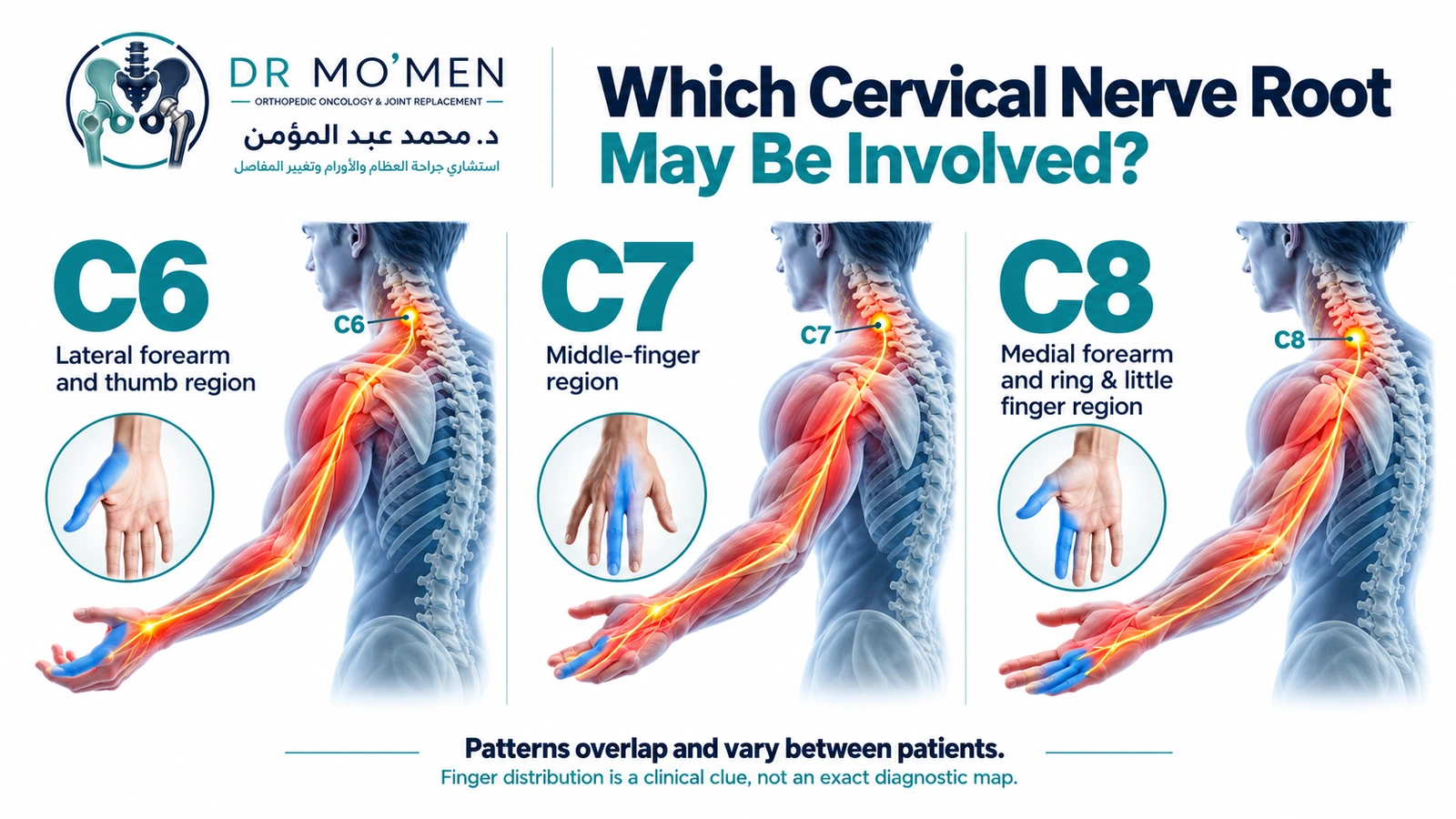
Cervical nerve-root patterns overlap and vary between patients. Finger distribution is a clinical clue, not an exact diagnostic map.
| Nerve root | Common sensory region | Possible weakness |
|---|---|---|
| C5 | Shoulder / lateral upper arm | Shoulder abduction, elbow flexion |
| C6 | Lateral forearm, thumb ± index region | Elbow flexion, wrist extension |
| C7 | Middle-finger region | Triceps / finger extension |
| C8 | Ulnar forearm/hand, ring- and little-finger region | Finger flexion / hand function |
| T1 | Medial forearm / hand overlap | Intrinsic hand muscles |
Important: these distributions are approximate. A patient should not diagnose a specific cervical disc level simply from which finger feels numb.
Cervical Radiculopathy vs Carpal Tunnel Syndrome
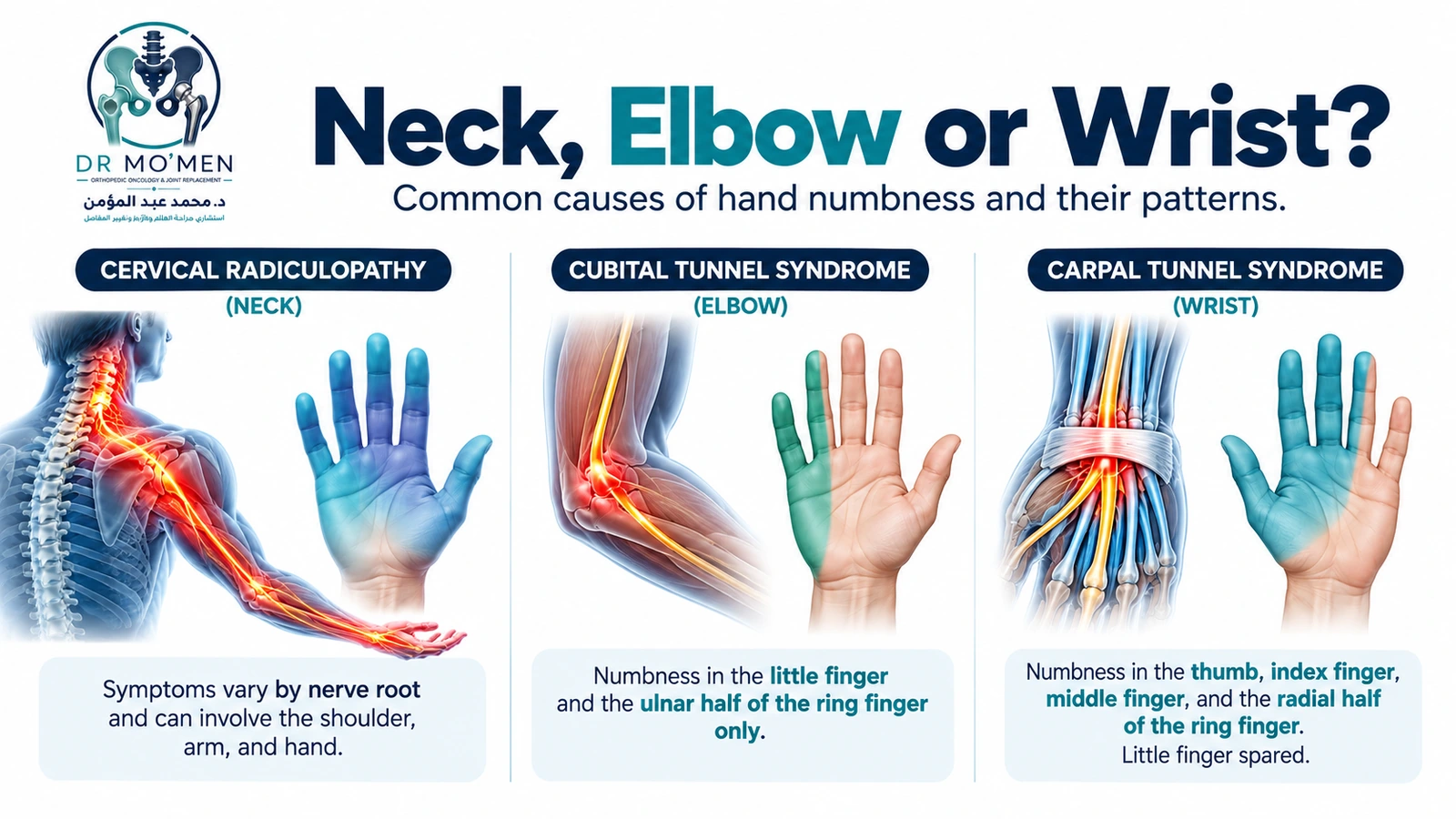
Carpal tunnel syndrome is compression of the median nerve at the wrist. Its characteristic sensory symptoms involve the thumb, index finger, middle finger and radial half of the ring finger. The little finger is usually spared.
Cervical radiculopathy originates from a nerve root in the neck. Clues favoring a cervical source include neck or shoulder-blade pain, pain travelling down the arm, weakness involving muscles outside a single peripheral nerve, reflex changes, and symptoms influenced by neck movement.
The two conditions can coexist, so hand numbness alone does not establish where the nerve is compressed.
Cervical Radiculopathy vs Cubital Tunnel Syndrome
Cubital tunnel syndrome involves the ulnar nerve around the elbow. Its classic sensory pattern is the little finger and ulnar half of the ring finger. Symptoms often worsen with prolonged elbow flexion, sleeping with the elbow bent or leaning on the inner elbow.
C8 radiculopathy can overlap with ulnar-nerve symptoms, so the neurological examination considers muscles, reflexes, neck findings and the full nerve pathway rather than finger distribution alone.
Neck, Elbow or Wrist? Quick Comparison
| Clue | Cervical radiculopathy | Cubital tunnel | Carpal tunnel |
|---|---|---|---|
| Common source | Cervical nerve root | Ulnar nerve at elbow | Median nerve at wrist |
| Typical sensory clue | Varies by root; may extend from neck/shoulder into arm and hand | Little finger + ulnar half of ring finger | Thumb, index, middle + radial half of ring finger; little finger spared |
| Helpful associated features | Neck/scapular pain, radiating arm pain, reflex or multi-muscle weakness | Worse with elbow flexion or pressure on inner elbow | Often nocturnal hand numbness; median-nerve distribution |
Can a Neck Disc Cause Hand Numbness Without Severe Neck Pain?
Yes. Some patients primarily notice arm pain, tingling, finger numbness or hand weakness and may have only mild neck discomfort. The absence of severe neck pain does not completely exclude a cervical source of hand symptoms.
How Is Cervical Radiculopathy Diagnosed?
Diagnosis starts with the history and neurological examination. Assessment may include neck movement, symptom distribution, sensation, muscle strength, deep tendon reflexes, shoulder examination, provocative cervical tests, assessment for carpal or cubital tunnel syndrome, and evaluation for cervical spinal-cord involvement.
The objective is not simply to prove that an MRI is abnormal. The objective is to determine whether an imaging abnormality actually explains the patient’s symptoms and examination findings.
Do I need an MRI for cervical radiculopathy?
Not everyone with neck and arm pain immediately needs an MRI. In uncomplicated presentations without major neurological deficit or red flags, an initial period of clinical assessment and nonoperative treatment is often appropriate.
MRI becomes particularly useful when symptoms remain significant despite an appropriate period of conservative care, objective neurological weakness is present or progressing, cervical myelopathy is suspected, another serious structural problem is suspected, or an injection or surgical procedure is being considered.
Does an abnormal MRI automatically mean I need surgery?
No. Degenerative cervical changes can appear on imaging even in people who do not have matching neurological symptoms. Treatment should not be based on the MRI report alone. Symptoms, neurological examination and imaging level should correlate before surgery is considered.
When are EMG and nerve-conduction studies useful?
Electrodiagnostic testing can be useful when the anatomical source remains uncertain. It may help distinguish cervical radiculopathy from carpal tunnel syndrome, cubital tunnel syndrome or another peripheral neuropathy. Routine electrodiagnostic testing is not required when the diagnosis is already clinically clear.
When radiculopathy is being evaluated, nerve-conduction studies alone are not equivalent to a complete electrodiagnostic assessment; needle EMG is normally part of the appropriate study.
What Are the Red Flags in Neck and Arm Pain?
Most cervical radiculopathy is not an emergency. However, some symptoms suggest that the problem may involve the spinal cord rather than a single nerve root.
Possible cervical myelopathy
- Increasing difficulty walking or imbalance.
- Unusually clumsy hands.
- Difficulty with buttons, handwriting or other fine hand tasks.
- Symptoms affecting both arms or both legs.
- Progressive weakness.
- Abnormal stiffness or loss of coordination.
- New bowel or bladder neurological dysfunction.
Cervical spinal-cord compression is clinically different from isolated radiculopathy and requires specialist assessment.
Other reasons for earlier assessment
- Significant trauma.
- Known malignancy.
- Unexplained weight loss.
- Persistent constitutional symptoms.
- Fever or suspected infection.
- Immunosuppression.
- Rapidly progressive neurological weakness.
- Severe unremitting pain with concerning clinical features.
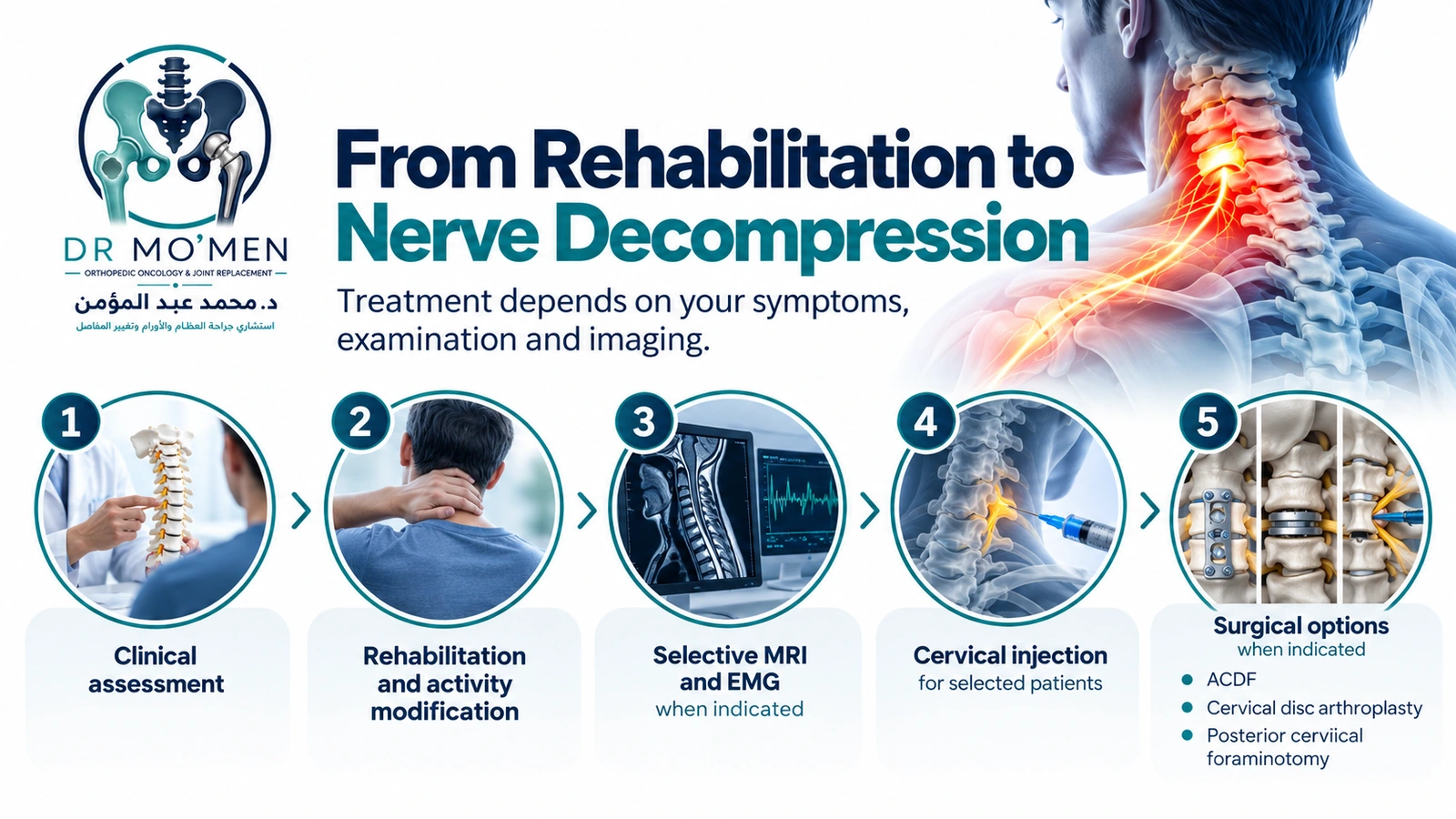
How Is Cervical Radiculopathy Treated Without Surgery?
Many patients can initially be treated without an operation when there is no major progressive neurological deficit or evidence of spinal-cord dysfunction. Treatment is individualized.
Activity modification
Short-term modification of movements that repeatedly reproduce severe arm symptoms may help during an acute episode. This does not mean prolonged immobilization; gradual return to normal movement is usually part of recovery.
Physiotherapy and rehabilitation
A structured rehabilitation programme may include cervical mobility work, posture and ergonomic modification, strengthening, scapular mechanics, selected nerve-mobility techniques, and individualized traction in selected patients.
Medication
Medication may sometimes be used for symptom control. The appropriate choice depends on medical history, kidney or gastrointestinal risk, other medications, and the severity and type of pain.
What about cervical epidural steroid injection?
An epidural or selective cervical injection may be considered in selected patients with persistent radicular pain. Its aim is generally to reduce inflammation and pain, not mechanically remove a disc herniation. Potential benefit varies between patients and cervical injections have procedure-specific risks, so they should follow appropriate clinical assessment and imaging.
Can cervical radiculopathy improve without surgery?
Yes. Many patients improve with nonoperative treatment and time, particularly when there is no progressive motor deficit or spinal-cord compression. Immediate surgery is not required simply because a cervical disc protrusion appears on MRI.
When Is Surgery Considered?
- Progressive neurological weakness.
- Significant motor deficit.
- Evidence of cervical myelopathy.
- Persistent disabling radicular pain despite appropriate nonoperative treatment.
- Clear imaging evidence that matches the neurological symptoms.
- Structural pathology for which decompression is considered appropriate.
The decision depends on the patient, symptoms, examination and anatomy, not simply on the size of a disc bulge.
What Operations Are Used for Cervical Radiculopathy?
Anterior cervical discectomy and fusion — ACDF
The disc and compressive structures are approached from the front of the neck. The affected level is decompressed and then fused.
Cervical disc arthroplasty
In selected patients, the diseased disc can be replaced with an artificial cervical disc rather than fused. Not every patient or cervical level is suitable for disc replacement.
Posterior cervical foraminotomy
Selected nerve-root compression can be approached from the back of the neck to enlarge the foramen and decompress the affected nerve root while preserving motion at the segment.
ACDF or posterior foraminotomy: which is better?
There is no single operation that is best for every patient with cervical radiculopathy. Procedure selection depends on where the nerve is compressed, whether compression is central or foraminal, soft-disc versus bony pathology, cervical alignment, instability, number of levels, previous operations and patient-specific factors.
What Are the Risks of Cervical Surgery?
The exact risks depend on the procedure. Potential complications can include infection, bleeding, nerve injury, persistent or recurrent symptoms, dural injury or cerebrospinal-fluid leak, rare spinal-cord injury, and fusion- or implant-related complications where applicable. Anterior cervical surgery also has approach-specific risks such as swallowing difficulty or voice changes.
How Long Does Nerve Recovery Take?
Pain, numbness and weakness do not always recover at the same speed. Arm pain may improve before numbness, grip function or muscle strength. A nerve that has been significantly compressed for a prolonged period may recover slowly, and severe pre-existing neurological deficit may not recover completely.
When Should You Seek Specialist Assessment?
- Pain travels persistently from the neck into the arm.
- Numbness is persistent.
- Weakness is developing.
- Hand function is deteriorating.
- Symptoms keep recurring.
- Conservative treatment has not helped.
- The MRI appears abnormal but its significance is unclear.
- Carpal tunnel and cervical radiculopathy are difficult to distinguish.
- Cubital tunnel and cervical radiculopathy are difficult to distinguish.
- Surgery has been recommended and you want the diagnosis and imaging correlation reviewed.
Specialist Assessment and Second Opinion
Upper-limb numbness can become confusing when cervical imaging, nerve-conduction tests and hand symptoms appear to suggest different diagnoses. A useful assessment therefore asks whether the neurological problem is at the neck, elbow, wrist—or more than one level.
Dr. Mohammed Abdelmoemen Abuelhadid evaluates complex orthopedic and musculoskeletal presentations and can review existing imaging and investigations when the anatomical source of symptoms is uncertain. When a cervical-spine procedure may be required, evaluation should include appropriate spine-specialist input according to the pathology.
For patients outside Egypt, existing MRI images, reports and EMG/NCS results can be reviewed through the orthopedic second-opinion pathway before arranging travel when appropriate.
Related Nerve and Hand Topics
- Carpal tunnel syndrome and hand numbness
- Cubital tunnel syndrome and ulnar nerve compression
- Ganglion cyst of the hand and wrist
- Fractures & General Orthopedics patient-education hub
Selected Evidence Sources
- North American Spine Society — Diagnosis and Treatment of Cervical Radiculopathy from Degenerative Disorders.
- Nonoperative Management of Cervical Radiculopathy. American Family Physician review.
- Cervical radicular pain: diagnosis and treatment review.
- Degenerative cervical myelopathy clinical practice guideline.
- 2026 randomized-trial meta-analysis: ACDF versus posterior cervical foraminotomy for cervical radiculopathy.
Frequently Asked Questions
Can a slipped disc in the neck cause hand numbness?
Yes. A cervical disc herniation can irritate or compress a nerve root and produce pain, tingling, numbness or weakness extending into the arm or hand.
How can I tell cervical radiculopathy from carpal tunnel?
Carpal tunnel syndrome usually produces symptoms in the median-nerve territory of the hand, while cervical radiculopathy may include neck or shoulder-blade pain, radiating arm symptoms, weakness or reflex abnormalities. Examination is often necessary because symptoms can overlap.
Do I need an MRI immediately?
Not necessarily. MRI is particularly useful when symptoms persist despite an appropriate period of treatment, neurological deficits are progressing, red flags exist, or an intervention is being considered.
Do I need EMG if I already have an MRI?
Not always. EMG and nerve-conduction studies can add useful information when the clinician needs to distinguish cervical radiculopathy from peripheral nerve compression such as carpal or cubital tunnel syndrome.
Does every cervical disc herniation need surgery?
No. Many patients can initially be managed without surgery when neurological function is stable. Surgery is considered when symptoms, examination and imaging indicate that decompression is appropriate.
Need assessment for neck-to-arm pain, numbness or weakness?
For appointments or imaging/EMG review, contact the clinic on 01021690693. Progressive weakness or signs of spinal-cord dysfunction need timely in-person assessment.