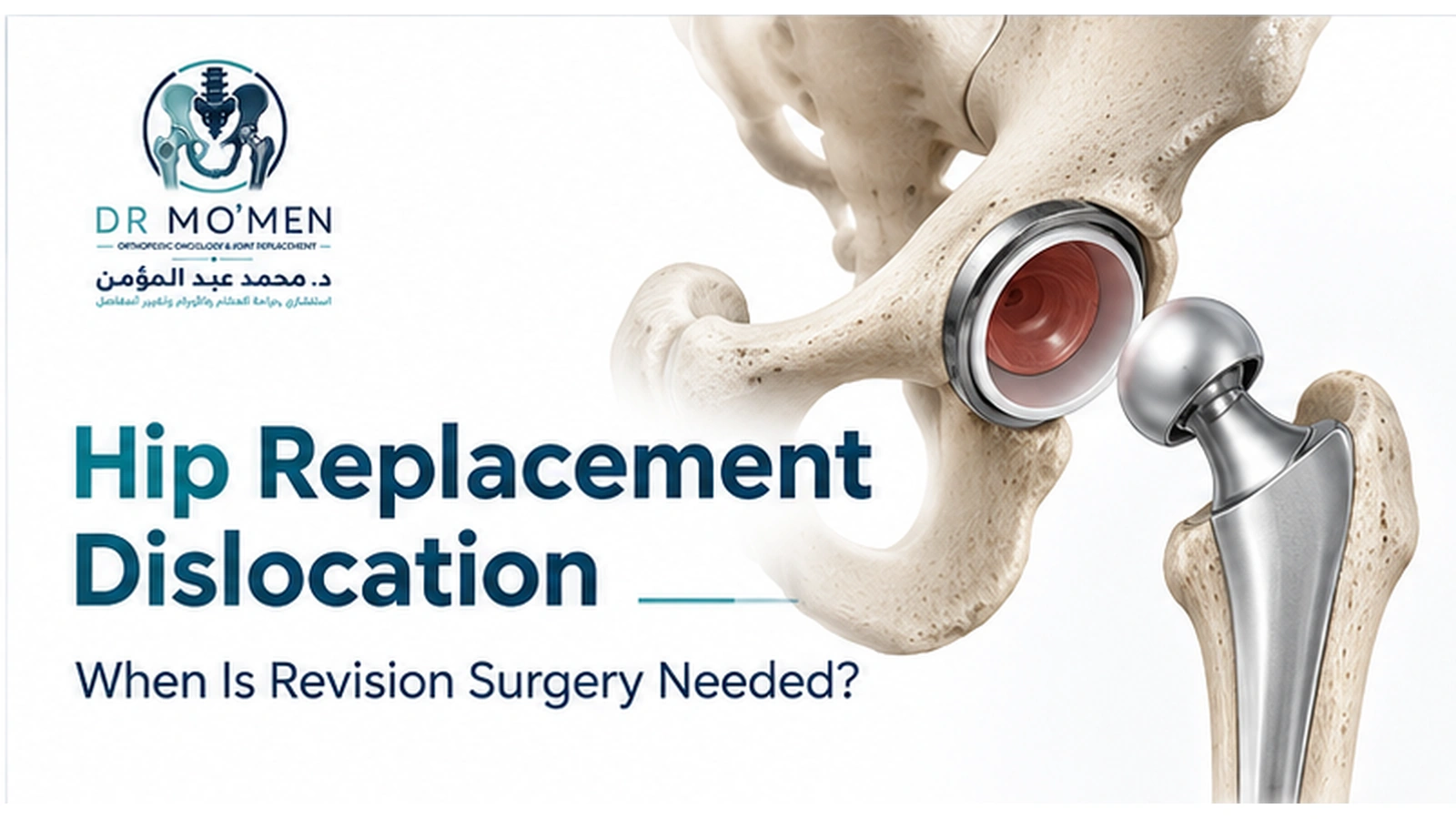
A hip replacement dislocation occurs when the artificial femoral head comes out of the acetabular socket. For many patients, the immediate question is whether this means another major operation is required. Not necessarily.
A first dislocation can often be reduced without replacing the prosthesis. Revision surgery becomes more relevant when instability recurs, the hip cannot be reduced normally, or a structural or biomechanical reason for instability is identified.
The key question is not simply how many times the hip has dislocated. It is: Why is this hip unstable? The answer determines the operation.
What Happens When a Hip Replacement Dislocates?
A total hip replacement consists of an acetabular cup fixed into the pelvis, a liner, a femoral stem and an artificial femoral head. Normally, the head remains centered in the socket during movement. In a dislocation, the head moves completely outside the socket.
Typical symptoms include sudden severe pain, inability to stand or move the hip normally, apparent shortening or abnormal position of the leg, and inability to bear weight. A suspected prosthetic hip dislocation requires urgent medical assessment and imaging. It should not be manipulated by the patient or family.
Does Every Hip Replacement Dislocation Need Surgery?
No. A first dislocation is frequently treated with closed reduction, usually under sedation or anesthesia. The prosthetic head is returned to the socket without reopening the hip.
After reduction, the treating team may reassess component position, stability, fracture risk, the circumstances of the dislocation and whether further imaging is needed. If instability continues, repeatedly reducing the hip without investigating the underlying cause may delay definitive treatment.
When Does a Dislocation Become Recurrent Instability?
There is no single number of dislocations that automatically dictates revision surgery. Concern increases when the hip dislocates repeatedly, dislocation occurs during ordinary daily activity, progressively smaller movements trigger instability, reduction becomes difficult, imaging shows component malposition or loosening, there is significant abductor or soft-tissue deficiency, or a previous instability revision has failed.
Modern orthopedic literature treats recurrent total hip arthroplasty instability as a multifactorial problem rather than an implant-size problem alone.
Why Does a Hip Replacement Dislocate?
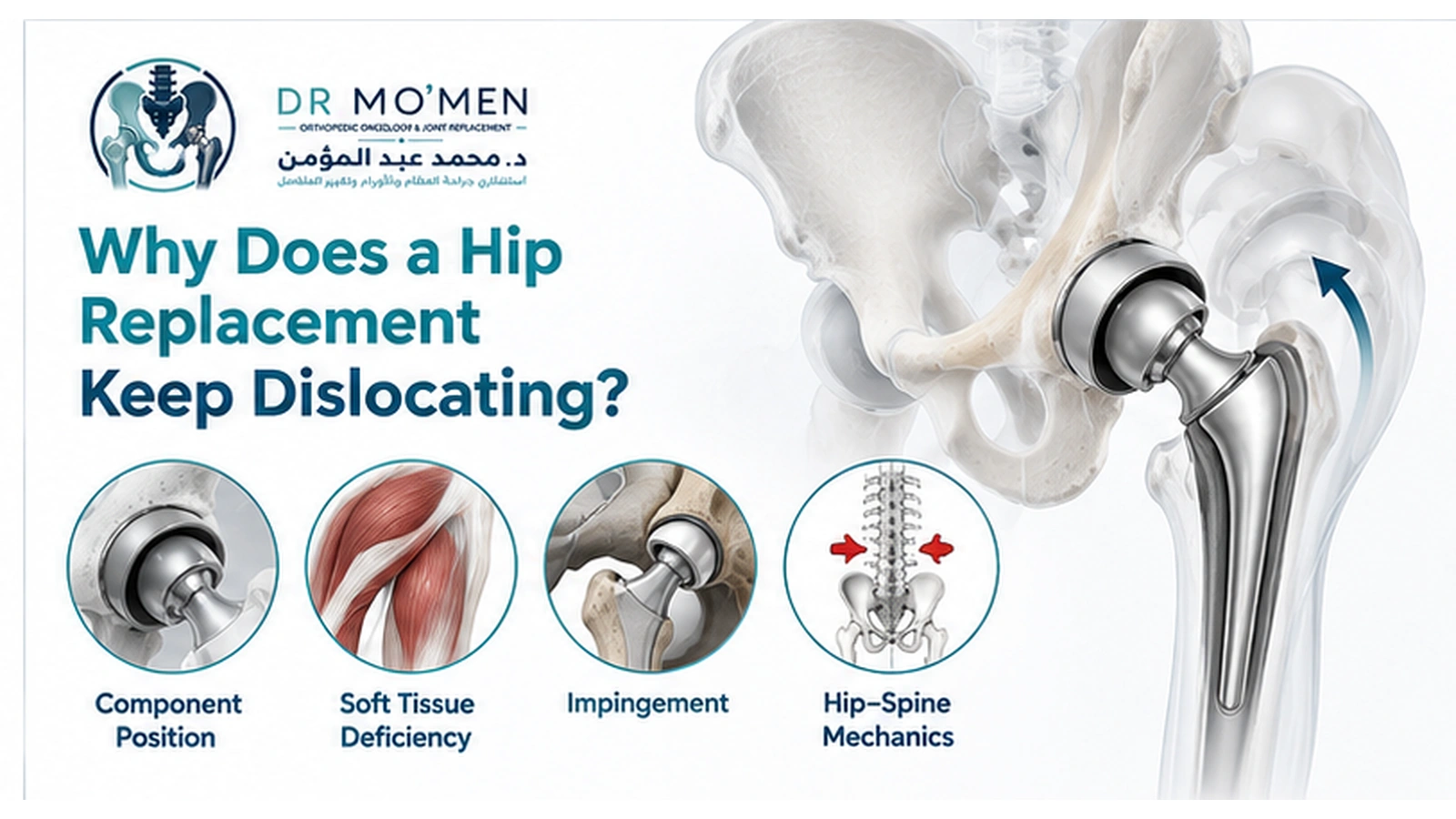
1. Implant Malposition
The position of the acetabular cup and femoral component affects how the artificial hip moves. Instability can relate to cup inclination, cup anteversion, femoral version, combined component orientation, offset, leg length or restoration of the center of rotation.
A component can appear acceptable on a routine static X-ray yet still behave poorly during functional movement. Recurrent instability therefore requires more than a simple visual check that the implant looks normal.
2. Abductor Muscle or Soft-Tissue Deficiency
The abductor mechanism and surrounding soft tissues contribute substantially to hip stability. Problems may follow gluteus medius or minimus deficiency, greater trochanteric problems, multiple previous operations, scar formation, soft-tissue damage or inadequate tension around the reconstructed hip.
Major abductor deficiency can substantially change the revision strategy and may be one reason a technically well-positioned implant remains unstable.
3. Impingement
Implant components, bone, scar tissue or surrounding anatomy may come into abnormal contact during movement. This impingement can act as a lever and force the femoral head out of the socket.
Revision should correct the mechanism of impingement rather than simply insert a different liner without understanding why the hip is levering out.
4. Loss of Offset or Soft-Tissue Tension
Hip stability depends partly on restoring appropriate leg length, femoral offset, center of rotation and soft-tissue tension. If these relationships are not adequately restored, the artificial hip may be less stable.
5. Hip-Spine and Spinopelvic Mechanics
The pelvis changes orientation as a person moves from standing to sitting. Spinal stiffness, degenerative spinal disease or previous spinal fusion can alter pelvic movement and therefore change the functional orientation of the acetabular cup.
In selected patients with recurrent instability, functional standing and sitting assessment can help explain why a component that appears acceptable on a conventional image behaves poorly during daily movement.
6. Implant Loosening
A loose acetabular or femoral component may change position or compromise joint mechanics. In this situation, instability can be one feature of a broader failed hip replacement and revision must address both fixation failure and instability.
7. Previous Revision Surgery
Revision hips can be more difficult to stabilize because previous surgery may alter muscles, capsule, bone stock, component position and soft-tissue tension. Recurrent dislocation after a previous revision deserves a structured reassessment rather than assuming the previous strategy simply needs to be repeated.
Could Infection Cause Instability?
Yes. Mechanical causes are common, but periprosthetic joint infection should remain in the differential diagnosis of a painful or failed hip replacement when the history raises concern.
Features such as unexplained pain, loosening, previous wound problems, elevated inflammatory markers or multiple previous procedures may prompt an infection work-up before major revision surgery. For a dedicated discussion of hip PJI diagnosis and treatment, see Infection After Hip Replacement: DAIR, One-Stage or Two-Stage Revision?.
What Tests Are Needed After Recurrent Hip Dislocation?
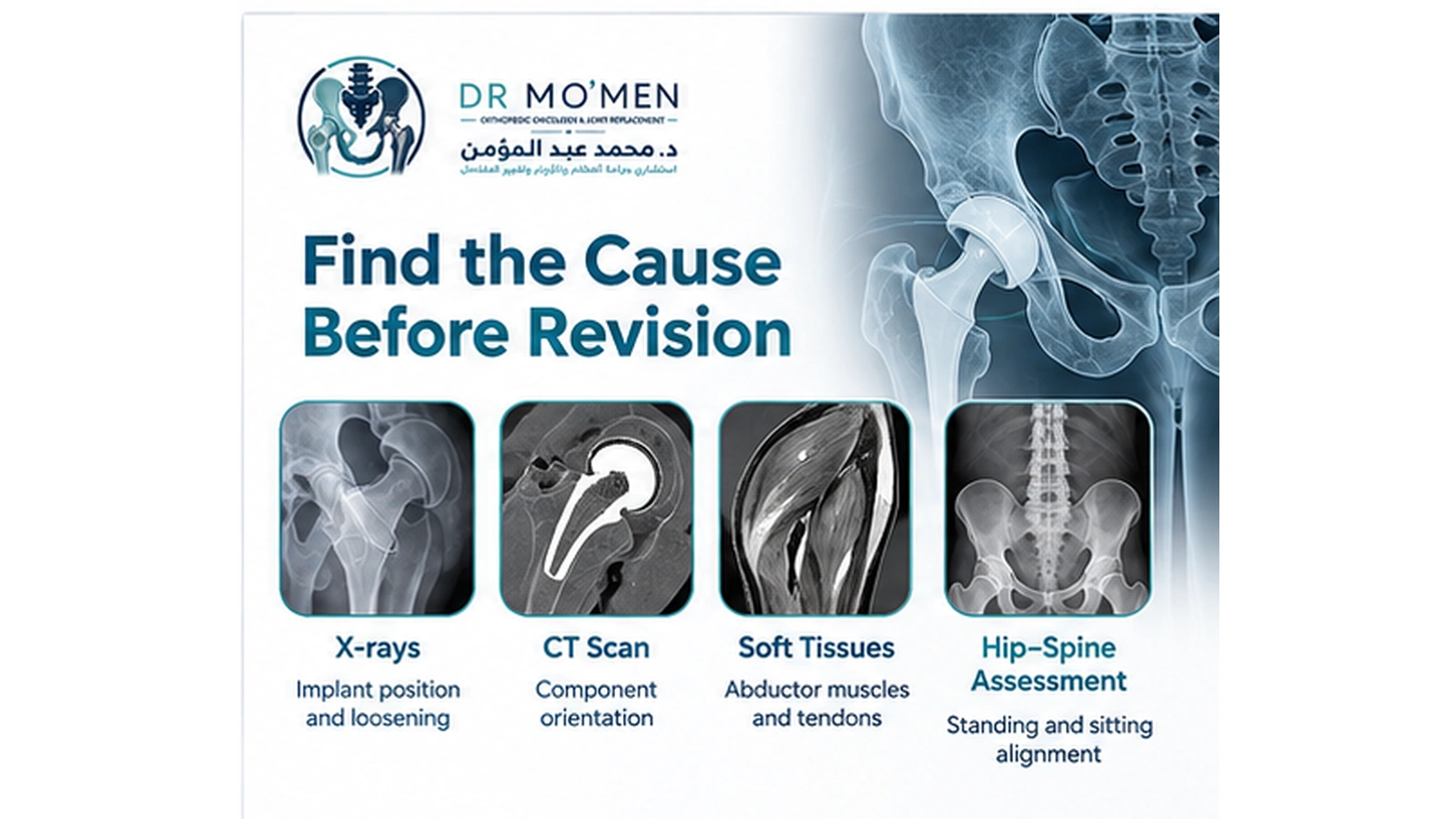
X-rays
Plain radiographs can confirm dislocation and assess component position, loosening, fracture, bone loss, leg length, offset and implant migration. Previous postoperative films can be particularly useful for comparison.
CT Scan
CT can help define acetabular and femoral component orientation, subtle malposition, bone loss, impingement and complex revision anatomy. It is especially useful when recurrent instability cannot be explained by routine radiographs alone.
Standing and Sitting Imaging
In selected patients with spinal fusion, significant spinal stiffness, lumbar deformity or unexplained recurrent instability, functional standing and sitting imaging can help assess spinopelvic behavior. The aim is to understand how the pelvis and cup behave during real movement rather than relying only on one static angle.
Soft-Tissue Imaging
When abductor failure or another soft-tissue problem is suspected, additional imaging may be useful to assess the gluteal tendons, greater trochanter, muscle quality and surrounding soft tissues.
Infection Tests When Indicated
Not every instability case needs the same infection work-up. If there are features suggesting possible periprosthetic joint infection, evaluation may include ESR, CRP, joint aspiration, cultures or other tests depending on the clinical situation.
When Is Revision Surgery Needed?
Revision becomes more relevant when recurrent instability persists or when a correctable structural cause has been identified. Typical reasons include recurrent dislocation, component malposition, implant loosening, persistent impingement, major abductor or soft-tissue deficiency, or failure of a previous instability revision. For a broader overview of revision indications and reconstruction, see Revision Hip Replacement: When Does a Hip Replacement Need Revision?.
The objective is to correct the cause, not simply treat the latest dislocation.
What Can Be Changed During Revision Surgery?
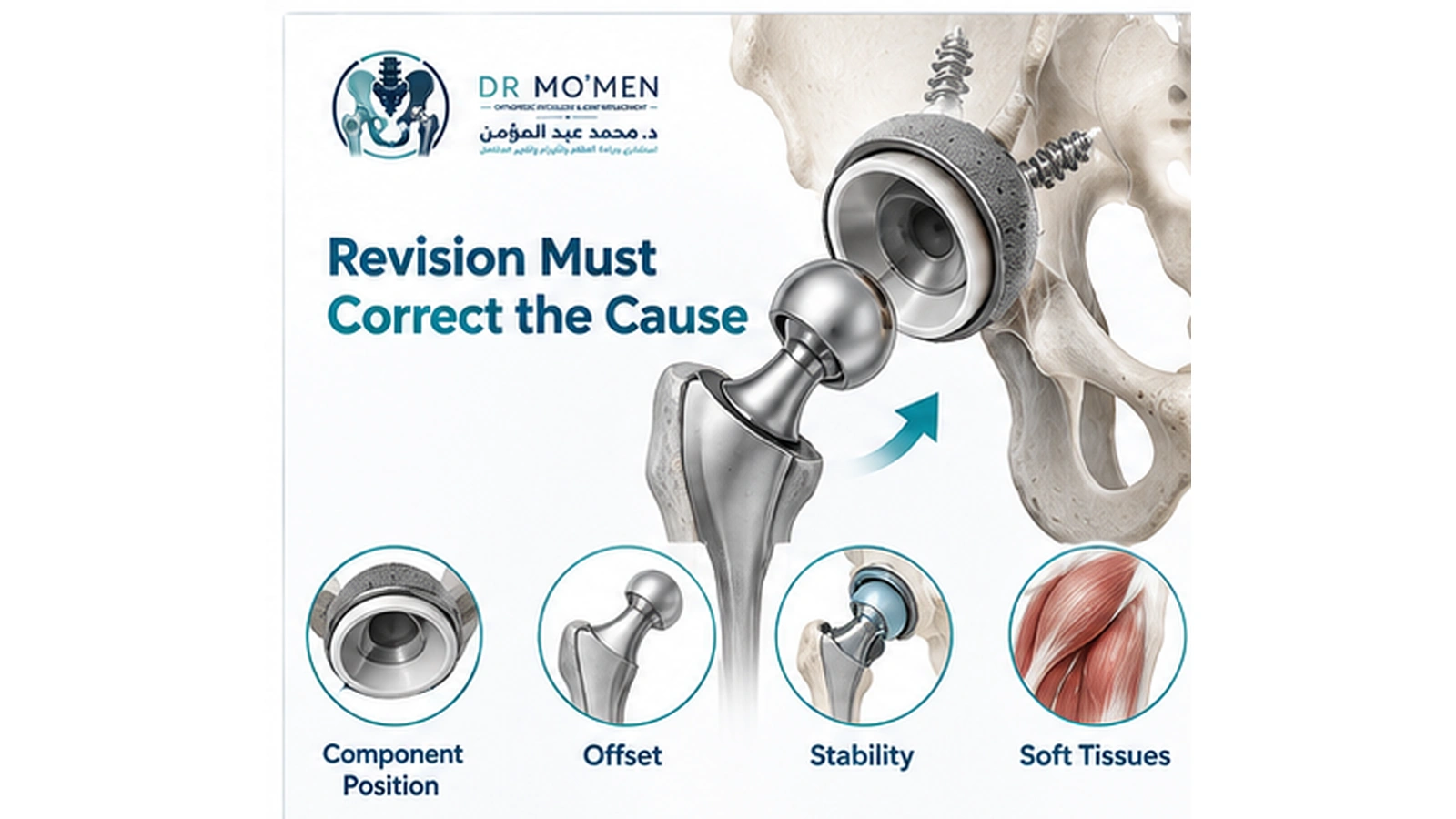
1. Correcting Component Position
If the acetabular cup is malpositioned, revision may involve removal and reconstruction of the cup in a more appropriate functional orientation. Femoral revision may also be required when stem position contributes to instability.
2. Head and Liner Exchange
In selected cases where the major components are well fixed, appropriately positioned and compatible with a stable reconstruction, modular component exchange may be considered. This should only be done after the instability mechanism has been defined.
3. Restoring Offset and Soft-Tissue Tension
Revision may attempt to restore appropriate offset, neck length, center of rotation and soft-tissue tension. These adjustments require balance because overcorrection can create new mechanical problems.
4. Dual-Mobility Components
Dual-mobility articulation is designed to increase effective head size and jump distance and can be useful in selected high-risk primary and revision hips. Systematic reviews suggest favorable stability outcomes in revision settings compared with conventional fixed-bearing constructs in many populations, but implant choice must be individualized.
Dual mobility is a tool, not a substitute for diagnosing malposition, impingement, soft-tissue deficiency or hip-spine problems.
5. Constrained Liner
A constrained liner mechanically captures the femoral head more tightly. It may be considered in selected complex situations, particularly when soft-tissue stability is severely compromised. Because constraint can transfer greater forces to the implant-bone interface, it is not automatically the first choice for every recurrent dislocation.
6. Abductor or Soft-Tissue Reconstruction
When instability is driven by major abductor deficiency, management may require abductor repair, trochanteric reconstruction or another soft-tissue strategy depending on the defect and previous operations.
Dual Mobility or Constrained Liner?
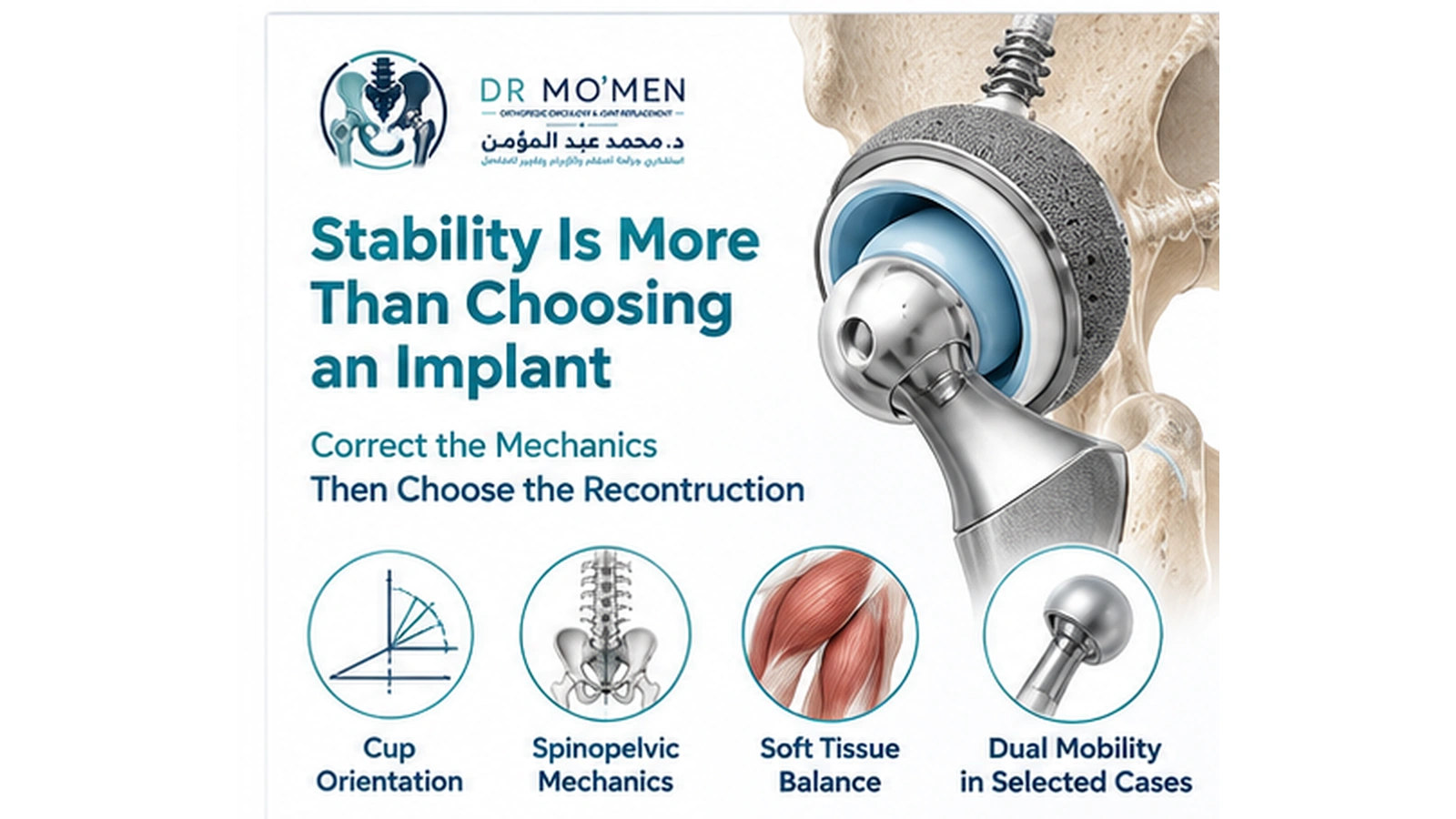
There is no universal answer. The choice among a standard bearing, larger head, dual mobility or constrained liner depends on the actual mechanism of instability, implant fixation, bone stock, soft tissues and patient-specific risk factors.
Recent revision literature supports dual mobility as a useful stability strategy in selected cases, but no implant should be presented as a guaranteed solution.
Why Can Revision for Instability Fail?
Instability is often multifactorial. A stability-focused implant may still fail if severe malposition, unrecognized hip-spine abnormality, major abductor deficiency, untreated impingement, incorrect offset, loosening or infection remains unaddressed.
This is why revision planning should begin with diagnosis of the biomechanical failure mechanism rather than immediate selection of a new implant.
What Happens After a First Dislocation?
After successful reduction, management depends on the individual case. The treating surgeon may recommend temporary precautions, walking support, activity modification, follow-up imaging and further assessment if instability recurs.
A single uncomplicated dislocation does not automatically mean revision surgery, but recurrent instability deserves detailed investigation.
When Is Hip Dislocation an Emergency?
Seek urgent assessment for sudden severe hip pain, inability to stand or walk, obvious abnormal leg position, sudden shortening, symptoms after a fall, numbness or weakness in the foot, or concern for an associated fracture.
Do not attempt to force a prosthetic hip back into position outside an appropriate medical setting.
Is Recurrent Dislocation Always Caused by Surgical Error?
No. Instability can result from a combination of implant factors, anatomy, soft tissues, spinal mechanics, neuromuscular factors, trauma and previous revision surgery. The purpose of revision assessment is to identify the correctable failure mechanism, not to assign blame.
Getting a Second Opinion for Recurrent Hip Dislocation
A second specialist review can be useful when the hip has dislocated repeatedly, the cause remains unclear, revision has been recommended, different surgeons suggest different implants, dual mobility or a constrained liner has been proposed, a previous revision has failed, there is major bone loss or abductor deficiency, or the patient has previous spinal fusion. You can also review the structured Second Opinion pathway.
A useful second opinion should clarify why the hip is unstable, whether existing components are positioned and fixed appropriately, whether a soft-tissue or hip-spine problem is present, whether the whole prosthesis needs revision, and which reconstruction best addresses the failure mechanism.
For International Patients Considering Revision Surgery in Egypt
Patients outside Egypt with recurrent hip replacement dislocation can often benefit from preliminary review of available investigations before arranging travel.
Useful records include current pelvis and hip X-rays, images taken during or after previous dislocations, older postoperative X-rays, CT scans when available, operative reports, implant details, previous revision records, information about spinal fusion or major lumbar disease, and infection investigations when performed.
The preliminary review may indicate that further investigation is required, revision is likely, another treatment may be appropriate, or urgent in-person evaluation is needed. This does not replace clinical examination or definitive surgical planning. For travel planning, see International Patients — send X-rays and reports before travel.
Role of Dr. Mohammed Abdelmoemen Abuelhadid in Complex Hip Instability
Assessment of recurrent hip replacement instability focuses first on identifying the cause rather than selecting an implant immediately. Evaluation may include component position, implant fixation, bone loss, impingement, abductor function, soft-tissue tension, infection when relevant, previous revision surgery and hip-spine mechanics.
The revision strategy can then be tailored to the actual failure mechanism. Patients outside Egypt may also request an initial review of available imaging and reports before arranging travel.
For appointments or X-ray/report review: 01021690693
Scientific References
- Dunleavy ML, Minutillo GT, Shaw JH, Paprosky WG. Prevention and Management of Instability After Total Hip Arthroplasty. J Am Acad Orthop Surg. 2025;33(21):1184-1192. PMID: 41105500.
- Burgio L, et al. What Are the Rates of Recurrent Dislocation and Re-Revision After Revision Total Hip Arthroplasty for Instability? 2026. PMID: 42373022.
- Outcomes of Dual Mobility Versus Fixed-Bearing Components in Revision Total Hip Arthroplasty: A Systematic Review and Meta-Analysis. PMID: 39128780.
- Dual-Mobility versus Fixed-Bearing Constructs in Revision Total Hip Arthroplasty: A Systematic Review of Comparative Outcomes. PMID: 41611102.
- First Revision Total Hip Arthroplasty for Instability: 10-Year Outcomes and Risk Factors Associated With Rerevision. PMID: 42269952.