Pre-intervention checkpoint: treatment should not be chosen from the MRI label alone. Before an injection or operation is planned, the actual X-rays and MRI should be reviewed for subchondral fracture, femoral-head collapse, lesion size and location, and the condition of the joint surface.
The correct decision depends on the stage, size and location of the lesion, symptoms, age, activity level, and the condition of the joint as a whole.
What Is Avascular Necrosis of the Femoral Head?
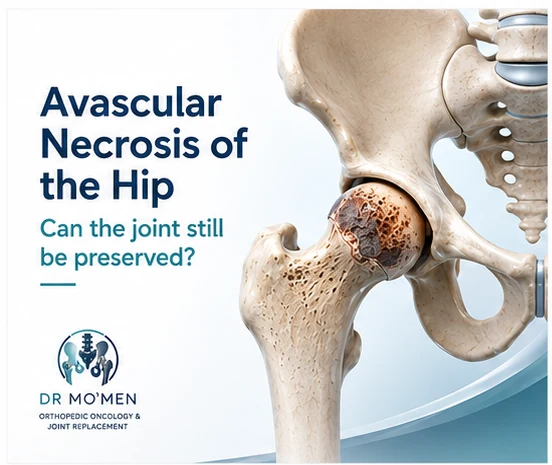
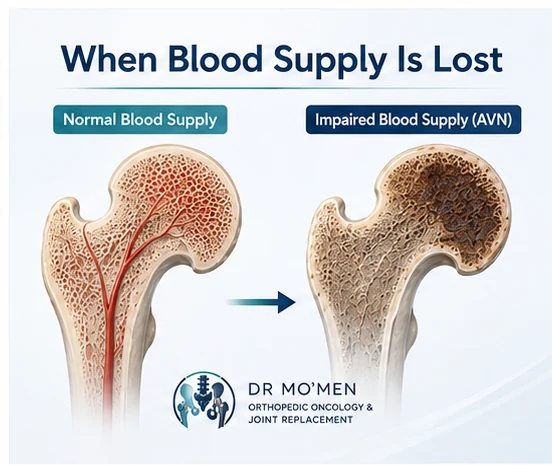
The hip is a ball-and-socket joint. The rounded upper end of the femur—the femoral head—fits inside the acetabulum of the pelvis. Bone is living tissue and requires a continuous blood supply. When blood flow to part of the femoral head becomes impaired, bone cells within that area can die.
The terms avascular necrosis, osteonecrosis, femoral head osteonecrosis and AVN of the hip refer to the same general disease process. The phrase “bone death” does not mean that the entire femur has died; it means that a defined area of bone within the femoral head has been affected.
Why Is Early Diagnosis Important?
The major structural turning point in AVN is collapse of the femoral head. Before collapse, the joint surface may remain relatively preserved. After a subchondral fracture and progressive collapse, the once-round femoral head may become flattened, altering hip mechanics and eventually damaging cartilage on both sides of the joint.
Clinically, treatment planning often distinguishes between pre-collapse disease and post-collapse disease.
What Causes Avascular Necrosis?
AVN may occur after trauma or without a major injury. More than one risk factor may be present, and in some patients no definite cause is identified.
Corticosteroid exposure
Prolonged corticosteroid treatment or substantial glucocorticoid exposure is one of the best-recognized risk factors for non-traumatic osteonecrosis. This does not mean that every patient who takes corticosteroids will develop AVN. Dose, duration, the underlying disease and individual susceptibility all matter.
Patients should not stop medically necessary corticosteroids without discussing this with the physician who prescribed them.
Hip trauma
A displaced femoral-neck fracture or traumatic hip dislocation can damage vessels supplying the femoral head. Post-traumatic AVN may appear months or longer after the original injury.
Heavy alcohol exposure
Chronic heavy alcohol consumption is an established risk factor for non-traumatic osteonecrosis.
Blood and systemic disorders
- Sickle cell disease
- Gaucher disease
- Some coagulation disorders
- Certain autoimmune diseases
- Conditions requiring prolonged corticosteroid therapy
What Does AVN Pain Feel Like?
Early AVN can sometimes cause few or no symptoms. When symptoms develop, the most characteristic complaint is deep hip or groin pain.
- Pain in the buttock, front of the thigh or occasionally around the knee
- Pain while walking or standing
- Difficulty climbing stairs
- A limp
- Reduced hip movement
- Difficulty putting on shoes or socks
- Pain when getting in or out of a car
- Increasing pain at rest in advanced disease
Symptoms alone cannot reliably determine the stage. Two patients with similar pain may have very different MRI findings.
Can AVN Affect Both Hips?
Yes. Non-traumatic osteonecrosis can affect both femoral heads. A patient may have severe symptoms on one side while the opposite hip has little or no pain. The treating surgeon may therefore consider assessment of the opposite hip in selected patients.
How Is AVN Diagnosed?
Clinical examination
Assessment usually reviews pain, corticosteroid exposure, previous hip trauma, alcohol exposure, medical and hematological history, walking pattern, hip range of motion and functional limitations.
X-rays
X-rays are useful for evaluating the shape of the femoral head and more advanced structural changes. However, an early X-ray can be completely normal.
MRI
MRI is the key imaging investigation when AVN is suspected. It can detect osteonecrosis before characteristic abnormalities become visible on plain X-rays and can help define the location and extent of the necrotic area.
CT scan
CT is not always required, but it can be useful when the surgeon needs to define a subchondral fracture, early collapse or femoral-head contour more clearly.
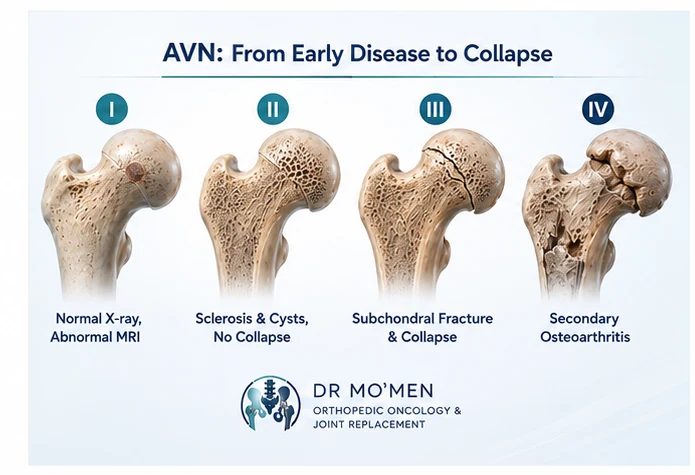
The ARCO Stages of Avascular Necrosis
ARCO Stage I: X-ray normal, MRI abnormal
Plain X-rays are normal, but MRI or another sensitive investigation demonstrates osteonecrosis. There is no subchondral fracture and no collapse.
ARCO Stage II: X-ray changes without collapse
X-rays may show sclerosis, altered bone density or cystic change, but the femoral head has not developed a subchondral fracture or flattening.
ARCO Stage III: subchondral fracture or collapse
The structural integrity of the femoral head has begun to fail. ARCO IIIA describes femoral-head depression of 2 mm or less; ARCO IIIB describes depression of more than 2 mm.
ARCO Stage IV: secondary hip arthritis
Osteonecrosis has progressed to degenerative changes in the whole joint, which may include femoral-head deformity, joint-space narrowing, acetabular changes and secondary arthritis.
Treatment of Avascular Necrosis
There is no single AVN operation that is appropriate for every patient. Treatment should consider stage, collapse, lesion size and location, symptoms, age, function, medical condition, underlying cause and the acetabular cartilage.
The main strategic question is whether the natural femoral head can reasonably be preserved or whether structural damage has progressed to a stage where replacement provides a more predictable solution.
Core Decompression vs Hip Replacement: How the Decision Changes by Stage
Direct answer: core decompression is mainly a joint-preservation option for selected pre-collapse AVN, while total hip replacement becomes more relevant after structural collapse or secondary arthritis. Neither procedure is automatically appropriate simply because an MRI report says “AVN.”
| Decision factor | Core decompression / preservation may be more relevant | Total hip replacement may be more relevant |
|---|---|---|
| Femoral-head structure | No subchondral fracture or collapse; the femoral head remains structurally preserved. | Established collapse, flattening, or secondary arthritic change has damaged the joint surface. |
| Typical disease stage | Most often selected ARCO I–II disease, depending on lesion size, location and patient factors. | More relevant in advanced post-collapse disease, particularly when pain and function are substantially affected. |
| Main objective | Preserve the native femoral head and delay or avoid arthroplasty when realistic. | Replace a structurally failed painful joint when durable preservation is unlikely. |
| Imaging question | How large is the lesion, where is it located, and is the weight-bearing surface still intact? | How much collapse and arthritis are present, and does the imaging match the symptoms and examination? |
| Important limitation | Core decompression does not guarantee that AVN will stop progressing. | Hip replacement can improve pain and function but carries implant- and surgery-related risks and is not automatically required for every AVN diagnosis. |
Important: this matrix is a decision-support summary, not a treatment algorithm. Current reviews continue to emphasize stage, lesion size/location and collapse status when choosing between joint preservation and arthroplasty.
Treatment Before Femoral-Head Collapse
Activity and risk-factor management
- Modification of painful high-impact activity
- Temporary adjustment of weight bearing when indicated
- Pain control
- Management of underlying medical conditions
- Review of corticosteroid exposure with the appropriate physician
- Avoidance of heavy alcohol consumption
These measures may help symptoms and risk management, but they should not be assumed to reverse an established necrotic lesion.
Core Decompression
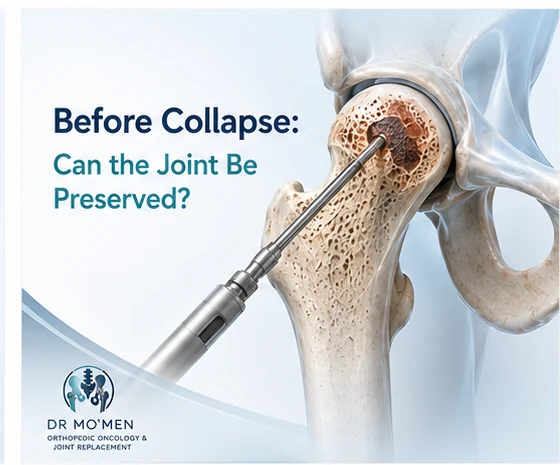
Core decompression is one of the most commonly considered joint-preserving operations for selected pre-collapse AVN. One or more channels are created through the femoral neck into the affected portion of the femoral head.
The aim is to reduce intraosseous pressure and create a biological environment that may support repair and revascularization. The procedure is generally considered in carefully selected patients with ARCO I or II disease, before subchondral fracture or collapse.
Outcome is influenced by stage, lesion size, lesion location, age, underlying cause and the extent of structural involvement. Core decompression cannot guarantee that AVN will stop progressing.
Bone-Marrow Concentrate and Biological Augmentation
Some surgeons combine core decompression with bone-marrow concentrate or other biological techniques. Current evidence suggests potential benefit in selected pre-collapse patients, but no single adjunct is universally superior and these approaches should not be presented as a guaranteed “stem-cell cure.”
Other Joint-Preserving Procedures
Selected specialist centres may consider vascularized bone grafting, osteotomy or other reconstructive strategies. These are not routine choices for every AVN patient and require individualized assessment.
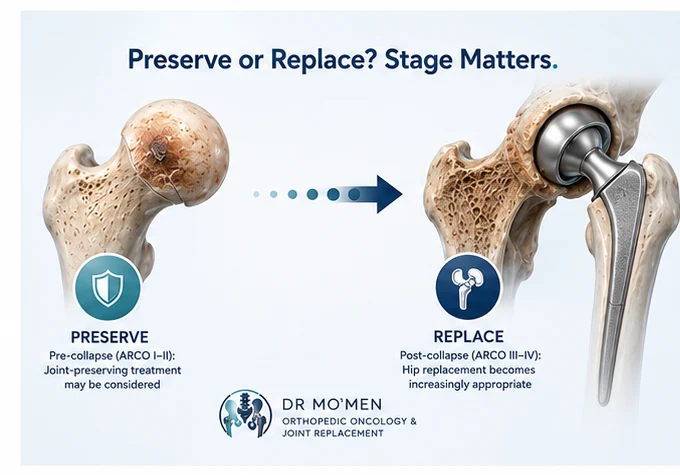
When Is Total Hip Replacement Considered?
Once the femoral head has developed substantial collapse—and especially when secondary arthritis has developed—the probability of successfully preserving the natural joint decreases.
Total hip replacement becomes increasingly appropriate when there is significant collapse, pain interfering with daily activities, secondary arthritis, restricted motion, difficulty walking, a low likelihood of durable joint preservation, or failure of previous preservation treatment.
In appropriately selected patients, hip replacement can provide substantial pain relief and meaningful improvement in mobility and function. It does not guarantee a completely pain-free hip or unlimited activity.
Does Every Stage III Patient Need an Immediate Hip Replacement?
No. After subchondral fracture or early collapse, femoral-head preservation becomes less predictable than in ARCO I–II disease, but the decision still depends on the amount of collapse, lesion size and location, age, symptoms, cartilage condition, functional requirements and patient priorities.
What Are the Risks of Surgery?
Core decompression risks
- Persistent pain
- Progression of osteonecrosis
- Femoral-head collapse despite surgery
- Infection
- Bleeding
- Rare fracture
- Need for later hip replacement
Total hip replacement risks
- Infection
- Blood clots
- Dislocation
- Fracture
- Leg-length discrepancy
- Nerve or vascular injury
- Implant wear or loosening
- Need for future revision surgery
Recovery After Hip Replacement for AVN
Recovery varies between patients. Many modern pathways encourage early assisted mobilisation, sometimes on the day of surgery or the following day when medically appropriate.
- Pain control and early mobilisation
- Walking with an appropriate aid
- Gradual increase in walking distance
- Restoration of strength and balance
- Return to daily activities
- Longer-term functional recovery
When Should You Seek Specialist Assessment?
- Persistent groin or deep hip pain
- Hip pain with a normal X-ray but ongoing clinical suspicion
- A previous diagnosis of AVN
- Substantial previous corticosteroid exposure and new hip symptoms
- Previous hip dislocation or femoral-neck fracture
- MRI showing osteonecrosis
- Questions about core decompression versus replacement
- A recommendation for hip replacement when you want a second opinion
Urgent medical assessment is appropriate for sudden severe pain after trauma, inability to bear weight, or suspected fracture or dislocation.
Do I Really Need Hip Replacement?
An MRI report saying “AVN” does not automatically answer this question. The decision requires evaluation of the actual images—not only the written report.
- Has the femoral head collapsed?
- Is there a subchondral fracture?
- How large is the necrotic lesion?
- Is it in the main weight-bearing area?
- Is the acetabular cartilage preserved?
- How severe are the symptoms?
- Is joint preservation still realistic?
Need a specialist review of hip AVN?
Clinical examination and review of the actual X-rays and MRI images can help determine whether the femoral head is still structurally salvageable or whether replacement is more appropriate.
Specialist Evaluation of Complex AVN Cases
Dr. Mohammed Abdelmoemen Abuelhadid evaluates hip conditions requiring a decision between joint preservation, reconstruction and joint replacement. For AVN, assessment focuses on the clinical examination together with the actual X-rays and MRI images to determine whether the femoral head remains structurally salvageable.
The objective is not to recommend replacement simply because AVN appears on MRI, but to select the strategy appropriate to the disease stage and the individual patient. For patients outside Egypt, an online second-opinion review of available X-rays, MRI studies and medical reports may help clarify the likely treatment pathway before travelling.
Related reading: Joint Replacement service, weight loss and knee osteoarthritis, and a separate anonymized AVN case in the Case Library.
Frequently Asked Questions
Can AVN heal without surgery?
Some small or early lesions may remain stable for a period, but established osteonecrosis should not be assumed to heal spontaneously. Progression depends on lesion size, location, underlying cause and other factors.
Is MRI necessary if my X-ray is normal?
When AVN is clinically suspected, MRI is the preferred diagnostic investigation because early disease may not be visible on plain radiographs.
Is core decompression better than hip replacement?
They are used for different clinical situations. Core decompression is mainly a joint-preservation strategy before collapse, whereas total hip replacement becomes more relevant after significant structural collapse or secondary arthritis.
Can AVN affect both hips?
Yes. Non-traumatic AVN may be bilateral, so the opposite hip may need evaluation in selected patients.
Does AVN always mean I will eventually need hip replacement?
No. The course depends strongly on lesion size, location, disease stage and other factors. Early diagnosis may provide an opportunity for joint-preserving treatment in appropriately selected patients.
Medical References
- Yoon BH, et al. The 2019 Revised Association Research Circulation Osseous (ARCO) Staging System of Osteonecrosis of the Femoral Head. PubMed
- Osteonecrosis of the Femoral Head: Evolution of Contemporary Management Strategies. 2026 review. PubMed
- Techniques of core decompression in the treatment of idiopathic avascular necrosis of the femoral head. 2024 review. PubMed
Medical disclaimer: This article is intended for patient education and does not replace clinical examination, review of imaging or individualized medical advice. Treatment decisions for avascular necrosis should be based on specialist assessment of the patient and the actual imaging studies.
How this article was reviewed
This patient-education article was reviewed for clinical accuracy, patient safety, and decision-making clarity by Dr. Mohammed Abdelmoemen Abuelhadid. It is intended to support, not replace, clinical examination and review of the actual imaging and reports.
Author and medical reviewer
Dr. Mohammed Abdelmoemen Abuelhadid — Orthopedic Oncology & Joint Replacement Surgeon and Lecturer of Orthopedic Surgery at Ain Shams University.