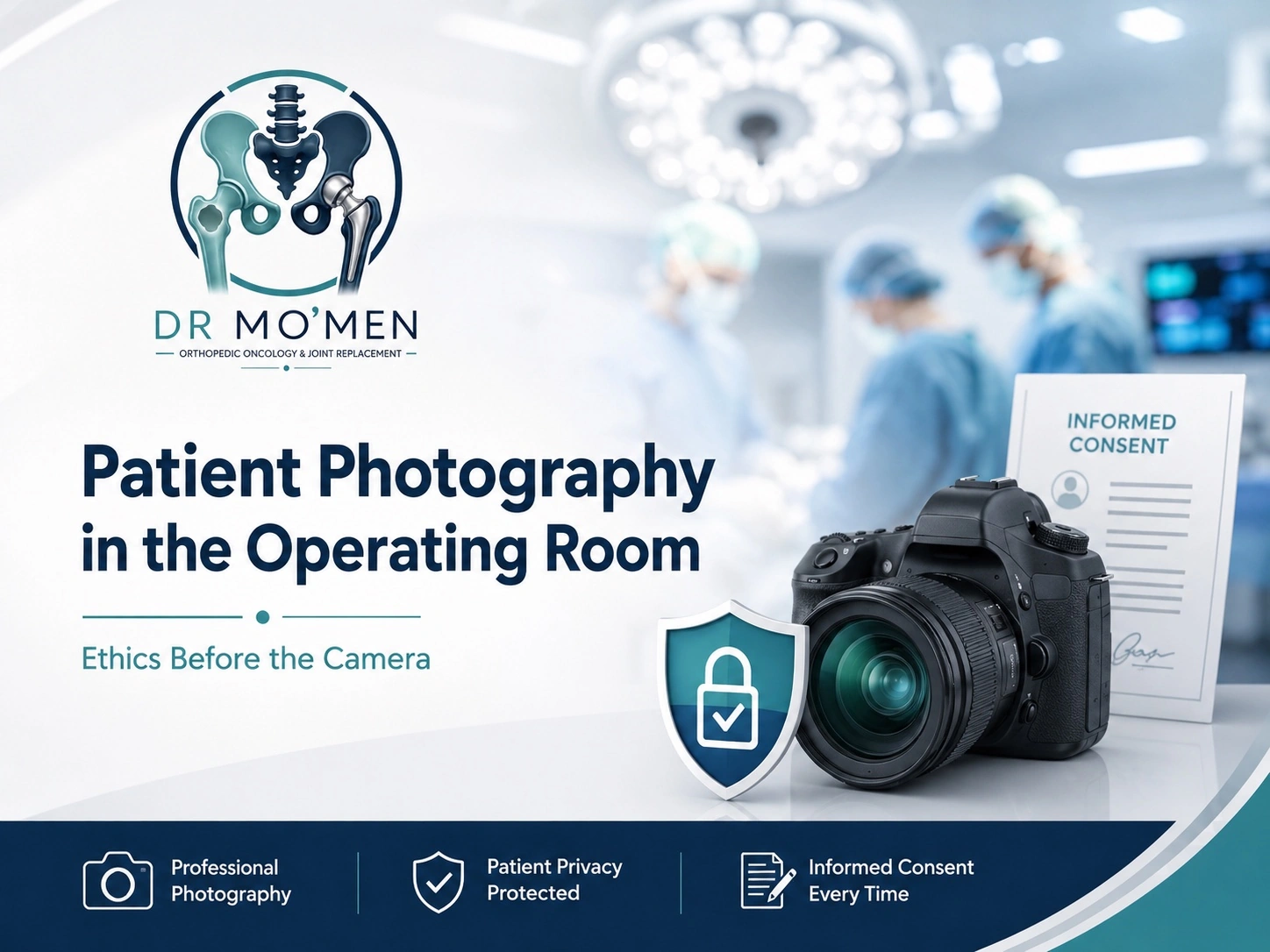
Patient Photography in the Operating Room: Ethics Before the Camera
Medical photographs and surgical videos can be powerful educational tools. They can help doctors teach anatomy, document rare findings, explain complex procedures, and improve patient understanding. But the operating room is not a studio, and the patient is not marketing material. When a patient is under anesthesia, exposed, vulnerable, and unable to object in real time, photography becomes an ethical issue before it becomes a media issue.
Why operating-room photography is ethically sensitive
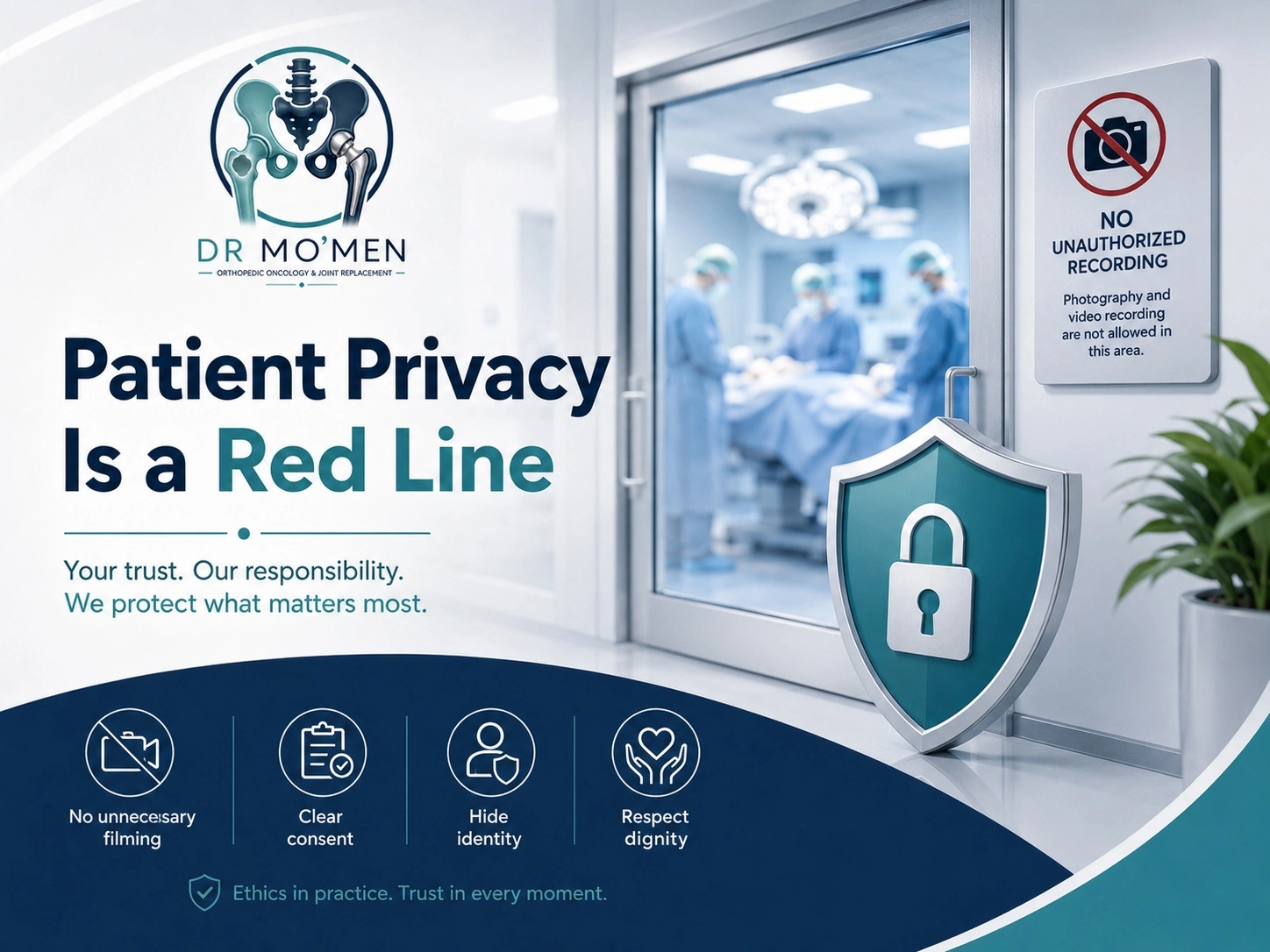
Operating-room photography is different from a routine clinic photograph. The patient may be under anesthesia, partially exposed for surgical access, unable to withdraw consent at the time of filming, and unaware of how far an image may spread once it is uploaded online. This is why operating-room photography should be treated as an exception, not a routine social-media habit.
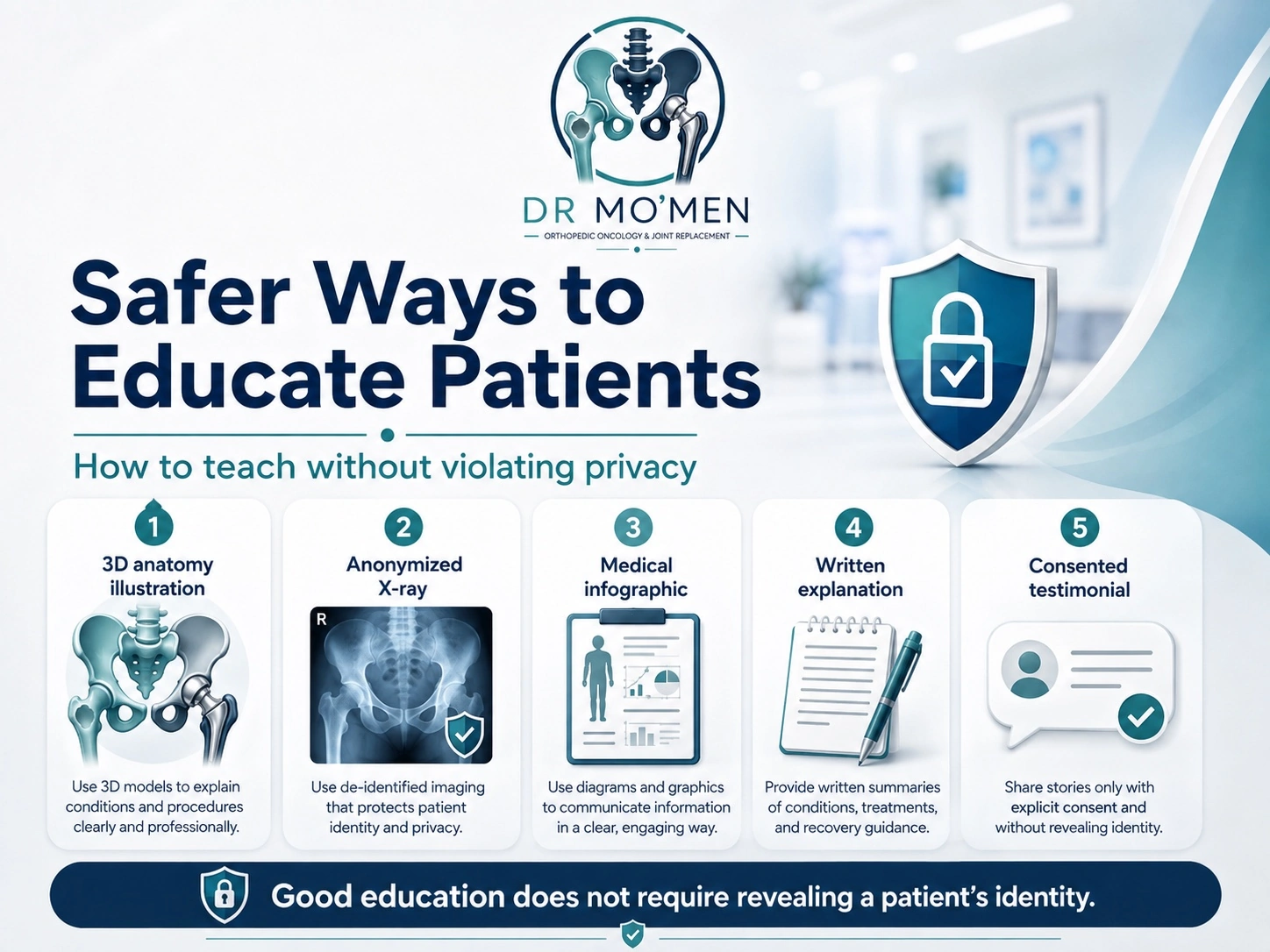
The practical rule is simple: if the same educational point can be made with an anonymized X-ray, a medical illustration, or a 3D model, there is usually no need to use a real patient’s body.
Four different purposes require four different standards
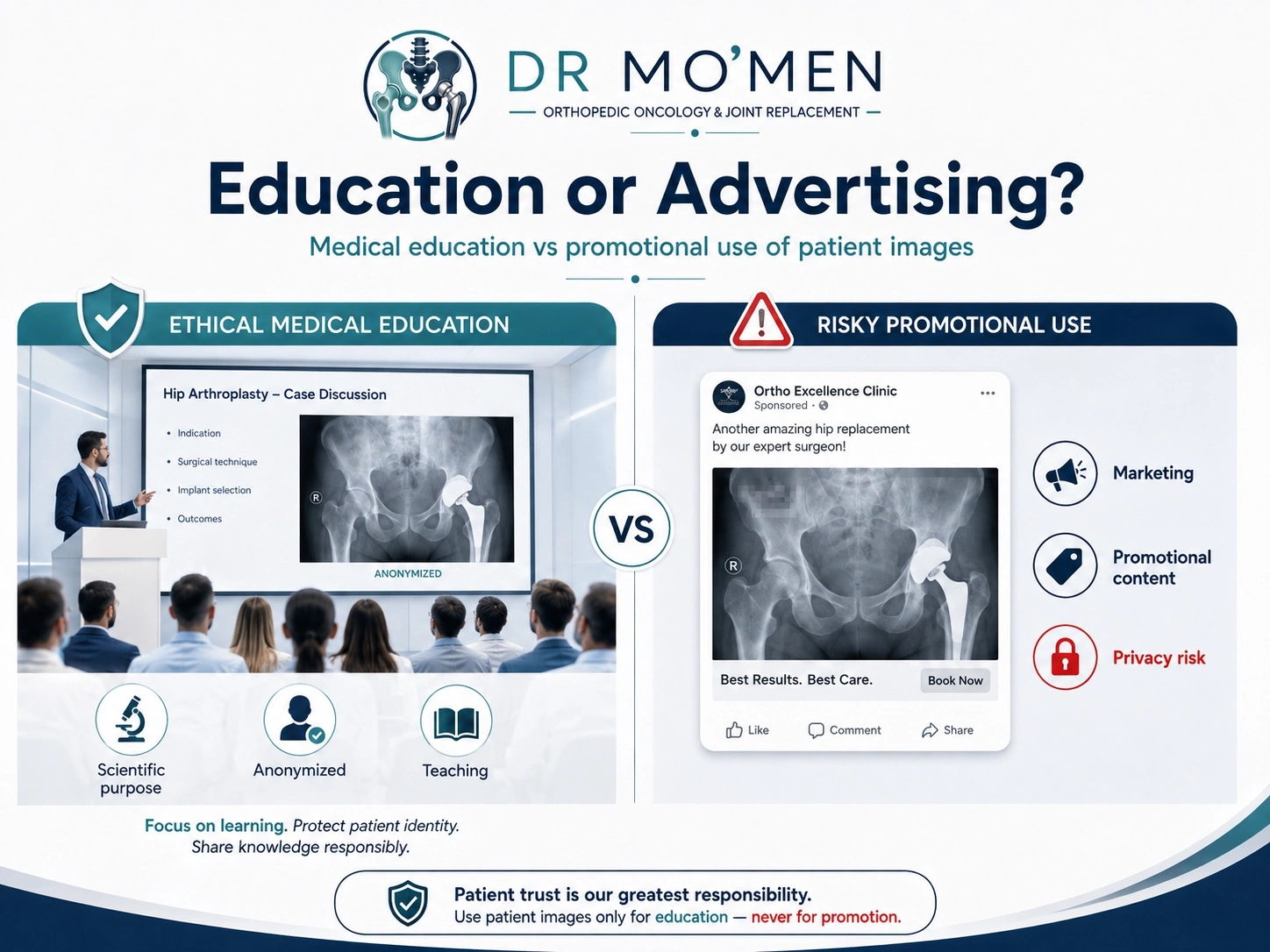
Not all medical images are the same. Clinical documentation, closed professional teaching, public education, and medical advertising carry different ethical risks. As the audience becomes broader, the responsibility to obtain specific consent, protect identity, and avoid promotional misuse becomes stronger.
Clinical documentation
A surgeon may photograph a wound, deformity, tumor, implant position, arthroscopic view, or intraoperative finding as part of the medical record. This can be clinically useful, but the image should be stored securely and handled like other confidential health information, not kept casually on a personal phone or shared in informal groups.
Closed medical education
A de-identified image may be appropriate in a hospital meeting, academic lecture, training session, or professional case discussion. Written consent is still best practice, especially when the image is sensitive, rare, or potentially identifiable.
Public patient education and advertising
Public education through websites, YouTube, Facebook, Instagram, or TikTok is more sensitive because the audience is broad and the content can be redistributed outside its original context. Advertising is the highest-risk category. Using an anesthetized patient’s body, incision, implant, tumor, or operative scene to promote a doctor or clinic can easily move from education into exploitation.
Is patient consent enough?
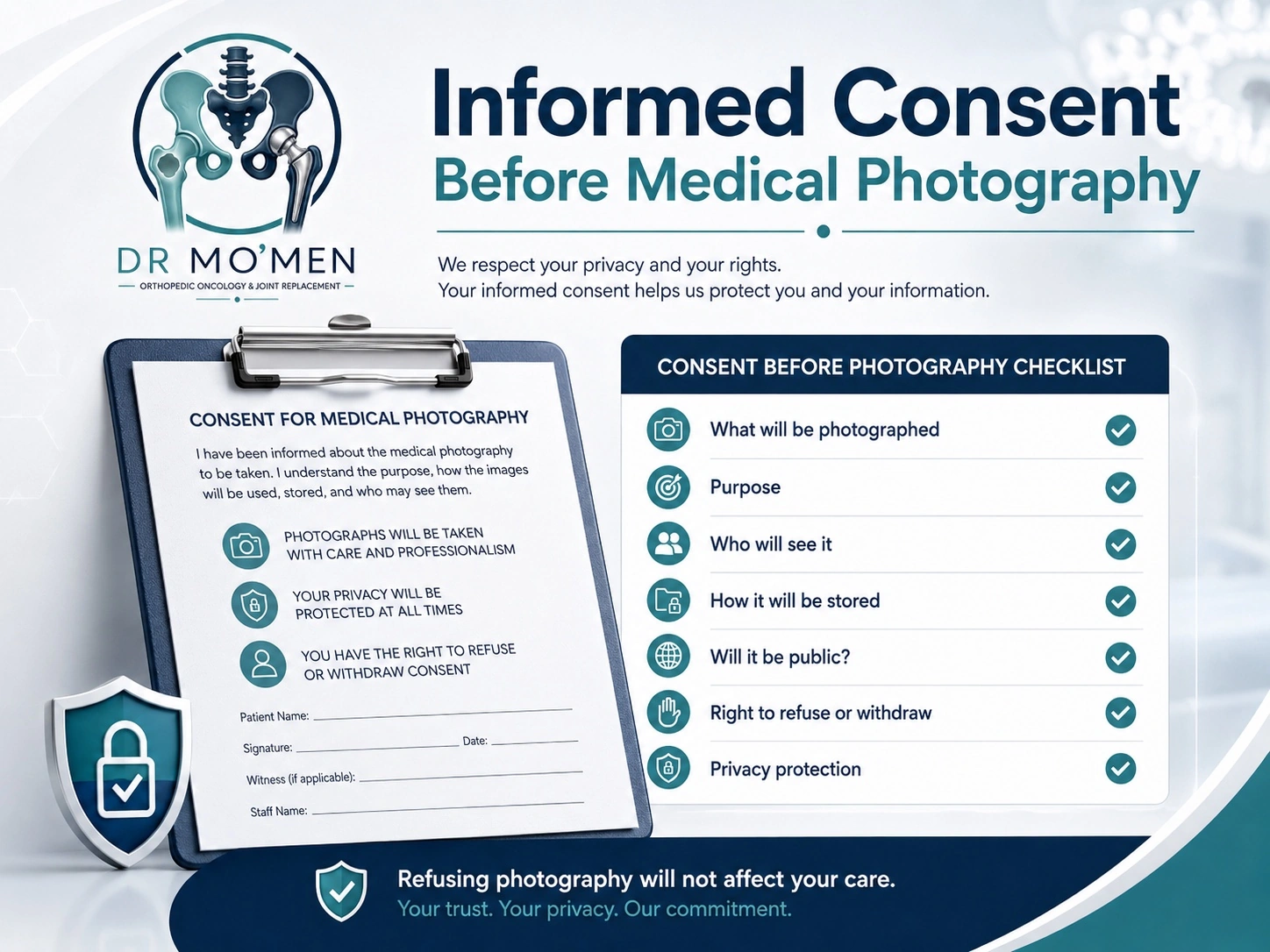
No. Consent is essential, but consent alone does not make every image ethical. Valid consent should be specific, informed, voluntary, written, and separate from surgical consent. A patient may agree to the operation and still refuse photography, teaching use, website publication, or advertising use.
The patient should know what will be photographed, who will see it, where it will be stored, whether it will be public, and whether refusing photography will affect care. Refusal should never reduce the quality of treatment or the doctor-patient relationship.
Why the operating room needs stricter boundaries
The patient may not be able to object at the time of recording. The body may be exposed for surgical necessity. Additional cameras or unnecessary personnel may create safety, infection-control, or workflow concerns. Surgical content can also be graphic, misunderstood, or used out of context. Therefore, recording in the operating room should be carefully planned, formally approved, and clearly justified.
Can a doctor explain a case on the patient’s body?
This should be approached with caution. It may be acceptable in limited educational settings if there is a clear necessity, specific written consent before anesthesia, strict de-identification, no unnecessary exposure, and no promotional or sensational presentation. However, using the patient’s body under anesthesia mainly to attract attention or market the doctor is ethically inappropriate in most circumstances.
Better educational alternatives include anonymized imaging, 3D medical illustrations, anatomical models, diagrams, written case summaries, and infographics. These usually communicate the message more clearly while protecting the patient’s dignity.
Islamic perspective
From an Islamic ethical perspective, photographing a patient or disclosing details of their condition falls under the principles of trust, confidentiality, dignity, and protection of privacy. The default rule is that a physician must not reveal a patient’s secrets or identifying medical information unless there is a genuine necessity, and even then disclosure should be limited to what is strictly needed and to the proper authorities. Therefore, operating-room photography or public posting of a patient’s body or case should not be used for promotion; it may only be considered when there is a clear educational or medical benefit, explicit and voluntary consent, strict de-identification, avoidance of unnecessary exposure, and full respect for the patient’s dignity. In Islamic terms, the patient is an amanah — a trust — not a marketing asset.
What should not be posted?
- The patient’s face in the operating room.
- Exposed body areas without clear necessity.
- Hospital ID, file number, X-ray name, date of birth, or labels.
- Anesthesia moments, intubation scenes, or vulnerable positioning.
- Dramatic music, jokes, trends, or entertainment-style captions.
- Guarantee-based claims such as “risk-free operation” or “best result.”
A safer operating-room photography policy
- No unauthorized mobile-phone photography in the operating room.
- One designated person responsible for approved photography.
- Written consent before anesthesia.
- Separate consent for clinical records, teaching, research, public posting, and advertising.
- Strict removal of identifying information.
- Secure storage, not personal phones or casual messaging apps.
- Ethical and scientific review before public publication.
- No live posting from the operating room.
Final message
Photographing patients in the operating room is not automatically unethical, but it is never casual. The standard should be strict: ethics before content, consent before camera, and dignity before marketing. A patient in the operating room is not a content asset. The patient is a human being at a moment of vulnerability, and the doctor is trusted to protect both health and dignity.
Patient FAQ
Can my surgeon photograph me during surgery?
Only under appropriate conditions. You should be told what will be photographed, why it is needed, who will see it, where it will be stored, and whether it will ever be published.
Is surgical consent the same as photography consent?
No. Agreeing to surgery does not automatically mean you agree to photography, teaching use, website use, or social-media publication.
Can I refuse medical photography?
Yes. Refusing photography should not affect the quality of your medical care.
Is it safe if my face is not shown?
Not always. A patient can still be identified through tattoos, scars, rare conditions, hospital labels, X-ray data, timing, or case details.
Disclaimer
This article is for general medical-ethics education only. It is not legal advice and does not replace local hospital policy, medical-syndicate regulations, institutional ethics review, or specialist legal consultation. Medical and legal requirements may vary by country and institution.
Patients preparing for complex orthopedic care can also review the second-opinion pathway and the site’s orthopedic services before sharing records or images.