
If you are preparing for knee, ankle, hand, or other limb surgery, you may hear your surgeon mention using a tourniquet during the operation. The term can sound concerning: does it completely stop circulation, can it damage muscles or nerves, and does every orthopedic operation require one?
A surgical tourniquet is a useful tool in selected procedures, but it is not necessary for every orthopedic operation. The decision depends on the procedure, the patient’s circulation and medical condition, the expected surgical time, and the operative strategy.
What Is a Surgical Tourniquet?
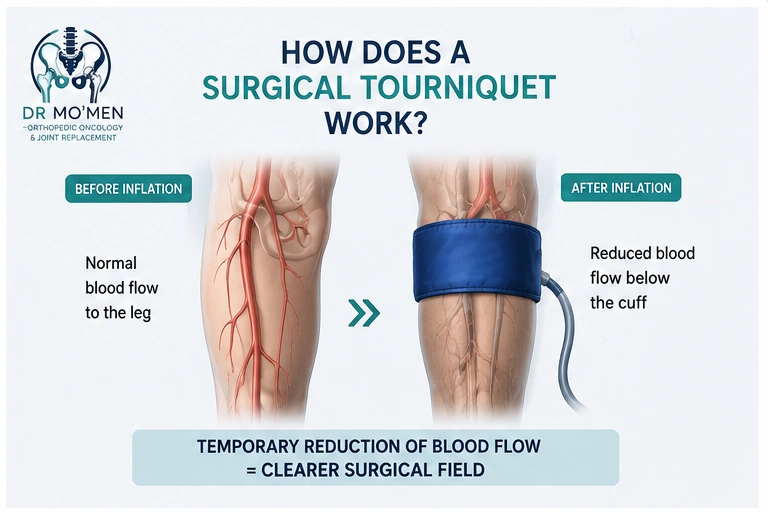
The tourniquet commonly used in orthopedic operating rooms is a pneumatic cuff. It resembles a larger, more specialized blood-pressure cuff and is usually positioned around the upper arm or thigh. The cuff is inflated to a controlled pressure during part of the operation, temporarily restricting arterial blood flow to the portion of the limb below it.
Its main purpose is to provide a clearer, relatively bloodless surgical field, which can make selected surgical steps easier to visualize and perform accurately. A surgical pneumatic tourniquet is different from the emergency tourniquets used to control life-threatening bleeding after trauma.
Why Do Orthopedic Surgeons Use a Tourniquet?
Even modest bleeding can obscure small structures during delicate extremity surgery. A tourniquet can therefore improve visualization during specific phases of an operation.
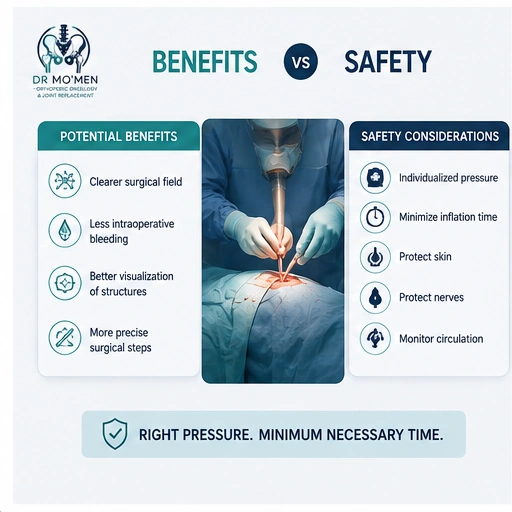
- Provide a clearer surgical field.
- Reduce intraoperative bleeding while the cuff is inflated.
- Improve visualization of small anatomical structures.
- Simplify selected surgical steps.
- Support precise execution in procedures where a dry field is technically useful.
Reducing bleeding during the operation does not necessarily mean that total perioperative blood loss will always be lower. In total knee arthroplasty, modern reviews consistently show less intraoperative bleeding with tourniquet use, while effects on total blood loss and early recovery are more variable.
Which Orthopedic Operations May Use a Tourniquet?
Knee Surgery
- Knee arthroscopy.
- Selected meniscal procedures.
- Selected ligament procedures.
- Some stages of total knee replacement.
Related reading: Joint replacement care and the wider orthopedic patient education blog.
Foot, Ankle, Hand, and Fracture Surgery
A tourniquet may be used during selected fracture fixation, ligament or tendon repair, and hand or wrist procedures where precise visualization is valuable. The decision depends on the operation, soft-tissue condition, and vascular status.
Related reading: Ankle Fracture: Cast or Surgery?
Is a Tourniquet Always Used During Total Knee Replacement?
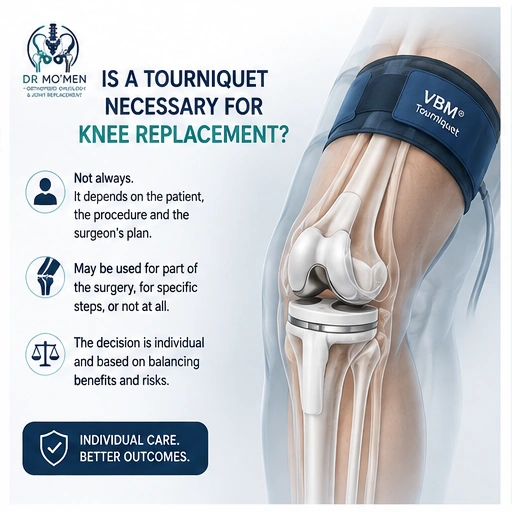
No. Tourniquet use during total knee arthroplasty remains an area of variation in surgical practice. Some surgeons use it for a substantial part of the procedure, others for selected steps, and some knee replacements are performed without one.
Recent meta-analyses suggest lower intraoperative blood loss and a slightly shorter operative time with tourniquet use, while some analyses report slightly greater early knee or thigh pain and more postoperative drainage. Longer-term outcomes do not appear to depend consistently on routine tourniquet use. This supports an individualized approach rather than a single rule for every patient.
Is Temporarily Restricting Blood Flow Safe?
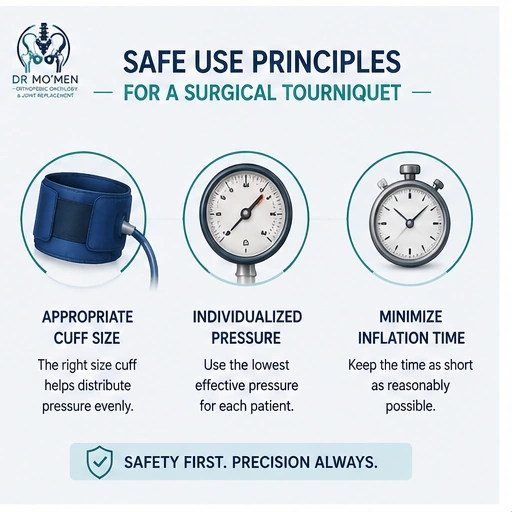
Safe tourniquet use depends on patient selection, cuff design and position, inflation pressure, inflation duration, skin protection, and intraoperative monitoring. Current perioperative guidance emphasizes patient-specific assessment and careful monitoring rather than treating tourniquet use as an automatic step.
How Long Can a Surgical Tourniquet Remain Inflated?
There is no single duration that replaces clinical judgment. The British Orthopaedic Association recommends that ischemic tourniquet time should ideally remain below 120 minutes and that use beyond this point should follow a deliberate reassessment of risks and benefits by the operating surgeon. This is an operating-room safety standard, not a rule for patients to apply themselves.
How Is Tourniquet Pressure Determined?
Modern practice increasingly avoids a one-pressure-fits-all approach. The required pressure may depend on blood pressure, limb circumference, cuff width and contour, vascular status, and—in systems that support it—limb occlusion pressure. The objective is not maximum pressure; it is the minimum effective pressure that achieves the surgical goal.
What Are the Possible Risks of Tourniquet Use?
Serious tourniquet-related complications are uncommon when appropriate safety measures are followed, but recognized risks exist.
Postoperative Discomfort
Some patients experience temporary thigh or upper-arm discomfort where the cuff was positioned.
Nerve Injury
Excessive pressure, poor cuff fit, or prolonged compression can increase the risk of nerve injury. Appropriate cuff selection and limiting pressure and time are therefore important.
Skin Injury
Pressure, friction, or surgical preparation fluid trapped beneath the cuff can injure the skin. Padding, careful positioning, and protecting the cuff site from prep solution are part of safe use.
Ischemic Tissue Effects
Restricting circulation affects tissues below the cuff. This is why inflation duration and pressure are monitored and minimized to what the operation requires.
Who Requires Additional Assessment?
- Patients with peripheral arterial disease or significantly impaired limb circulation.
- Patients with previous vascular surgery in the limb.
- Significant skin problems at the cuff site.
- Selected neurological conditions or severe neuropathy.
- A previous tourniquet-related complication.
- Other vascular or thrombotic risk factors identified during preoperative assessment.
What About Tourniquets During Bone Tumor Surgery?
Orthopedic oncology requires additional planning. The decision depends on tumor location, relationship to major nerves and vessels, biopsy diagnosis, planned surgical margins, reconstruction strategy, and imaging findings. Accurate diagnosis, appropriate biopsy planning, and multidisciplinary care come before technical details such as tourniquet use.
The BOA guidance specifically states that compressive exsanguination should not be used in the presence of infection, a history of malignancy, or risk of deep-vein thrombosis. This is distinct from simply applying a cuff and illustrates why tumor cases require individualized planning.
Related reading: Bone Biopsy Planning: Why the First Procedure Matters
Is Surgery Without a Tourniquet Better?
Not necessarily. The clinically useful question is whether a tourniquet offers a meaningful technical advantage for this operation and this patient, and whether that advantage can be achieved with the lowest appropriate pressure for the shortest necessary time.
When Should You Discuss Tourniquet Use With Your Surgeon?
Tell your surgeon if you have known arterial disease, previous vascular surgery, a history of blood clots, markedly impaired circulation, severe neuropathy, skin problems around the upper thigh or arm, or a previous complication associated with a tourniquet.
Dr. Mo’men’s Role in Complex Orthopedic Cases
The quality of orthopedic decision-making cannot be judged by a single technical step. Planning integrates the examination, imaging, the patient’s medical condition, and the goals of surgery—particularly in bone and soft-tissue tumors, limb-salvage surgery, hip and knee replacement, revision arthroplasty, sports injuries and arthroscopy, and complex fractures.
For complex cases and patients living outside Egypt, scans and reports can also be reviewed as part of an online second medical opinion before deciding whether travel or surgery is necessary.
Frequently Asked Questions
Does a tourniquet completely stop circulation?
A surgical tourniquet temporarily restricts arterial blood flow below the cuff to create a relatively bloodless operative field. The pressure and duration are controlled and monitored by the surgical team.
Can a tourniquet damage nerves?
Nerve injury is a recognized potential complication, but appropriate cuff selection, individualized pressure, and minimizing inflation duration are intended to reduce this risk.
Is a tourniquet always used for knee replacement?
No. It may be used for selected stages, for much of the procedure, or not at all depending on the patient and the surgeon’s operative strategy.
Will I feel the tourniquet during surgery?
Patients receive appropriate anesthesia, and pain, blood pressure, and physiological parameters are monitored throughout the operation.
Does tourniquet use mean severe bleeding is expected?
No. In elective orthopedic surgery it is generally used to improve visualization, not because the patient is experiencing dangerous bleeding.
Medical References
1. BOASt - The Safe Use of Intraoperative Tourniquets — British Orthopaedic Association, 2021.
2. AORN - Pneumatic Tourniquet Safety — Evidence-based perioperative safety guidance on selection, application, monitoring, and deflation.
3. Are tourniquets indicated in total knee arthroplasty in the modern era? — Systematic review and meta-analysis, 2024.
4. Total knee arthroplasty with or without a tourniquet — Systematic review and meta-analysis, 2025.
Medical Disclaimer
This article is for patient education and does not replace clinical examination, imaging review, investigations, or individualized medical advice.