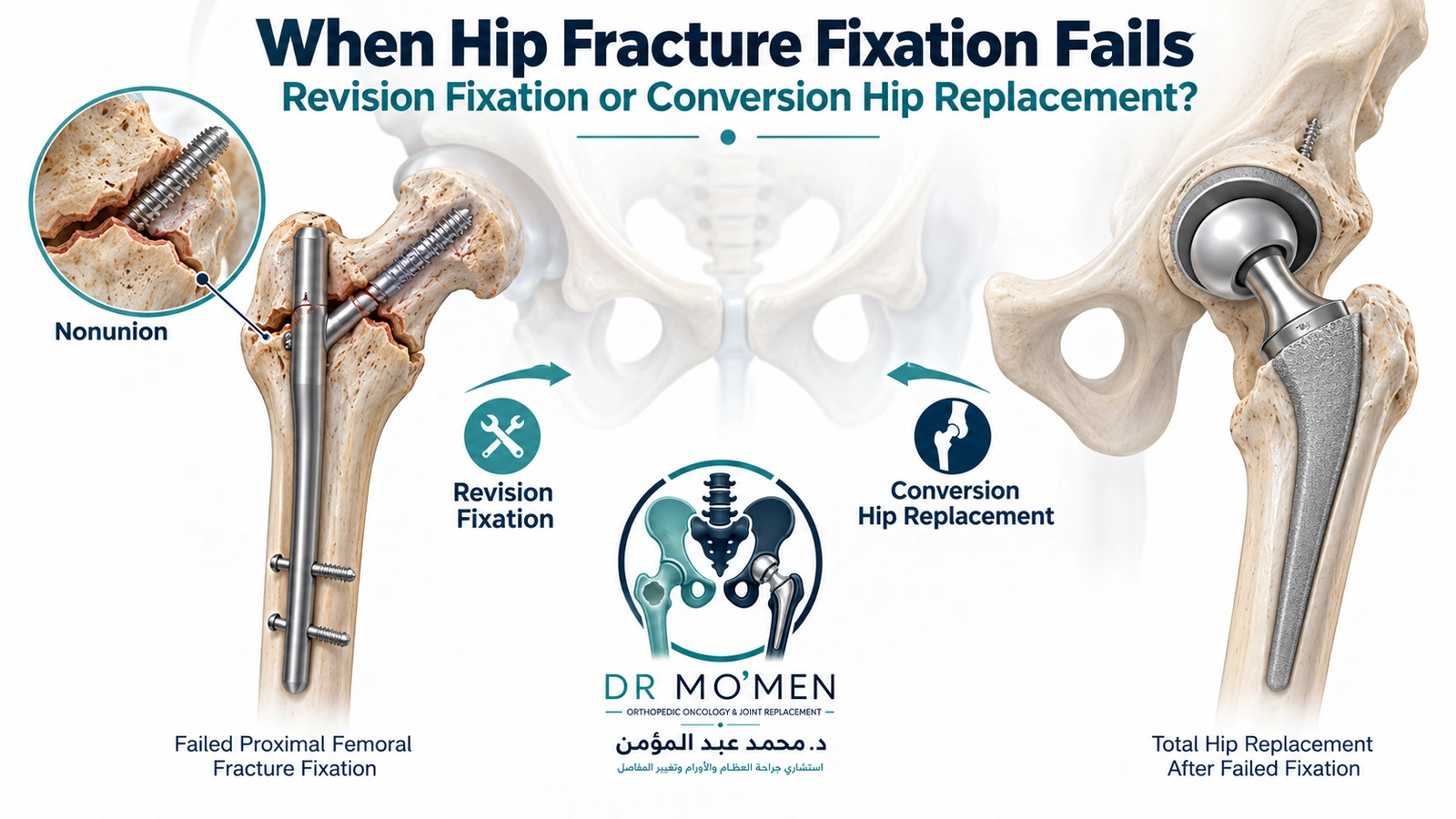
Hip fractures are commonly treated with internal fixation using screws, a sliding hip screw, a cephalomedullary nail, plates, or other fixation devices. Most fixation procedures are intended to allow the patient's own bone to heal.
Sometimes, however, the fracture does not unite, the femoral head loses its blood supply and collapses, the implant fails mechanically, or painful post-traumatic arthritis develops. The patient may then be told that the fixation has failed and a hip replacement may be needed.
This situation is often called conversion hip arthroplasty. When a total hip replacement is used, the operation is commonly called conversion total hip arthroplasty (conversion THA).
Conversion THA is not simply the same operation as a routine primary hip replacement. The surgeon may need to manage failed metalwork, altered anatomy, bone defects, previous screw holes, nonunion or malunion, possible infection, and hip reconstruction. A 2025 systematic review of 1,260 patients confirmed that conversion THA after previous proximal femoral fracture fixation is technically demanding and carries meaningful complication risks.[1]
What Does Failed Fracture Fixation Mean?
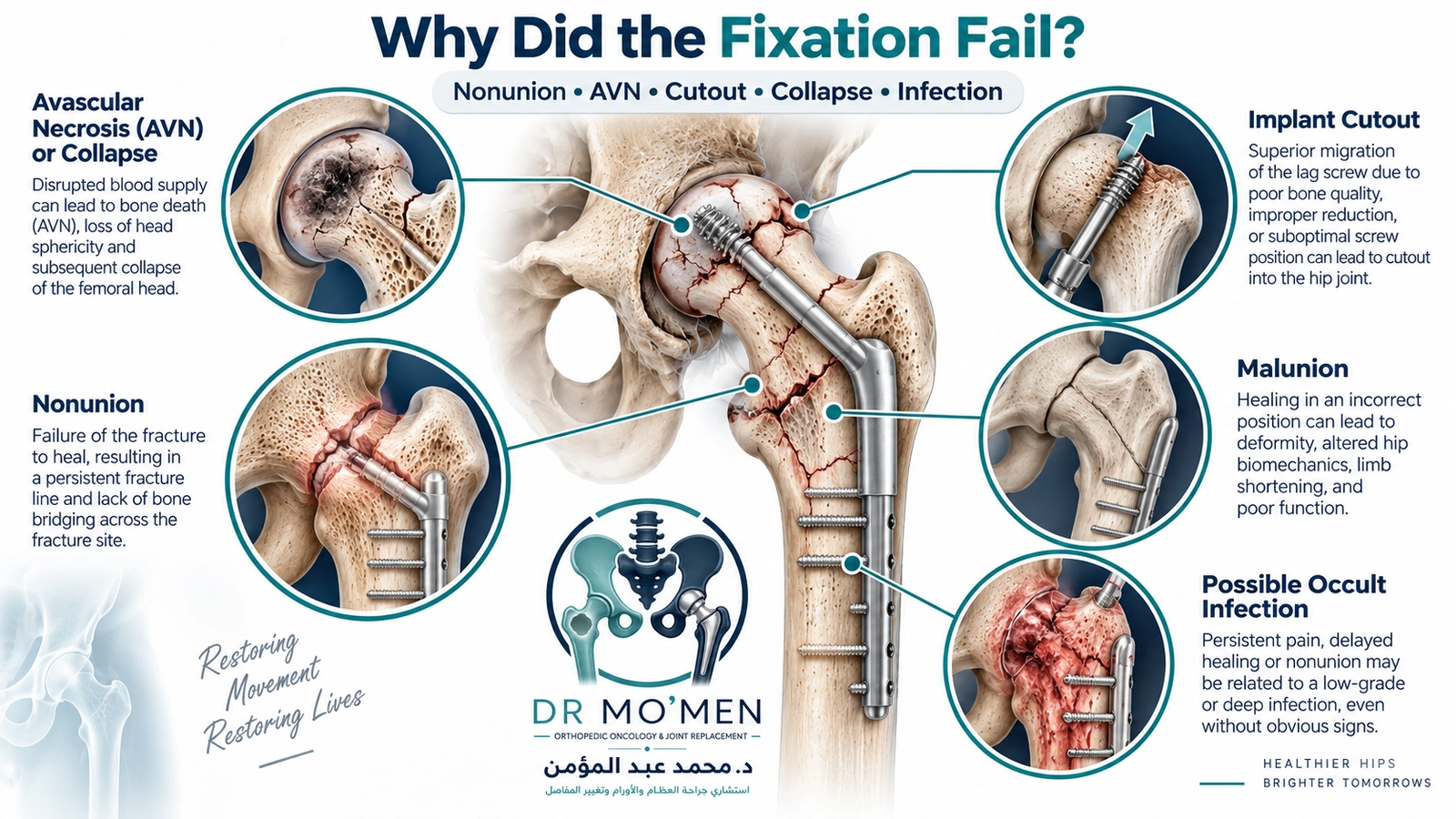
Fixation can fail in several different ways. These are not the same problem, and treatment should depend on why the first operation failed.
Common failure patterns include:
- nonunion;
- femoral head avascular necrosis (AVN);
- collapse of the femoral head;
- screw or nail cutout;
- implant breakage;
- loss of reduction;
- progressive varus collapse;
- painful malunion;
- post-traumatic arthritis;
- deep or occult infection;
- or severe persistent pain with loss of function.
The first question should therefore not be "Which hip replacement should we use?" It should be: Why did the original fixation fail?
Which Hip Fractures Can Later Require Conversion Hip Replacement?
Femoral neck fractures
Conversion arthroplasty may become relevant when fixation is followed by nonunion, femoral head collapse, AVN, or secondary arthritis.
Intertrochanteric fractures
Failure may occur after cephalomedullary nail fixation, dynamic/sliding hip screw fixation, or other constructs.
Subtrochanteric fractures
These can be particularly difficult because nonunion, deformity, and previous implants may substantially alter proximal femoral anatomy.
Does Every Failed Fixation Need a Hip Replacement?
No. Some patients may still be candidates for revision fixation instead of arthroplasty.
The choice depends on factors such as:
- patient age and physiological reserve;
- activity level;
- viability of the femoral head;
- condition of the hip cartilage;
- fracture type and biology;
- degree of nonunion;
- bone quality;
- deformity;
- infection status;
- and remaining reconstructive options.
When Might Revision Fixation Still Be Considered?
Revision fixation may be reasonable particularly in a younger patient when the femoral head remains viable, the joint surface is relatively preserved, fracture healing is still achievable, deformity can be corrected, and reliable stable fixation can be obtained.
Revision fixation may involve stronger fixation, correction of deformity, bone grafting, biological stimulation, or osteotomy in selected circumstances. The aim is to preserve the native hip when that remains a realistic option.
When Does Hip Replacement Become More Relevant?
Conversion arthroplasty becomes increasingly relevant when there is:
- irreversible femoral head damage;
- AVN with collapse;
- advanced post-traumatic arthritis;
- severe nonunion in an older or lower-reserve patient;
- failed fixation with major pain and poor function;
- implant cutout into the joint;
- severe malunion;
- multiple previous failed fixation procedures;
- or bone loss that makes another fixation unlikely to succeed.
What Is the Difference Between Conversion THA and Primary THA?
A primary THA is performed in a hip that has not previously undergone fracture fixation. In conversion THA, the surgeon may encounter old screws, plates, cephalomedullary nails, broken hardware, previous incisions, scar tissue, abductor injury, trochanteric damage, screw holes in the femur, proximal femoral deformity, malunion, nonunion, bone defects, and leg-length changes.
This makes conversion THA closer to a complex reconstructive or revision-type arthroplasty than to a straightforward primary THA. A 2025 meta-analysis comparing conversion THA after failed femoral neck fixation with primary THA found higher pooled risks of deep infection, periprosthetic fracture, and reoperation in the conversion group.[2]
Why Is Removing the Old Metalwork Difficult?
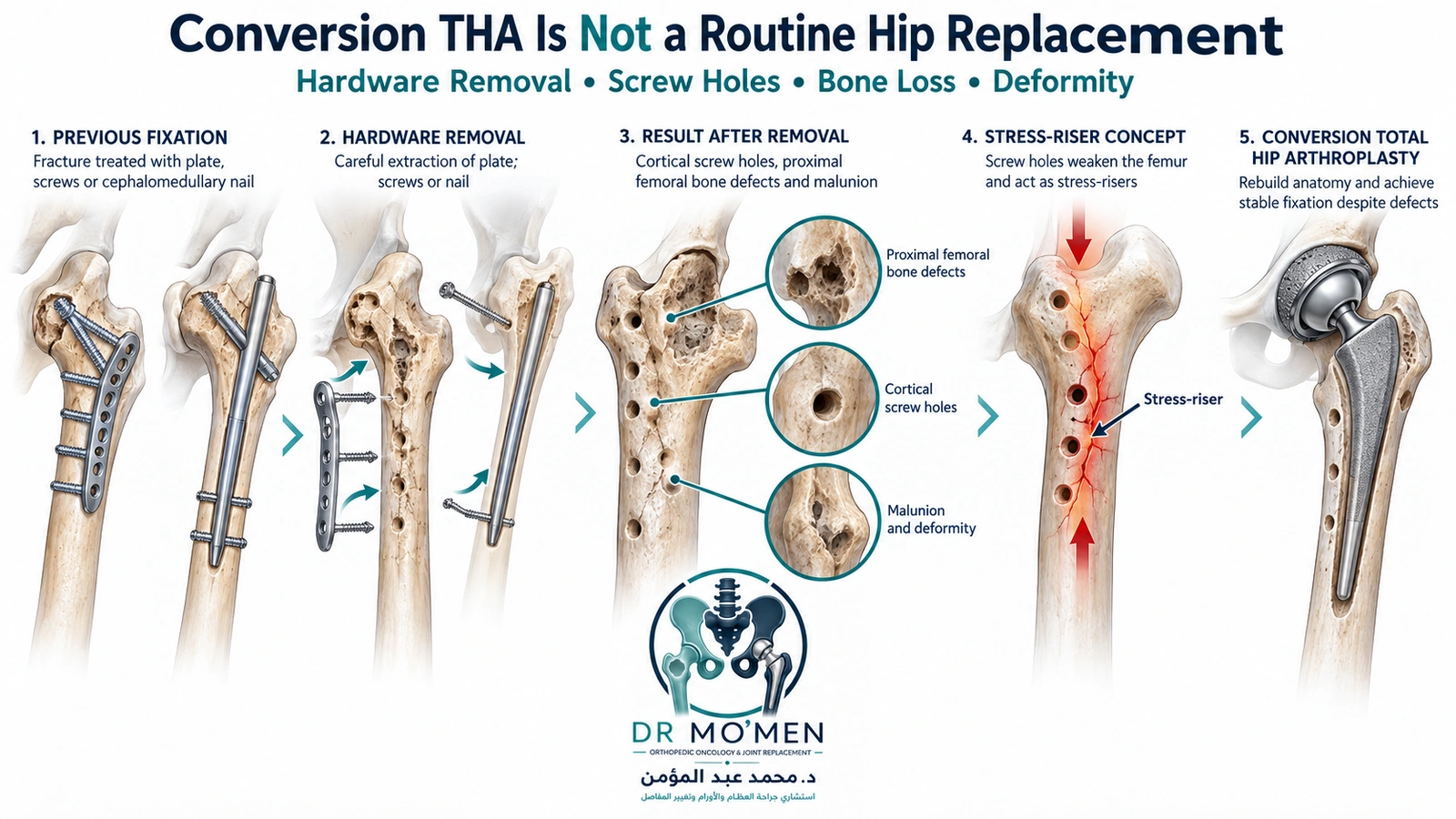
Hardware removal can be one of the most challenging parts of surgery. Problems may include buried screw heads, broken screws, stripped screw heads, overgrown bone, broken nails, difficulty accessing distal locking screws, scarred soft tissues, and deformity around the implant.
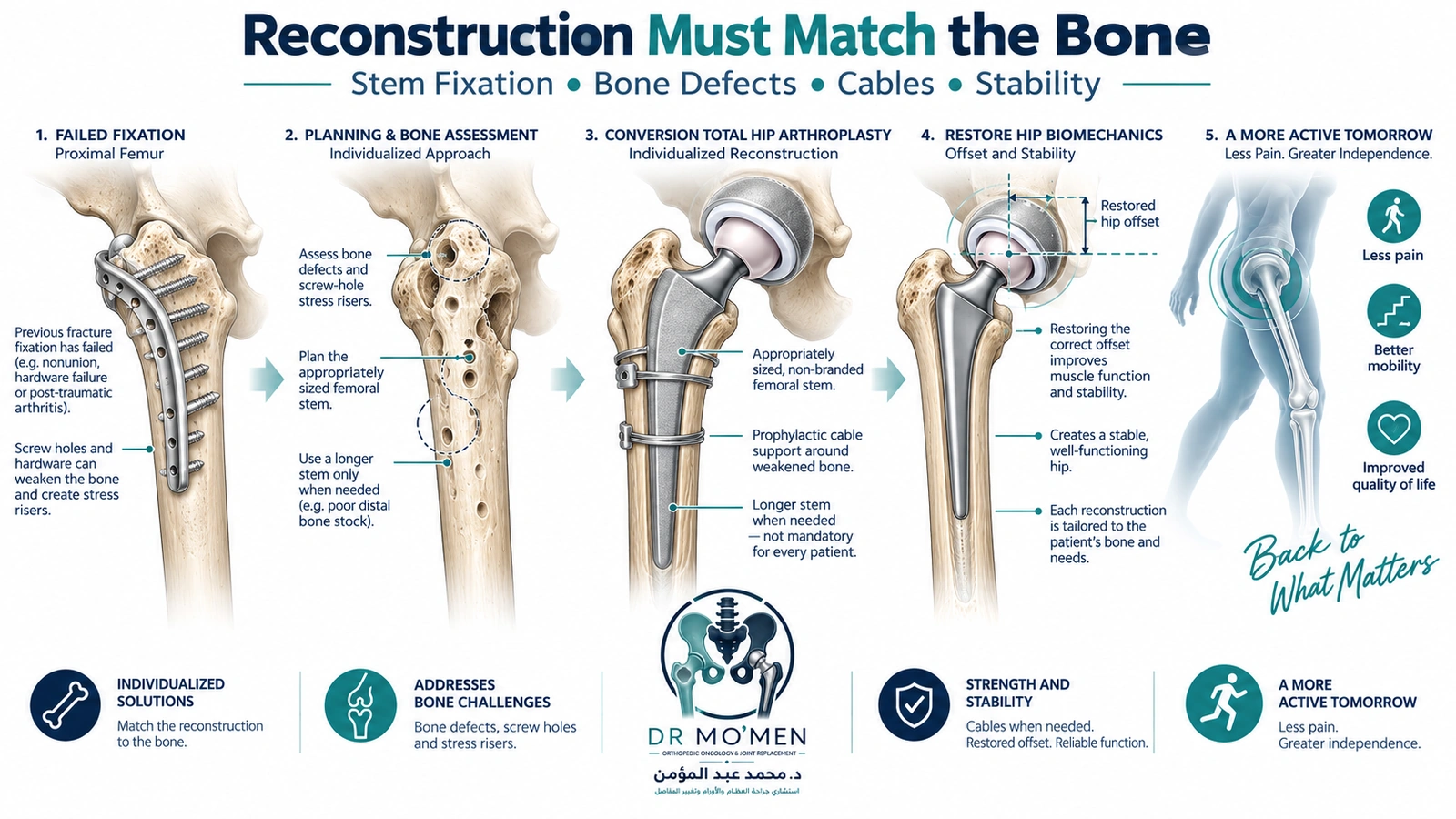
Removing hardware can also leave multiple cortical holes and weakened areas in the femur, which may act as stress risers.
Why Are Old Screw Holes Important?
After a plate or nail is removed, the femur may contain several cortical defects. These holes can weaken the bone temporarily.
The surgeon must plan the femoral component so that fixation is achieved in reliable bone and, when necessary, the reconstruction bypasses vulnerable regions. This can influence stem length, fixation method, cemented versus cementless strategy, cables, plates, or prophylactic fixation.
There is no single stem design appropriate for every conversion THA.
Is Conversion THA After a Nail More Difficult?
It often can be. Previous cephalomedullary nail fixation may result in proximal femoral bone loss, greater trochanteric damage, abductor injury, altered femoral anatomy, retained or broken hardware, and stress risers after nail removal.
The 2025 systematic review of conversion THA after proximal femoral fixation found meaningful postoperative complications and showed that the complication profile varies according to the original fixation method.[1] A separate 2026 systematic review specifically addressing conversion THA after cephalomedullary nailing also emphasizes the technical and postoperative complexity of these cases.[5]
What Problems Can Occur After a Failed Dynamic or Sliding Hip Screw?
A failed sliding hip screw may leave a large lateral femoral plate, multiple screw holes, collapse into varus, shortening, rotational deformity, or lag-screw damage to the femoral head.
After removal, the femur may require careful reconstruction. A 2025 systematic comparative review found that conversion THA after both sliding hip screw and cephalomedullary nail failure remains a complex salvage procedure.[3]
What If the Fracture Never United?
This is called nonunion. A proximal femoral nonunion can lead to persistent pain, instability, hardware fatigue, implant breakage, deformity, limb shortening, and loss of function.
The decision between revision fixation and conversion arthroplasty depends heavily on patient age, joint condition, viability of the femoral head, fracture biology, bone stock, and whether another biological reconstruction is realistically likely to heal.
What If There Is Avascular Necrosis?
AVN may occur after femoral neck fractures because the blood supply to the femoral head can be compromised. If AVN progresses to femoral head collapse, painful secondary arthritis, or severe functional limitation, conversion to hip replacement may become appropriate.
If the femoral head is still preserved, treatment can differ depending on age, stage of collapse, and symptoms.
What If the Screw Has Cut Out Into the Hip Joint?
A fixation screw or blade can migrate through the femoral head and damage the acetabular cartilage. If the acetabulum has been significantly damaged, total hip replacement may be more appropriate than hemiarthroplasty.
The extent of joint damage should be assessed before reconstruction.
Total Hip Replacement or Hemiarthroplasty?
Not every failed fracture fixation requires THA. In selected older, lower-demand patients with preserved acetabular cartilage, limited activity, and suitable anatomy, hemiarthroplasty may sometimes be considered.
THA becomes more relevant when there is acetabular damage, pre-existing arthritis, screw penetration into the acetabulum, higher functional demand, or another reason to replace both sides of the joint.
The decision requires individualized assessment.
Why Must Infection Be Excluded Before Conversion THA?
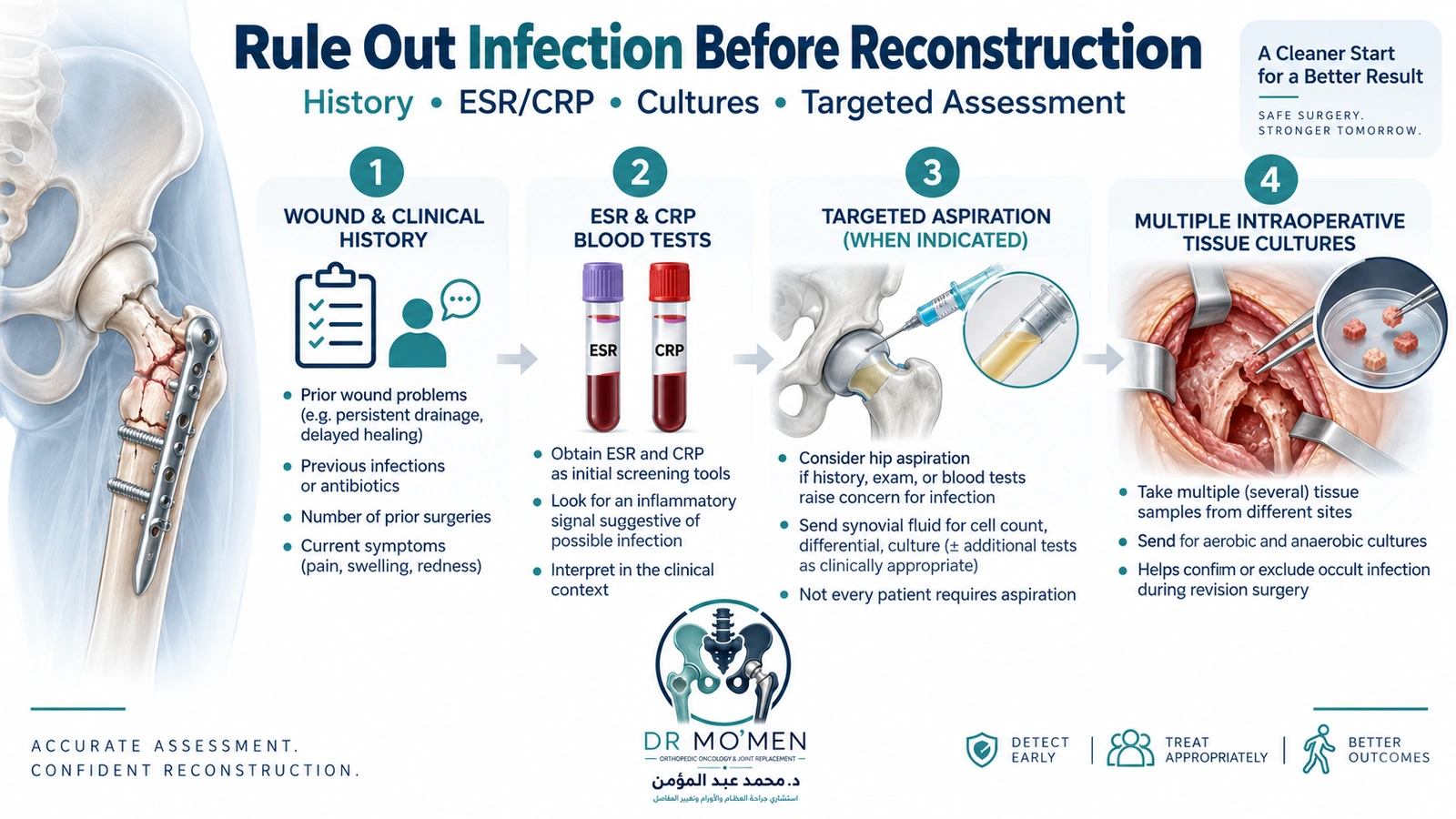
This is a critical point. Failed fracture fixation can harbor occult infection, even when the patient has no obvious fever, wound drainage, or severe inflammatory signs.
Infection may be present around screws, plates, an intramedullary nail, a nonunion site, or surrounding scar tissue. A 2026 current-concepts review stresses that preoperative screening for occult—including extra-articular— infection is important because organisms may be located around retained hardware rather than only inside the hip joint.[4]
How Is Infection Assessed?
Depending on the clinical situation, evaluation may include:
- CBC;
- ESR;
- CRP;
- review of previous wound problems or antibiotic courses;
- examination for sinus or drainage;
- aspiration when joint infection is suspected and clinically appropriate;
- targeted imaging in selected cases;
- and multiple deep tissue cultures during surgery when indicated.
No single test is appropriate for every patient.
Should Antibiotics Be Given Before Cultures?
For a stable patient in whom occult infection is being investigated, obtaining appropriate cultures before unnecessary antibiotics may improve diagnostic yield.
However, antibiotics should never be dangerously delayed in a septic or systemically unwell patient simply to obtain cultures. Clinical safety comes first.
Is Conversion THA More Like Revision Hip Replacement?
In many ways, yes. Although the patient does not have a failed hip prosthesis, the operation can require techniques familiar from revision arthroplasty:
- extended exposure;
- removal of metalwork;
- management of bone loss;
- longer or revision-style stems;
- cables;
- management of trochanteric defects;
- restoration of offset;
- restoration of leg length;
- and management of instability risk.
This is why experience with complex hip reconstruction. See also Revision Hip Replacement can be relevant.
How Is the Femoral Stem Chosen?
Stem choice depends on:
- quality of proximal bone;
- size and position of previous screw holes;
- femoral deformity;
- fracture nonunion;
- medullary canal anatomy;
- cortical defects;
- and where reliable fixation can be obtained.
Options may include conventional cementless stems, longer stems, modular tapered stems, cemented stems, revision-style stems, and additional cerclage or plating.
The correct stem is the one that provides reliable fixation for the patient's anatomy—not simply the longest or largest implant available.
Is a Long Stem Always Required?
No. Some cases have adequate proximal femoral bone and may accept a standard or moderately extended stem. Other cases need longer fixation to bypass large cortical defects, multiple screw holes, nonunion, deformity, or poor proximal bone.
The decision is based on reconstruction mechanics.
Why Can Periprosthetic Fracture Occur During Conversion THA?
The femur may already be weakened by osteoporosis, screw holes, previous plate fixation, nail removal, nonunion, malunion, bone loss, or deformity. During implant removal and stem insertion, this increases fracture risk.
Periprosthetic fracture is one of the important complications reported in modern conversion THA series and systematic reviews.[1][2]
Can the Femur Be Reinforced During Surgery?
Yes, in selected cases. The surgeon may use prophylactic cerclage cables, plates, longer stems, bone graft, or other reconstructive techniques when the bone is considered vulnerable.
This decision depends on preoperative imaging and intraoperative findings.
What If the Greater Trochanter Is Damaged?
Previous hip fracture fixation may leave trochanteric nonunion, abductor damage, migration of the greater trochanter, or weakness from previous nail entry.
This matters because the abductor mechanism contributes to walking, pelvic stability, hip stability, and reduction of limping. Trochanteric reconstruction may therefore become part of conversion THA.
Why Is Dislocation Risk Important?
Conversion THA can carry a meaningful instability risk because of altered anatomy, abductor dysfunction, scar tissue, leg-length changes, previous deformity, and complex component positioning.[1]
Can Dual Mobility Be Used?
Dual-mobility components may be considered in selected patients when instability risk is high—for example with abductor deficiency, complex reconstruction, previous surgery, or other instability risk factors.
Dual mobility is not a universal requirement and does not guarantee against dislocation.
What About Leg-Length Difference?
Failed proximal femur fixation can cause shortening, varus collapse, trochanteric migration, or malunion. Conversion THA attempts to restore hip center, offset, limb length, and soft-tissue tension.
Aggressive lengthening can place nerves and soft tissues at risk. The goal is safe functional reconstruction, not forced radiographic symmetry.
Is Conversion THA More Likely to Involve Significant Blood Loss?
It can. Hardware removal, longer operating time, scar tissue, bone reconstruction, and wider exposure can increase blood loss compared with a routine primary hip arthroplasty.
A 2026 clinical study found that conversion arthroplasty after failed intertrochanteric fixation involved longer procedures and greater estimated blood loss than conversion after failed femoral neck fixation.[7]
Preoperative anemia should therefore be identified and treated when possible.
What Are the Main Risks?
Potential complications include:
- infection;
- dislocation;
- intraoperative fracture;
- postoperative periprosthetic fracture;
- blood loss and transfusion;
- DVT or pulmonary embolism;
- nerve injury;
- abductor dysfunction;
- persistent limp;
- leg-length discrepancy;
- aseptic loosening;
- wound complications;
- and need for future revision surgery.
A 2026 meta-analysis of 1,468 hips undergoing conversion arthroplasty after failed intertrochanteric fixation confirmed that this is an effective salvage procedure but carries a substantial complication burden.[6]
Is Recovery the Same as a Routine Hip Replacement?
Not necessarily. Recovery depends on the amount of bone reconstruction, whether a fracture or nonunion is present, stem fixation, trochanteric reconstruction, muscle condition, blood loss, patient age, and medical fitness.
Some patients can mobilize early. Others may require protected weight bearing, walking aids for longer, additional physiotherapy, or slower progression.
The recovery plan must match the reconstruction.
When Is Urgent Assessment Needed?
Patients with failed fixation should seek urgent assessment if they develop:
- sudden inability to bear weight;
- new severe pain;
- new deformity;
- hardware prominence or protrusion;
- wound drainage;
- fever with worsening hip pain;
- a new fracture;
- or sudden shortening or rotation of the leg.
These findings may indicate acute mechanical failure, fracture, or infection.
What Should Be Reviewed Before Deciding on Conversion THA?
Current X-rays
Usually pelvis and proximal femur imaging.
Previous X-rays
These help show when fixation began to fail, whether collapse progressed, and whether the hip joint was previously preserved.
Full implant history
Including nail, plate, screws, fixation system, and previous operative reports if available.
CT when indicated
Useful in selected cases for deformity, bone stock, hardware position, acetabular damage, or complex reconstruction planning.
Infection work-up
Especially in nonunion, previous wound problems, unexplained loosening, multiple operations, or persistent inflammatory symptoms.
What Questions Should the Patient Ask?
Useful questions include:
- Why did the original fixation fail?
- Is revision fixation still realistic?
- Is the femoral head salvageable?
- Is there acetabular damage?
- Has occult infection been considered and appropriately investigated?
- Can all hardware be removed safely?
- Are special stems or cables likely to be required?
- Is there significant bone loss?
- Is the abductor mechanism intact?
- Will weight bearing be restricted afterward?
These questions are often more useful than asking only which implant brand will be used.
When Is a Specialist Second Opinion Useful?
A second opinion can be particularly valuable when:
- a failed nail or plate has been present for months;
- revision fixation and THA have both been proposed;
- the patient is relatively young;
- infection has not been adequately evaluated;
- there is major deformity;
- there is proximal femoral bone loss;
- previous operations have failed;
- or the case has been described as a complex conversion THA.
For Patients Traveling to Egypt
Stable patients considering treatment in Egypt can send current hip and femur X-rays, old fracture X-rays, CT if available, original operative reports, implant details, infection investigations, relevant laboratory tests, and medical history.
A preliminary review can help determine whether the likely pathway is:
Revision Fixation
or
Conversion Hemiarthroplasty
or
Conversion Total Hip Replacement
or
Further Investigation Before Surgery
This review does not replace clinical examination or final surgical planning.
Role of Dr. Mohammed Abdelmoemen Abuelhadid
Failed proximal femoral fixation requires a decision between fracture salvage and joint reconstruction.
Assessment focuses on the reason for fixation failure, viability of the femoral head, condition of the acetabulum, nonunion or malunion, bone stock, previous hardware, infection risk, abductor function, leg length, and overall patient fitness.
The aim is to determine whether preserving the native hip remains realistic or whether a conversion hip replacement provides the more appropriate reconstructive pathway.
For stable complex cases, X-rays and reports can be reviewed before travel.
Joint Replacement Service · Fracture Service
For appointments or X-ray/report review: 01021690693
Medical References
- Di Martino A, et al. Outcomes and complications of conversion THA after internal fixation of proximal femur fractures: a systematic review. 2025. PMID: 40956324. PubMed
- Yin H, et al. Comparison of complications between total hip arthroplasty following failed internal fixation and primary total hip arthroplasty for femoral neck fractures: a meta-analysis. 2025. PMID: 40783980. PubMed
- Chouhan D, et al. Conversion Total Hip Arthroplasty after Sliding Hip Screw and Cephalomedullary Nail Failures: A Systematic Comparative Review and Meta-analysis. Hip Pelvis. 2025. PMID: 40432175. PubMed
- Conversion total hip arthroplasty following failed proximal femoral fixation: current concepts review. 2026. PMID: 41786672. PubMed
- Khela HS, et al. Revision and postoperative complication rates of conversion total hip arthroplasty after cephalomedullary nailing of intertrochanteric femur fractures: a systematic review and meta-analysis. 2026. PMID: 41712004. PubMed
- Kang N, et al. Complication Analysis of Conversion Hip Arthroplasty after Failed Intertrochanteric Fracture Fixation: A Meta-Analysis. Clin Orthop Surg. 2026;18(2):228-240. PMID: 41938879. PubMed
- The impact of conversion arthroplasty for failed femoral neck or intertrochanteric fractures on complication and mortality rates: A “second-hit” effect? 2026. PMID: 41814670. PubMed