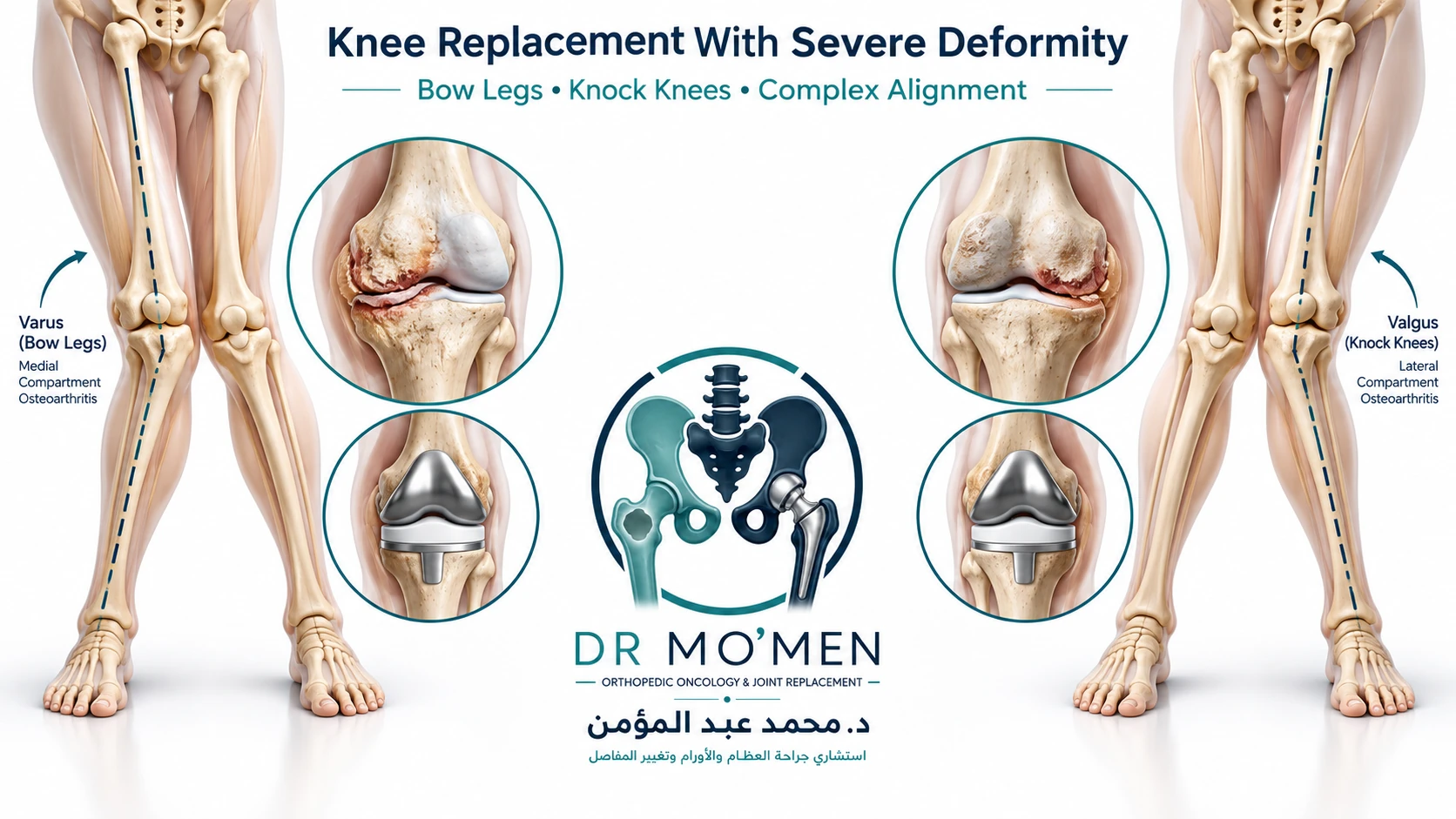
When knee arthritis becomes advanced, the leg may gradually become noticeably bow-legged or knock-kneed. A standard total knee replacement can correct many arthritic deformities, but when the deformity is severe, fixed, associated with bone loss, ligament imbalance or previous surgery, the operation becomes more demanding than an uncomplicated primary knee replacement.
The surgeon is no longer dealing only with damaged cartilage. The operation must address arthritis + alignment + bone loss + ligament balance + joint stability.
What Do Bow Legs and Knock Knees Mean?
Bow Legs — Varus Deformity
In a varus knee, the knee moves outward relative to the mechanical axis of the limb. Patients may notice separation between the knees when the ankles are together, greater wear on the inner side of the knee, progressive bowing, difficulty walking and medial-sided pain.
Knock Knees — Valgus Deformity
In a valgus knee, the knee angles inward. Patients may notice the knees coming together while the ankles remain separated, pain predominantly on the outer side, abnormal gait, instability or progressive collapse inward.
The clinical pattern matters because valgus knees can have very different combinations of lateral tightness, medial ligament competence and patellar tracking problems. [1]
Why Does Severe Deformity Make Knee Replacement More Complex?
With severe deformity, the knee may also have:
Simply inserting an implant without correcting these factors can leave the knee unstable, poorly balanced or difficult to move.
What Happens in a Severe Varus Knee?
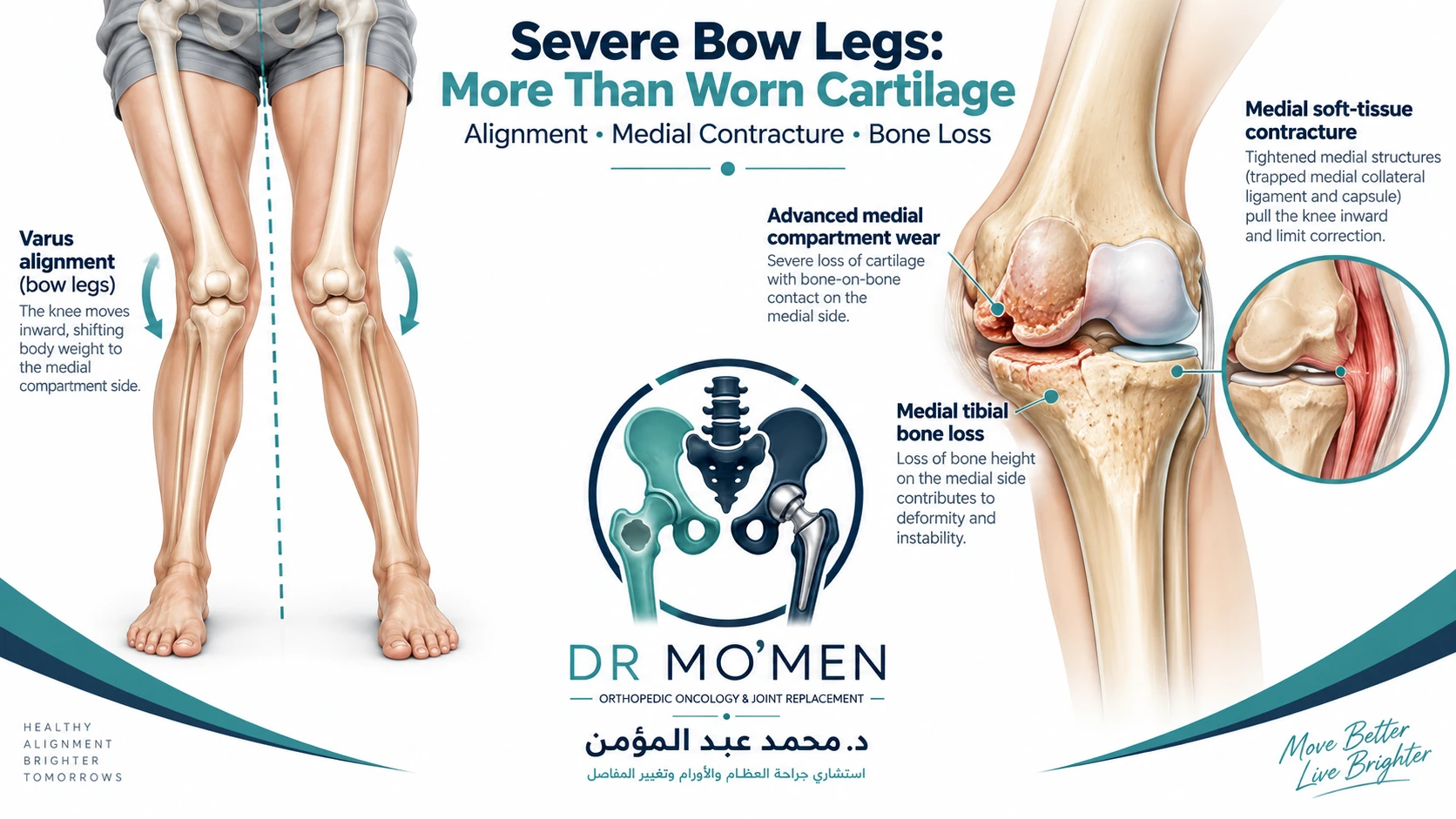
A longstanding bow-legged knee commonly has advanced medial compartment wear, large medial osteophytes, posteromedial soft-tissue contracture and sometimes medial tibial bone loss. The outer side may be relatively stretched.
The correction therefore requires more than resurfacing the joint. The surgeon must restore a stable relationship between the bone cuts and the surrounding ligament envelope.
What Happens in a Severe Valgus Knee?
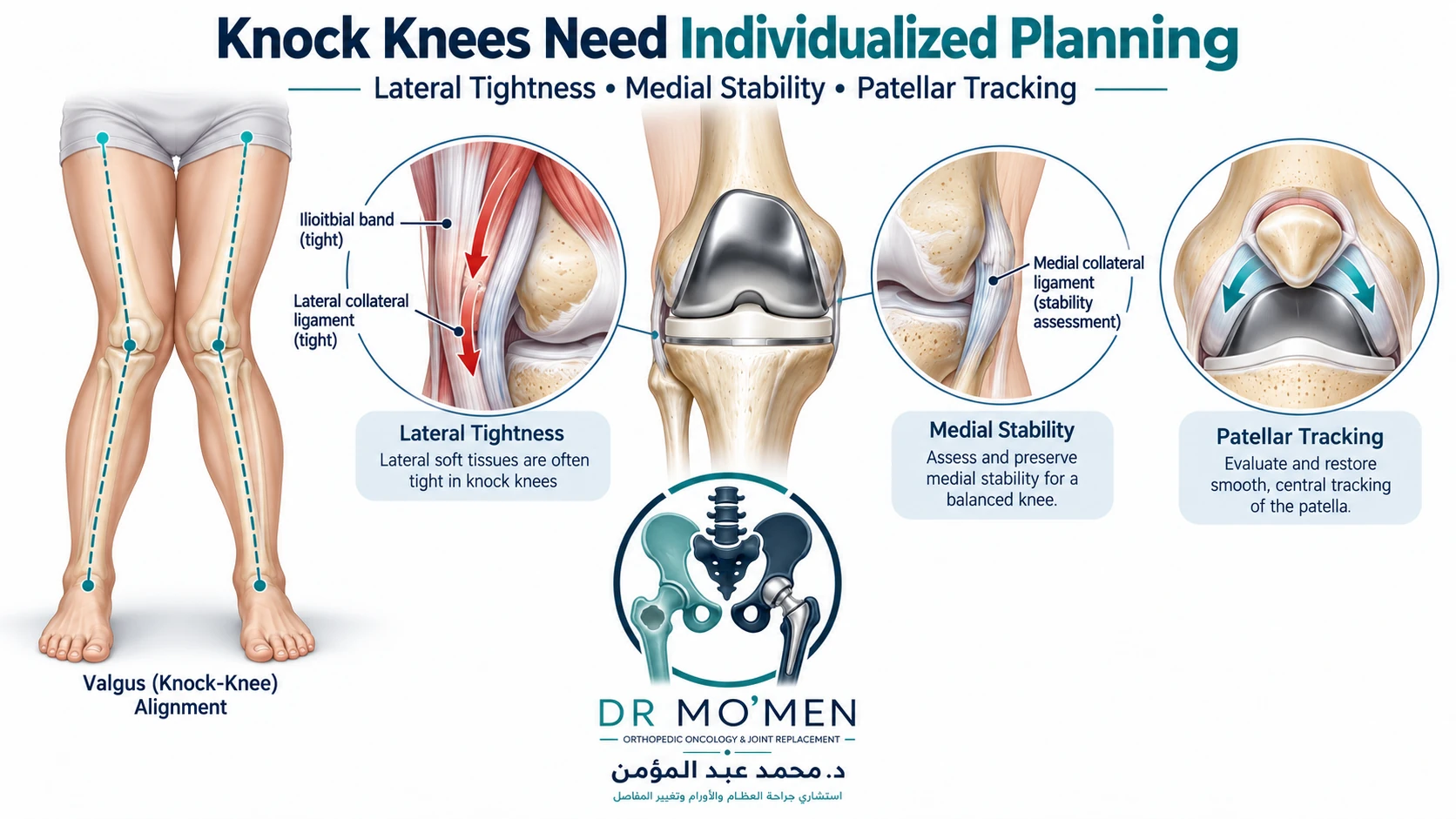
The pattern is often different. A severe valgus knee may have tight lateral structures, abnormal lateral femoral anatomy, lateral bone deficiency, medial ligament laxity and patellar maltracking.
The important question is not simply how many degrees of valgus are present. The surgeon must determine whether the medial collateral ligament is functionally competent, whether the lateral tissues require selective management and whether the patella tracks centrally after reconstruction. A recent review supports individualized rather than uniform treatment of valgus knees. [1]
Is the Degree of Deformity the Only Important Factor?
No. Two knees that look similarly crooked on a standing radiograph may require very different operations.
Important questions include:
What X-rays Are Useful Before Surgery?
Standing Knee X-rays
These show arthritis severity, joint-space loss, osteophytes, bone defects and local deformity.
Long-Leg Alignment X-rays
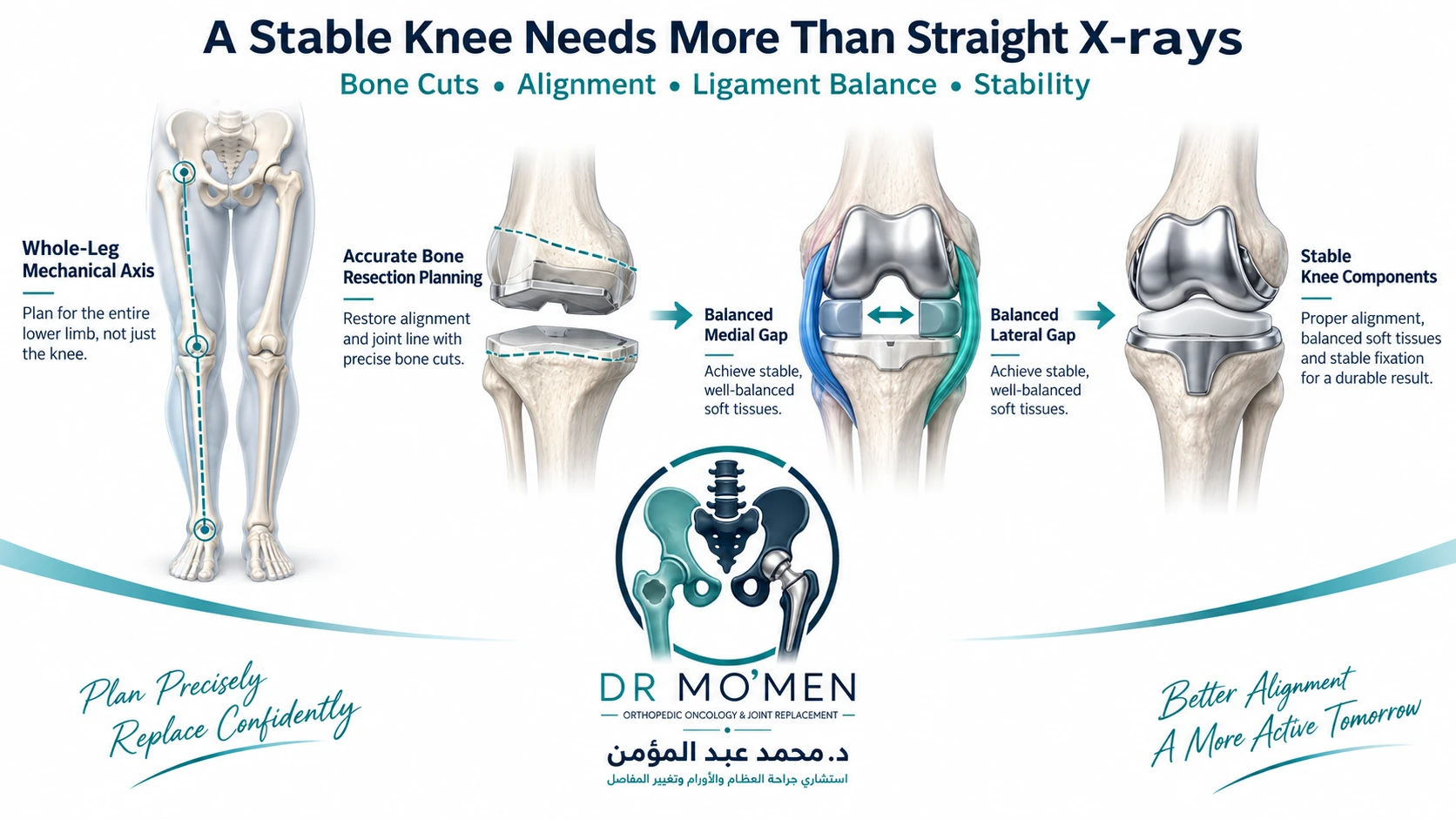
For significant deformity, long-leg films can be especially useful because they assess the mechanical relationship from hip to knee to ankle and help determine whether deformity arises mainly from the distal femur, proximal tibia, the joint itself or a previous fracture.
CT or Other Imaging
CT can be helpful in selected cases involving unusual anatomy, major rotational deformity, prior fracture, retained hardware or complex reconstructive planning.
Does Knee Replacement Straighten the Leg?
In many arthritic knees, total knee replacement corrects a substantial part of the deformity. But the goal is not to force every patient into exactly the same alignment regardless of anatomy.
The more meaningful objective is to create a knee that is stable, balanced, appropriately aligned and functional. Modern TKA includes several alignment philosophies, including mechanical and more personalized approaches, and current evidence does not establish one philosophy as universally superior for every patient. [2,3]
Why Are the Ligaments So Important?
A knee replacement is not stabilized by metal and polyethylene alone. The collateral ligaments remain critical.
The surgeon evaluates the medial and lateral soft-tissue tension in extension and flexion. The objective is controlled stability throughout the range of motion without unnecessary ligament release.
What Is Soft-Tissue Balancing?
If one side of the knee remains too tight while the other is loose, the reconstructed knee may be unstable or difficult to move. Balancing may involve:
The exact strategy should match the individual knee rather than follow a rigid one-size-fits-all rule. [2]
What Is Bone Loss?
Advanced deformity can wear away parts of the femur or tibia. Severe varus arthritis, for example, may produce a medial tibial defect.
Depending on the defect, reconstruction may involve:
The reconstructive choice depends on the location, size and quality of the remaining bone.
Does Severe Deformity Always Need a Constrained Knee?
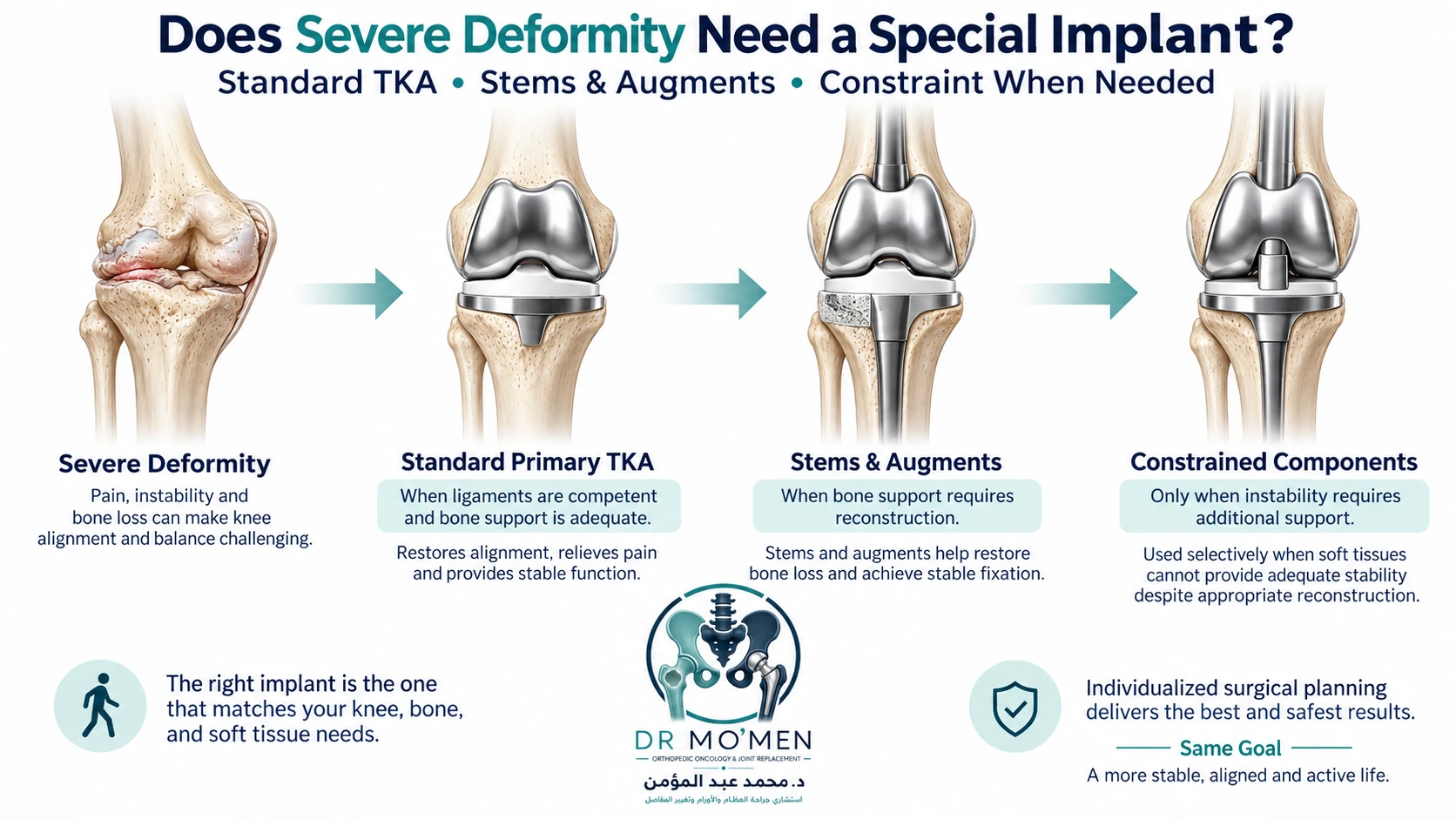
No. Many severe deformities can still be reconstructed with a conventional primary knee implant when the ligaments are competent, the bone can be reconstructed and adequate stability is achieved.
Greater implant constraint is considered when the knee cannot be stabilized reliably using the patient's own soft tissues.
What Does “Constraint” Mean?
Constraint describes how much mechanical stability the prosthesis itself provides. At one end, standard primary designs rely more heavily on intact ligaments. At the other end, constrained condylar or hinged designs provide additional mechanical stability for selected complex situations.
The principle is: use enough constraint to obtain a stable knee, but do not use more constraint than necessary.
For a more detailed discussion of implant constraint, see CCK vs Hinged Knee Replacement.
Does Severe Bowing Automatically Mean CCK or a Hinged Knee?
No. The angle of deformity alone does not determine the implant. A markedly bowed knee with competent ligaments may still be reconstructed with a standard or moderately constrained system, while a knee with less dramatic deformity but severe ligament deficiency may need additional constraint.
Implant choice is driven by bone loss + ligament competence + balance after correction + stability.
What About Patellar Tracking in a Valgus Knee?
Valgus deformity can affect the extensor mechanism. Surgical planning therefore considers femoral and tibial rotation, trochlear orientation, patellar position and lateral soft-tissue tension. Patellofemoral mechanics are an important part of individualized valgus TKA planning. [1]
Are Nerves at Risk in Severe Valgus Deformity?
Nerve injury after TKA is uncommon but clinically important. The common peroneal nerve deserves particular attention in a markedly valgus knee because major correction can change tension around the nerve.
This does not mean valgus deformity should not be corrected; it means nerve protection is part of careful planning.
What If the Knee Cannot Fully Straighten Before Surgery?
Severe arthritis may also cause a flexion contracture. Posterior osteophytes, capsular shortening and bony deformity can all contribute. In these cases the operation must address both coronal deformity and loss of extension.
Can Knee Replacement Correct Deformity From an Old Fracture?
Sometimes, but the surgeon must determine whether the deformity is mainly inside the joint or is an extra-articular deformity caused by a malunited femoral or tibial fracture.
In selected cases, treatment may require modified component positioning, navigation or robotic planning, patient-specific planning or occasionally a corrective osteotomy in addition to arthroplasty. Extra-articular deformity therefore requires individualized planning. [4]
Does Robotic Knee Replacement Help in Severe Deformity?
Robotic or navigation-assisted systems can help quantify alignment, plan bone resections and assess gaps. A comparative 2024 study reported improved alignment precision and some early functional advantages with robotic-assisted TKA in severe varus/valgus deformity. [5]
However, robotic surgery is a tool, not a guarantee of a superior result. Successful complex TKA still depends on diagnosis, surgical judgment, ligament management and appropriate implant selection.
Is a Robot Necessary for Severe Bow Legs or Knock Knees?
No. Severe deformities have been reconstructed successfully using conventional TKA techniques for many years. Robotics and navigation may add planning precision in selected cases but are not mandatory for a successful correction.
How Much Should a Bowed Leg Be Corrected?
There is no useful universal patient rule such as “every knee must be corrected to exactly X degrees.” The target depends on native anatomy, deformity location, ligament balance, bone loss, alignment philosophy and stability. [2,3]
Is Rehabilitation Different After Complex Deformity Correction?
The principles remain similar: early mobilization when medically appropriate, range-of-motion work, quadriceps activation, gait training and progressive strengthening. But patients with longstanding severe deformity may require more gait retraining because the entire lower limb has adapted to the old alignment.
What Are the Main Risks?
Potential risks include:
Severe deformity can increase the technical complexity of obtaining reliable alignment, ligament balance and stability.
When Should Surgery Be Considered?
A bow leg or knock knee alone does not automatically mean that knee replacement is necessary. TKA becomes relevant when advanced arthritis is associated with substantial pain, reduced walking ability, progressive deformity, functional limitation and failure of appropriate non-operative treatment.
For a broader treatment decision framework, see the Joint Replacement service and the patient-education hub.
Can Severe Bow Legs Be Treated Without Knee Replacement?
That depends on age, arthritis severity, deformity location and how much of the joint is damaged. In younger patients with deformity but relatively preserved joint surfaces, osteotomy may sometimes be considered. In advanced multi-compartment arthritis, total knee replacement is often more relevant.
When Is a Specialist Second Opinion Useful?
A specialist second opinion can be useful when:
For Patients Traveling to Egypt
For stable cases, patients outside Egypt can send standing knee X-rays, long-leg alignment films if available, previous imaging, operative reports, details of old fractures or implants, medical history and current medications for preliminary review before travel.
This may help clarify whether the case appears to be a routine primary knee replacement or a more complex primary reconstruction that may require additional planning or implant options.
Role of Dr. Mohammed Abdelmoemen Abuelhadid in Complex Knee Replacement
Assessment of severe bow-leg or knock-knee arthritis goes beyond deciding whether cartilage is worn. Planning focuses on the mechanical axis, deformity location, ligament competence, flexion contracture, bone defects, patellar tracking, previous surgery and the amount of implant constraint that may be required.
The surgical plan may range from a standard primary TKA to primary TKA with additional balancing or bone reconstruction, or in selected complex cases, stems, augments or constrained components.
The final implant strategy should be based on examination, imaging and intraoperative assessment.
For appointments or X-ray/report review: 01021690693