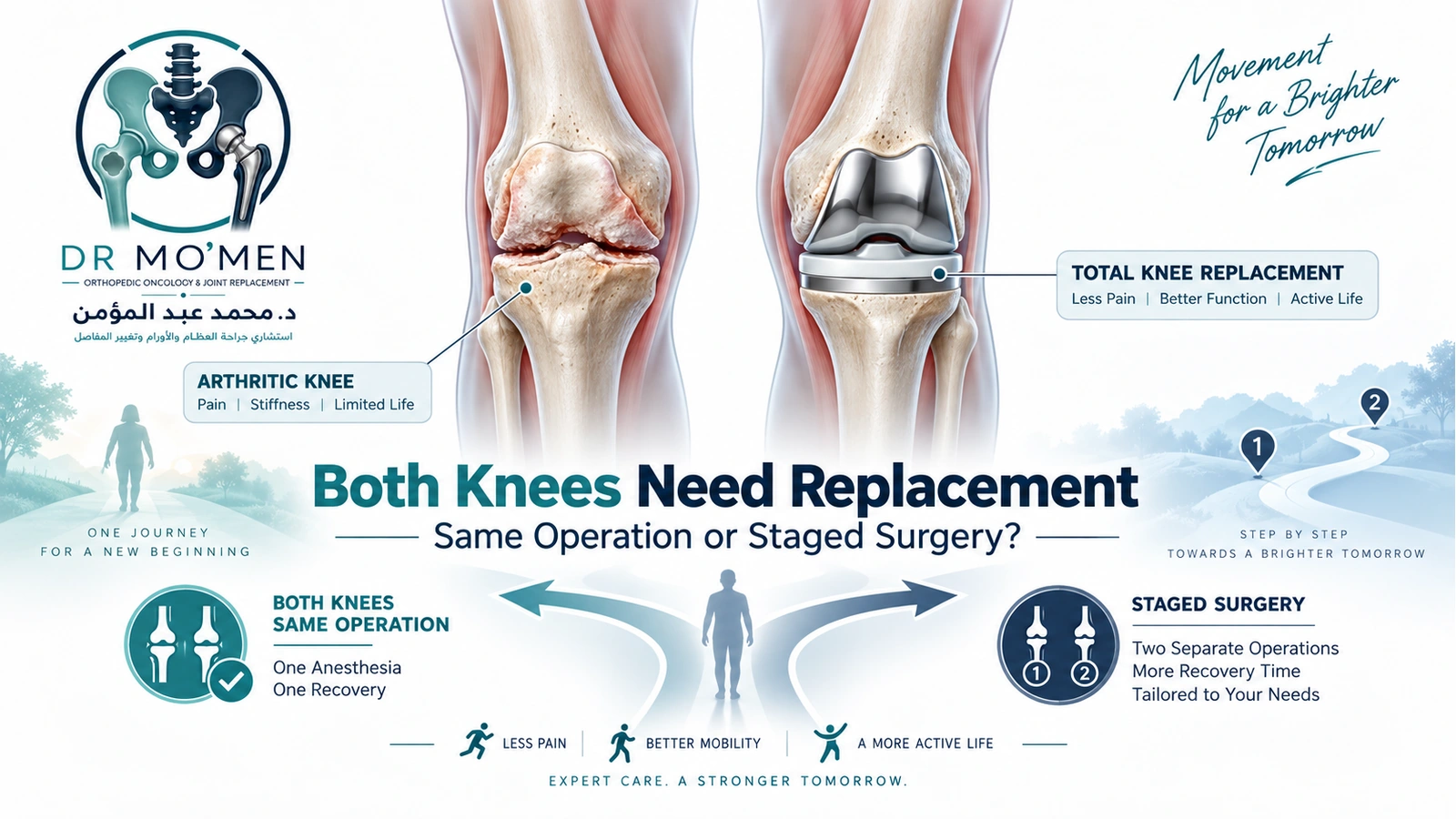
When severe arthritis affects both knees, patients may reach a point where each knee independently meets the indications for total knee replacement. That creates another decision: should both knees be replaced during the same operation, or should the operations be performed separately?
A simultaneous bilateral total knee replacement means replacing both knees during the same anesthetic session. A staged bilateral knee replacement means replacing one knee first and performing the second operation later.
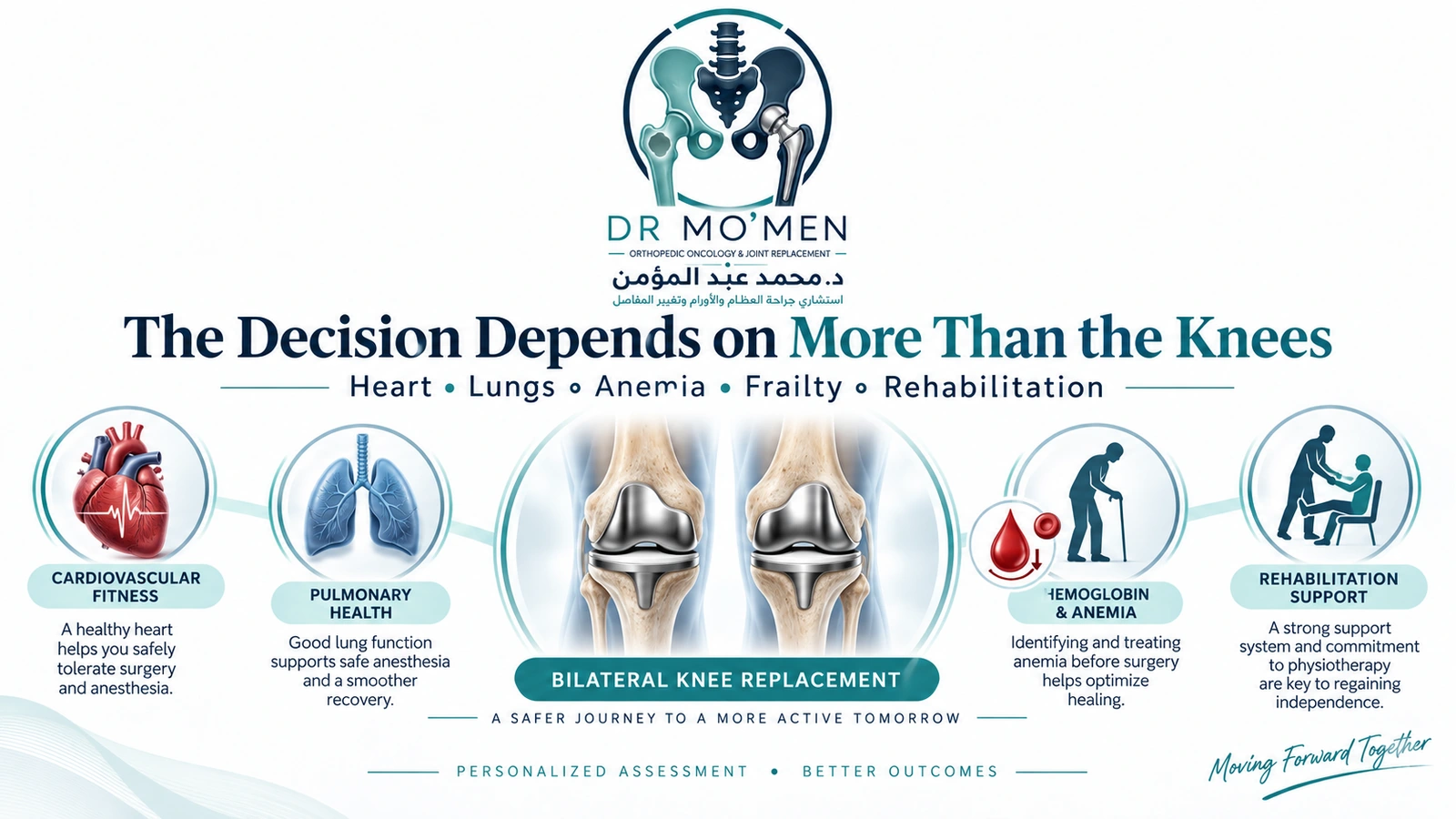
There is no single strategy that is best for every patient. The decision depends on general health, cardiopulmonary reserve, anemia, frailty, severity of symptoms in each knee, rehabilitation capacity, and the patient’s priorities. Current evidence suggests that simultaneous and staged surgery have different risk profiles rather than one approach being universally superior. [1,2]
What Is Bilateral Knee Replacement?
Bilateral knee replacement is considered when advanced osteoarthritis or another end-stage joint problem significantly affects both knees. Symptoms may include pain with walking, difficulty climbing stairs, night pain, stiffness, reduced walking distance, major bow-leg or knock-knee deformity, and loss of independence.
The indication for surgery should still be assessed for each knee individually. Having arthritis on X-rays in both knees does not automatically mean that both knees need replacement.
What Is Simultaneous Bilateral Knee Replacement?
In simultaneous surgery, the right and left total knee replacements are performed during one anesthetic session. This means one hospital admission, one anesthetic episode, and one combined early rehabilitation period.
Potential advantages include avoiding a second admission and compressing the total treatment journey into one episode. However, replacing both knees together is also a larger single physiological event than replacing one knee.

What Is Staged Bilateral Knee Replacement?
In staged treatment, one knee is replaced first. After recovery and medical reassessment, the second knee is replaced during another admission.
This approach means two operations and two early recovery periods, but it reduces the surgical burden of each individual episode and gives the patient and team an opportunity to reassess before the second operation.

Simultaneous vs Staged: The Main Differences
| Factor | Simultaneous bilateral TKA | Staged bilateral TKA |
|---|---|---|
| Number of operations | One operative session | Two separate operations |
| Anesthetic episodes | One | Two |
| Early rehabilitation | Both knees recover together | One operated knee at a time |
| Total treatment timeline | More concentrated | Longer overall timeline |
| Physiological burden per admission | Higher | Lower per operation |
| Blood-loss exposure | Concentrated in one episode | Divided between two operations |
| Patient selection | More restrictive | Suitable for a broader range of patients |
This is a conceptual comparison. Individual risk depends on the patient’s health, surgical complexity, perioperative protocol, and rehabilitation support.
What Are the Potential Advantages of Doing Both Knees Together?
One Anesthetic Episode
The patient undergoes anesthesia once instead of twice.
One Main Rehabilitation Period
Both knees recover together, which can reduce the total calendar time spent moving through two separate postoperative cycles in appropriately selected patients.
Both Deformities Are Addressed Together
For some patients with severe bilateral deformity, treating both knees during the same episode can simplify the overall alignment and rehabilitation plan.
Fewer Separate Admissions
There is one main admission rather than two. However, convenience or cost should never override medical safety.
What Are the Potential Disadvantages of Simultaneous Surgery?
The operation can involve greater total blood loss, a greater fall in hemoglobin, increased transfusion exposure, more demanding early mobilization, and greater physiological stress during a single admission.
A 2026 systematic review and meta-analysis of 53 observational cohort studies involving 572,881 patients found that simultaneous bilateral TKA was associated with higher reported short-term mortality, DVT, and transfusion requirements than staged surgery. The same analysis found different patterns for infection and several other outcomes, reinforcing that the strategies have distinct risk profiles rather than a simple “safe versus unsafe” distinction. Because all included studies were observational, selection bias and confounding remain important limitations. [1]
Is Simultaneous Bilateral Knee Replacement Safe?
It can be reasonable in carefully selected, medically fit patients, but it is not appropriate for everyone.
The better question is not merely whether both knees can be replaced together. It is whether a particular patient has enough physiological reserve to tolerate two major joint replacements during one anesthetic and then complete bilateral rehabilitation safely.
Who May Be Considered for Simultaneous Surgery?
Factors that may support consideration include:
- severe symptomatic disease in both knees;
- good cardiovascular and pulmonary reserve;
- acceptable kidney function;
- controlled medical conditions;
- acceptable preoperative hemoglobin;
- relatively low frailty;
- good preoperative mobility and muscle function;
- and strong postoperative rehabilitation and home support.
The final decision should involve the orthopedic surgeon, anesthetic/perioperative team, and the patient.
Who May Be Better Suited to Staged Surgery?
A staged approach may be more appropriate when there is substantial medical risk, such as significant cardiac or pulmonary disease, renal impairment, untreated anemia, previous thromboembolic disease, marked frailty, poor rehabilitation reserve, or other conditions that increase perioperative risk.
Age alone should not be used as an absolute cutoff. Biological fitness, comorbidities, functional reserve, and anesthetic assessment are more useful than a single age number.
Does the Severity of Each Knee Matter?
Yes. If both knees are severely painful and functionally limiting, bilateral surgery may be worth discussing. If one knee is clearly worse and the second causes only moderate symptoms, replacing both simply because both show arthritis on X-ray may be unnecessary.
One advantage of the staged approach is that the second knee can be reassessed after the first knee has recovered.
Is Recovery Harder When Both Knees Are Replaced Together?
Usually the early rehabilitation phase is more demanding because there is no unoperated knee to assist with transfers, standing, stairs, and early walking. Patients may initially need more help with activities of daily living and mobility aids.
This makes preoperative planning, pain control, home support, and physiotherapy particularly important.
Can the Patient Walk After Bilateral Knee Replacement?
Modern arthroplasty pathways generally aim for early mobilization when medically appropriate. The exact plan depends on anesthesia, pain control, blood pressure, hemoglobin, muscle function, balance, and overall medical stability.
Patients should follow the individualized rehabilitation plan provided by their treatment team rather than a generic online schedule.
What About Blood Loss and Transfusion?
Blood-management strategies such as tranexamic acid and preoperative optimization have reduced transfusion requirements in contemporary practice. Even so, pooled observational data continue to show higher transfusion exposure with simultaneous bilateral TKA than with staged surgery. [1]
Preoperative anemia should therefore be identified and treated when possible before elective bilateral surgery.
What About Blood Clots?
Total knee replacement carries a recognized risk of deep-vein thrombosis and pulmonary embolism. In the 2026 meta-analysis, DVT was reported more frequently after simultaneous bilateral TKA, whereas several other complications showed different or non-significant patterns. [1]
Thrombosis prevention may include early mobilization, mechanical prophylaxis, and appropriate anticoagulant medication based on individualized bleeding and clotting risk.
Which Approach Gives Better Function?
For appropriately selected patients who recover successfully, both strategies can provide meaningful improvement in pain and function. A 2025 systematic review of 69 studies involving 366,722 patients found only modest differences in some functional outcomes while also identifying different complication profiles between one-stage and two-stage bilateral TKA. [2]
The practical issue is therefore not only the final knee score, but how much perioperative risk and rehabilitation burden the patient assumes to reach that result.
How Long Should We Wait Between the Two Operations?
There is no universally correct interval. The second knee should not be scheduled only by the calendar; the first knee should have healed adequately, strength and mobility should have recovered sufficiently, and the patient should be medically ready for another major operation.
A 2025 network meta-analysis found favorable pooled outcomes for several staged intervals, particularly when the second procedure occurred more than six weeks after the first. These data were observational and should not be interpreted as a mandatory timetable for every patient. [3]
What If the First Knee Has a Complication?
The second operation should usually be reconsidered or delayed until the problem is understood and treated. Examples include wound problems, infection, DVT, unexplained severe pain, significant stiffness, instability, cardiopulmonary complications, or unexpectedly slow functional recovery.
Related knee-replacement topics
- Pain After Knee Replacement
- Revision Knee Replacement
- Infected Knee Replacement
- Stiff Knee After Knee Replacement
- Knee Replacement Instability
Does Severe Bow-Leg or Knock-Knee Deformity Change the Decision?
Major bilateral varus or valgus deformity can make gait inefficient and may make each operation technically more complex. Correcting both knees together can be attractive in selected patients, but severe deformity does not automatically favor simultaneous surgery. It increases the importance of detailed surgical planning.
For patients with marked varus or valgus, see how severe bow legs or knock knees change knee-replacement planning.
What Should Be Checked Before Deciding?
Orthopedic Assessment
This may include standing knee radiographs, long-leg alignment films where appropriate, range of motion, deformity, ligament stability, bone quality, previous surgery, and the severity of symptoms in each knee.
Medical Assessment
Depending on the patient, preparation may include blood count and anemia assessment, kidney function, diabetes control, cardiac evaluation when indicated, pulmonary assessment, thromboembolic history, medication review, and anesthesia assessment.
When Should Elective Surgery Be Delayed?
Elective bilateral knee replacement may need to be postponed when there is active infection, uncontrolled medical disease, significant untreated anemia, uncontrolled diabetes, recent serious cardiopulmonary illness, unresolved skin or wound problems around the knee, or another condition that creates unacceptable perioperative risk.
The aim is optimization before surgery, not simply reaching the earliest possible date.
For International Patients Considering Surgery in Egypt
Patients traveling from outside Egypt should not choose simultaneous versus staged bilateral TKA only on the basis of travel convenience or cost.
Before travel, useful records may include standing knee X-rays, long-leg alignment films if available, previous operative reports, medical history, medication list, recent blood tests, and relevant cardiac or other specialist reports.
For suitable patients, an initial second-opinion review of X-rays and reports may help clarify whether one knee should be replaced first, whether both knees can reasonably be considered, or whether further medical assessment is needed before travel.

When Is Specialist Assessment Particularly Useful?
Specialist assessment is especially useful when both knees have severe arthritis, different surgeons have recommended different strategies, there is marked deformity, the patient has important medical conditions, previous knee surgery has been performed, or the patient is planning travel for surgery.
Role of Dr. Mohammed Abdelmoemen Abuelhadid
For advanced bilateral knee arthritis, the goal is not simply to decide whether “one operation or two” sounds more convenient. Assessment should determine whether each knee actually requires replacement, how severe the deformity is, whether the ligaments are stable, what the bone quality is, and whether the patient is medically suited to simultaneous bilateral rehabilitation.
The final plan may therefore be simultaneous bilateral TKA, staged bilateral TKA, or replacement of the more symptomatic knee first followed by reassessment of the second knee.
For appointments or X-ray/report review: 01021690693
Medical References
- Wang H, Jiang Y, Wang X, Zhao T. Comparing simultaneous and staged bilateral total knee arthroplasty: a systematic review and meta-analysis. J Orthop Surg Res. 2026;21(1):513. PMID: 42298654. PubMed
- Bensa A, Delcogliano M, Moraca G, et al. One-Stage Versus Two-Stage Bilateral Total Knee Arthroplasty: A Systematic Review and Meta-Analysis. J Arthroplasty. 2025;40(9):2467-2477. PMID: 40090502. PubMed
- Chang CY, Lee KH, Wang JC, et al. Optimal timing for bilateral total knee arthroplasty: a systematic review and network meta-analysis. EFORT Open Rev. 2025;10(1):28-36. PMID: 40071914. PubMed