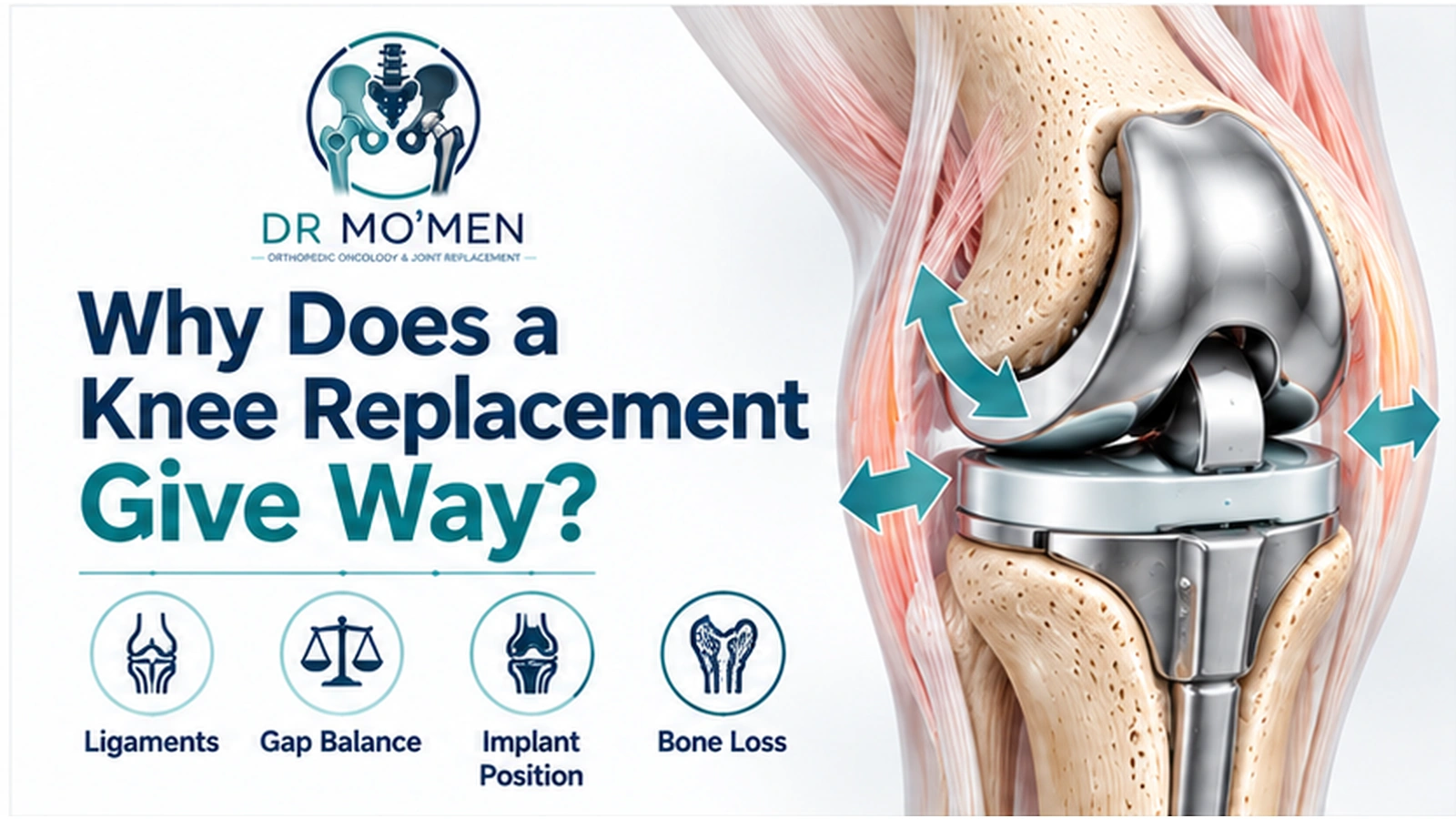
Some patients describe a very specific problem after total knee replacement: “My knee gives way.” The knee may feel unreliable during walking, stairs or rising from a chair. Some patients describe abnormal movement within the prosthetic joint rather than severe pain.
This may represent instability after total knee arthroplasty. Instability, however, is not a single diagnosis. Potential mechanisms include ligament imbalance, flexion-extension gap mismatch, component malposition, polyethylene wear, implant loosening, bone loss and progressive ligament insufficiency.
The first objective is therefore to establish which type of instability exists and why it has developed.
Why Does the Cause of Instability Matter?
| Possible mechanism | What evaluation looks for | Possible treatment direction |
|---|---|---|
| Muscle weakness or functional control problem | Strength, gait and absence of structural laxity | Targeted rehabilitation when appropriate |
| Flexion/extension gap or ligament imbalance | Pattern of laxity through the range of motion | Correct the imbalance; revision may be required when structural |
| Component malposition | Alignment, rotation and joint-line relationship | Correct clinically relevant malposition rather than masking it with constraint |
| Wear, loosening or bone loss | Fixation, osteolysis and structural support | Revision reconstruction when the mechanical problem is significant |
| Possible infection | History, examination and PJI investigations when indicated | Investigate infection before treating the knee as purely mechanical instability |
What Is Instability After TKA?
A stable knee replacement depends on coordinated interaction between prosthetic geometry, collateral ligaments, muscle control, alignment, component position and balanced flexion and extension spaces.
When abnormal laxity occurs during part of the range of motion, the patient can experience functional instability. Instability is an important cause of revision TKA, and contemporary evidence emphasizes accurate classification and correction of the underlying mechanism rather than simply increasing implant constraint.
Symptoms of an Unstable Knee Replacement
Patients may report:
- Giving way.
- Lack of confidence in the knee.
- Difficulty descending stairs.
- Recurrent swelling or effusions.
- Shifting during flexion.
- Difficulty rising from a chair.
- Weakness.
- Instability on uneven ground.
Flexion instability may produce recurrent effusions, difficulty particularly when descending stairs and subjective instability during flexed-knee activities.
Does Giving Way Always Mean Prosthetic Instability?
No. Similar symptoms can occur with quadriceps weakness, neurological problems, pain-related inhibition, hip or spinal pathology, recent injury or patellofemoral problems. Clinical assessment is therefore required before labeling the problem prosthetic instability.
Types of Knee Replacement Instability
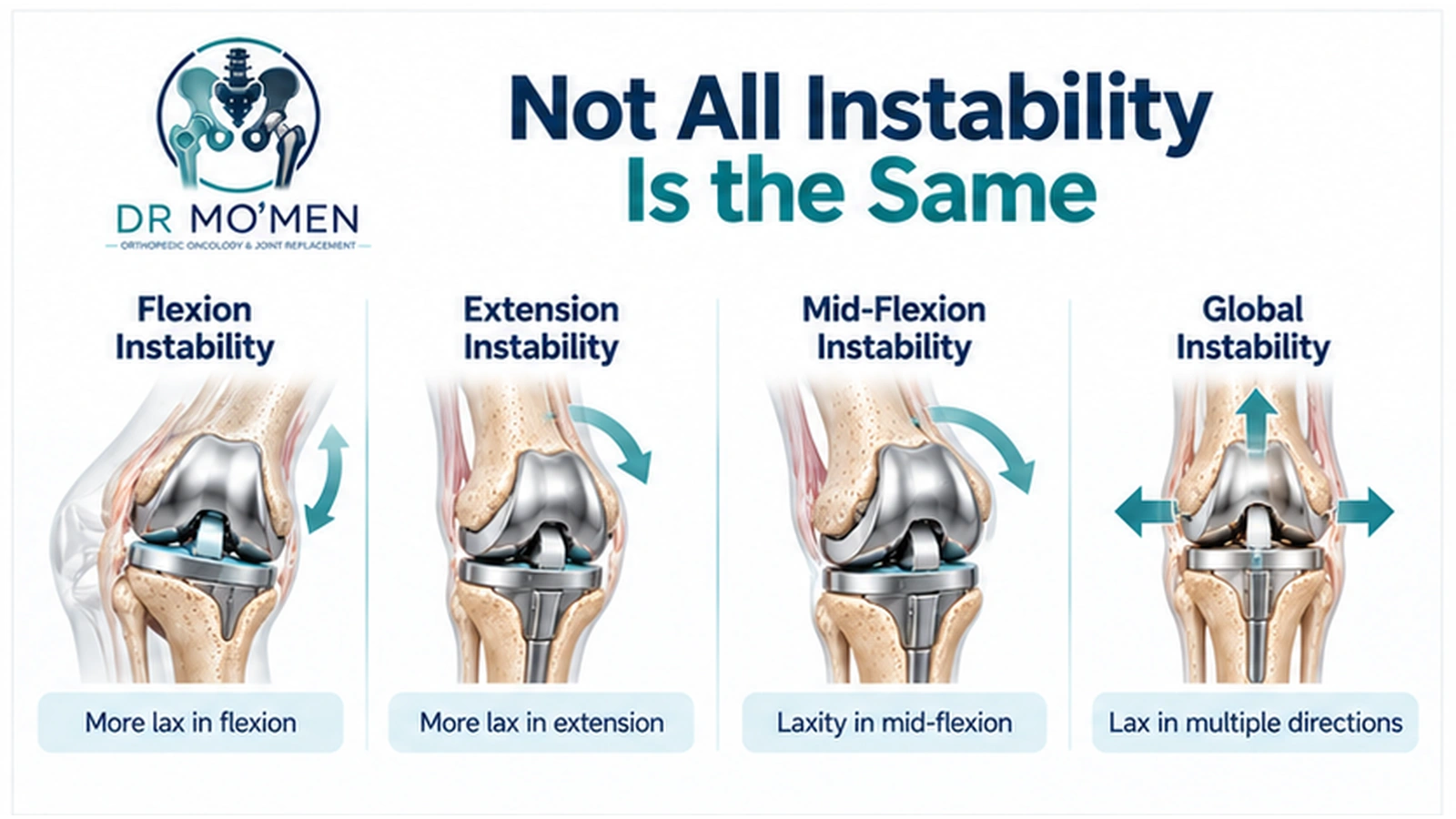
Flexion Instability
This occurs when the knee is excessively loose in flexion relative to extension. Possible causes include flexion-extension gap imbalance and problems with component size, position or geometry.
Extension Instability
Excessive laxity occurs nearer full extension. It may relate to ligament insufficiency, excessive releases or gap imbalance.
Mid-Flexion Instability
Abnormal laxity is most evident through the middle portion of knee flexion. Diagnosis can be challenging and requires examination through several degrees of flexion.
Global Instability
The knee is unstable in several directions or through multiple portions of its range. This may occur with substantial ligament insufficiency, major bone loss or previous complex revision surgery.
Recurvatum
The knee extends excessively beyond the expected position and may be associated with neuromuscular or ligament-related problems.
Why Does Instability Develop?
Ligament imbalance
Collateral ligament insufficiency or unequal soft-tissue tension can produce coronal instability.
Flexion-extension gap imbalance
An excessively large flexion gap can produce flexion instability, while other mismatches can create different patterns of laxity.
Component malposition
Malalignment or malrotation may alter ligament tension throughout the range of motion and can also affect patellar tracking.
Joint-line alteration
Changes in the joint line may alter knee mechanics and ligament function.
Polyethylene wear
Progressive wear can contribute to increasing laxity. A thicker insert should not be considered a universal solution before the cause is identified.
Implant loosening
Component migration can alter alignment and gap balance.
Ligament injury or insufficiency
Trauma, progressive attenuation or previous surgery may reduce collateral ligament function and influence the constraint required during revision.
Bone loss
Osteolysis or structural bone loss may compromise fixation, alter the joint line and contribute to instability.
Patellar Instability Is Different
Patellar maltracking, subluxation or dislocation is primarily a patellofemoral problem. Causes may include component rotation, soft-tissue imbalance, altered joint-line mechanics or extensor mechanism abnormalities.
CT may be useful in selected cases when component rotation is suspected.
How Is Knee Replacement Instability Diagnosed?
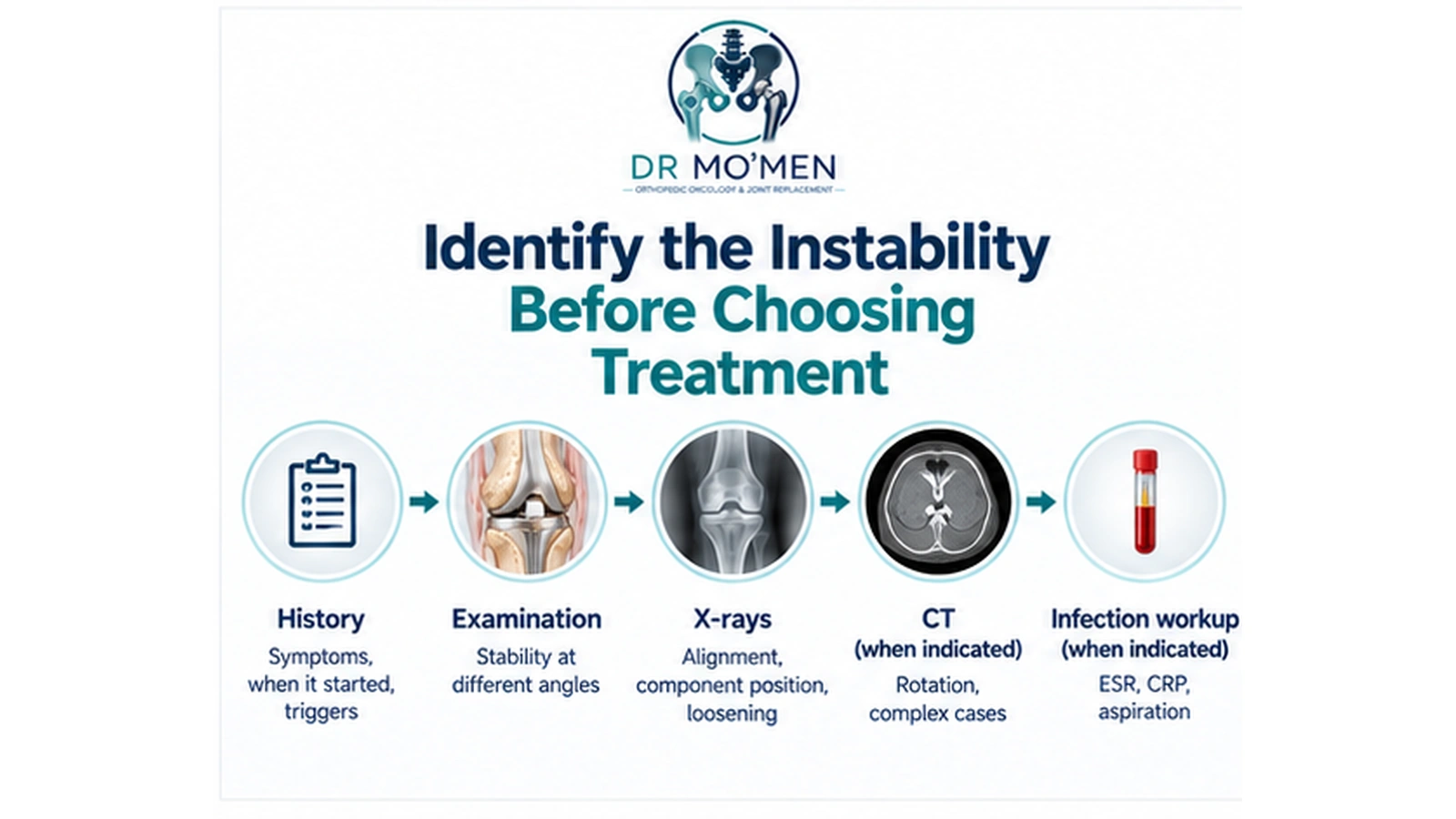
History
The surgeon determines when instability started, which activities provoke it, whether symptoms occur in flexion or extension, whether trauma occurred, whether the knee initially functioned well, whether swelling is recurrent and whether previous revision surgery was performed.
Clinical examination
The knee should be assessed at multiple flexion angles rather than only in full extension. The examination may include:
- Varus-valgus stability.
- Anterior-posterior laxity.
- Flexion stability.
- Mid-flexion stability.
- Quadriceps function.
- Extensor mechanism.
- Patellar tracking.
- Gait.
Radiographs
Imaging may assess component alignment, fixation, joint line, osteolysis, bone loss and fracture. Old radiographs can be valuable for comparison.
Stress radiographs
Stress views can be useful in selected cases to document coronal laxity.
CT
CT may be selected to evaluate component rotation, complex component position, bone loss or patellofemoral maltracking.
Infection investigation
When infection remains a possibility, appropriate testing may include ESR, CRP and aspiration according to the clinical picture.
Can Physiotherapy Treat Instability?
Strengthening and neuromuscular rehabilitation may help selected patients, particularly when muscle weakness contributes to symptoms. A brace may also provide temporary support.
However, rehabilitation cannot correct major ligament deficiency, implant malposition, gap imbalance or mechanical loosening.
Can the Polyethylene Insert Alone Be Changed?
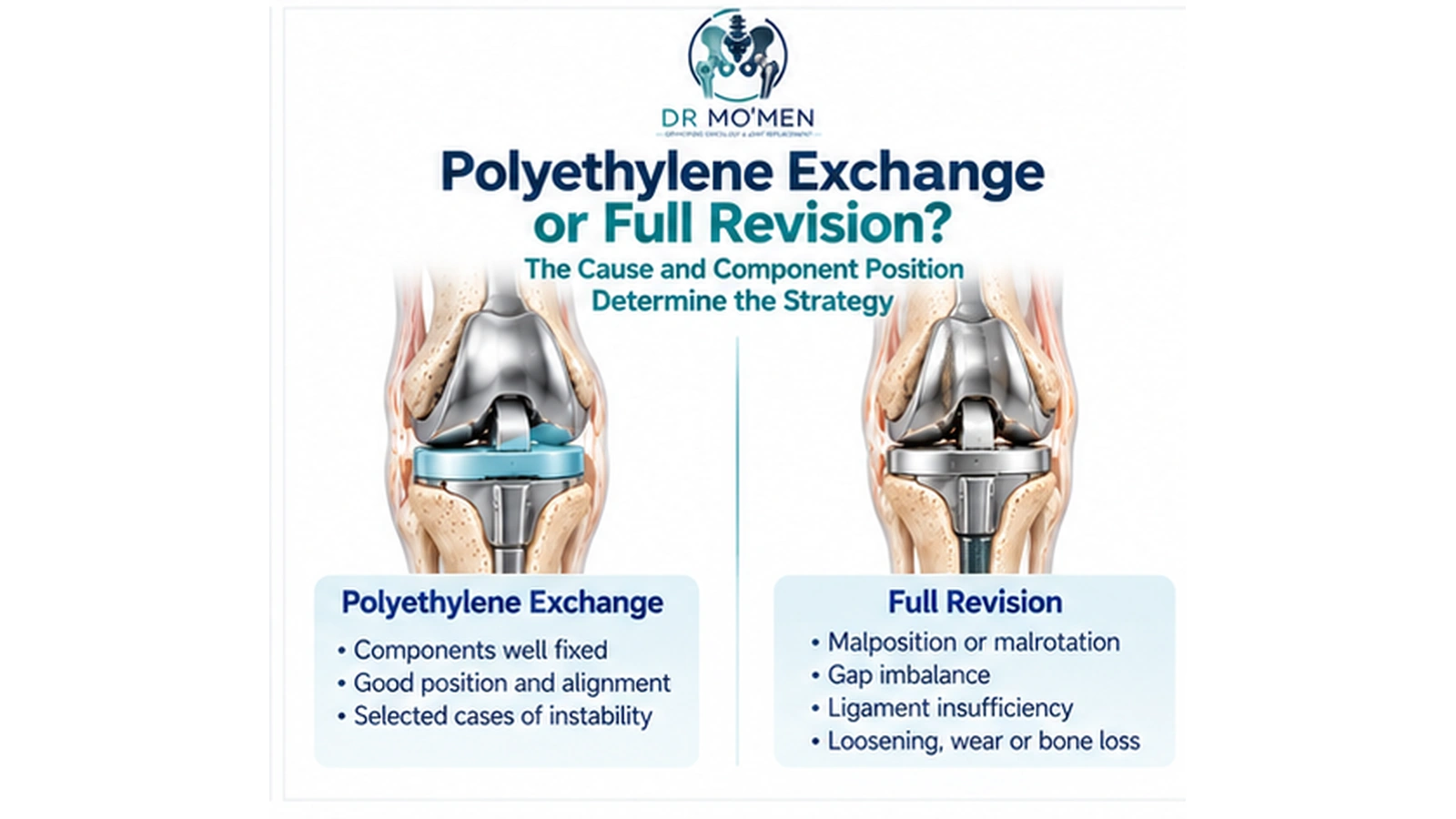
Sometimes, but selection is critical.
Isolated polyethylene exchange can preserve otherwise satisfactory components. It may be considered when components are well fixed, alignment and rotation are appropriate, and instability can genuinely be corrected by insert modification.
A thicker insert should therefore not be treated as a universal solution to an unstable TKA. Recurrent instability and subsequent revision can occur when the underlying mechanism is not adequately corrected.
When Is Revision Knee Replacement Needed?
Related guide: When Is Revision Knee Replacement Necessary?
Revision becomes more appropriate when instability is functionally significant and linked to a correctable mechanical problem such as:
- Major gap imbalance.
- Ligament insufficiency.
- Component malposition.
- Loosening.
- Wear and osteolysis.
- Substantial bone loss.
- Failure of appropriate previous treatment.
- Recurrent instability after previous revision.
The goal is not simply to insert a more constrained prosthesis. Revision aims to restore alignment, joint line, component position, flexion gap, extension gap, ligament balance and secure fixation.
What May Be Changed During Revision for Instability?
Revision may involve the femoral component, tibial component, polyethylene insert, joint-line restoration, posterior condylar offset, tibial slope or component rotation.
Stems, augments, cones or sleeves may be required when fixation or bone loss needs to be addressed. Implant constraint is then selected according to the reconstructed knee's remaining ligament support.
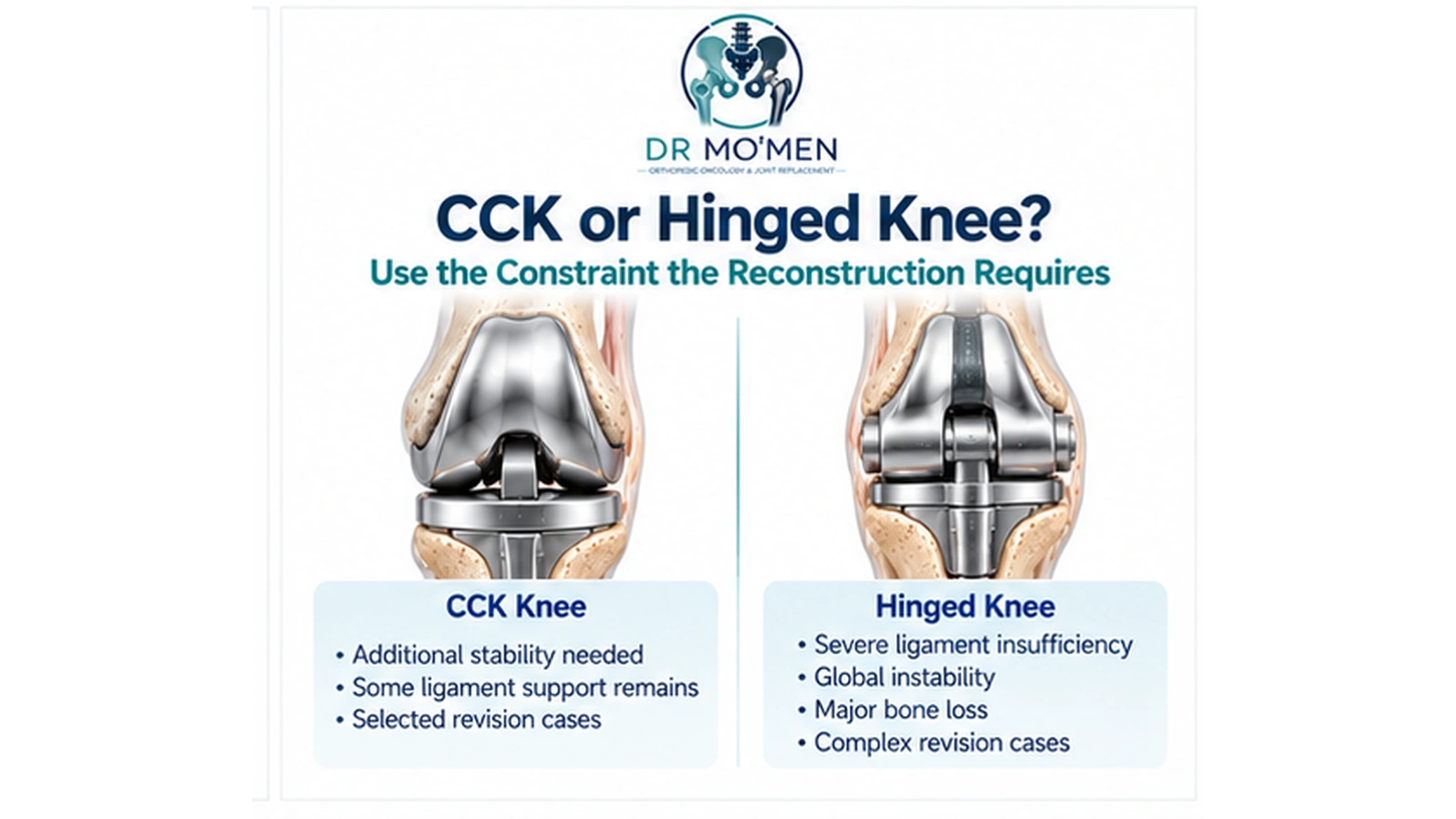
CCK or Hinged Knee?
Related guide: CCK vs Hinged Knee in Revision Knee Replacement
Constraint should be selected after the knee has been reconstructed and its ligament support assessed.
A CCK may be appropriate when additional coronal stability is required but useful soft-tissue support remains.
A rotating hinge may be required for selected knees with profound ligament insufficiency, global instability, severe bone loss or particularly complex revision reconstruction.
The most constrained implant is not automatically the best implant. The goal is to use the level of constraint the reconstruction actually requires.
Outcomes and Risks
Revision for instability can improve stability and function when the mechanism is correctly identified and corrected. However, revision remains complex surgery and should not be presented as a guaranteed solution.
Potential complications include:
- Infection.
- Recurrent instability.
- Stiffness.
- Fracture.
- Wound problems.
- Thrombosis.
- Neurovascular injury.
- Further bone loss.
- Later loosening.
- Additional revision surgery.
When Should You Seek Specialist Assessment?
Assessment is appropriate when a replaced knee repeatedly gives way, feels unstable on stairs, shifts during flexion, develops recurrent swelling, suddenly becomes unstable after trauma, deteriorates after years of good function, requires constant bracing or has already undergone a previous revision.
When Is Assessment Urgent?
Urgent assessment is appropriate with sudden deformity, inability to bear weight, severe pain after trauma, fever with swelling or wound drainage.
Dr. Mo’men's Role in Complex Knee Instability
Complex revision planning should begin with “Why is the knee unstable?” rather than “Which constrained implant should be used?”
Assessment may include:
- Reviewing old and current radiographs.
- Evaluating component alignment and rotation.
- Testing stability at multiple flexion angles.
- Assessing collateral ligament function.
- Identifying flexion, extension or global instability.
- Assessing bone loss.
- Excluding infection when clinically indicated.
- Determining whether components can safely be retained.
- Planning revision when necessary.
- Selecting the minimum constraint required to create a stable reconstruction.
International patients may send available imaging, operative reports and investigations for an initial orthopedic second opinion before travel.
Selected medical references
- Stroobant L, et al. Instability after total knee arthroplasty: A systematic review and meta-analysis of treatment options and outcomes. Knee Surg Sports Traumatol Arthrosc. 2025;33(11):3817-3839. PMID 40938882. PubMed
- Stambough JB, et al. Flexion Instability After Total Knee Arthroplasty. J Am Acad Orthop Surg. 2019;27(17):642-651. PMID 30676514. PubMed
- Labouyrie A, et al. Rate of complications and short-term Functional Results of Revision Total Knee Arthroplasty for Tibio-femoral Instability. Orthop Traumatol Surg Res. 2024. PMID 39241908. PubMed