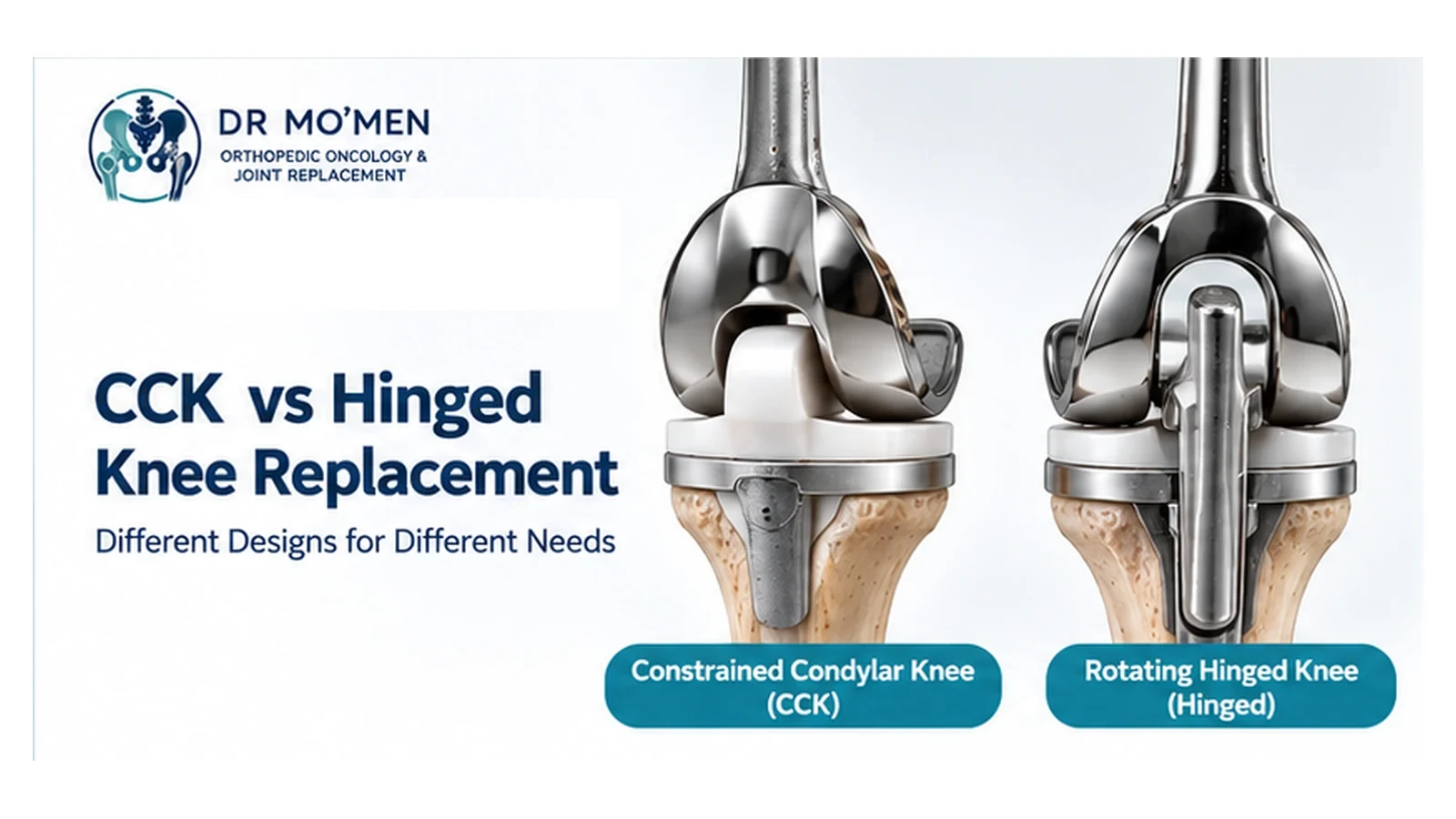
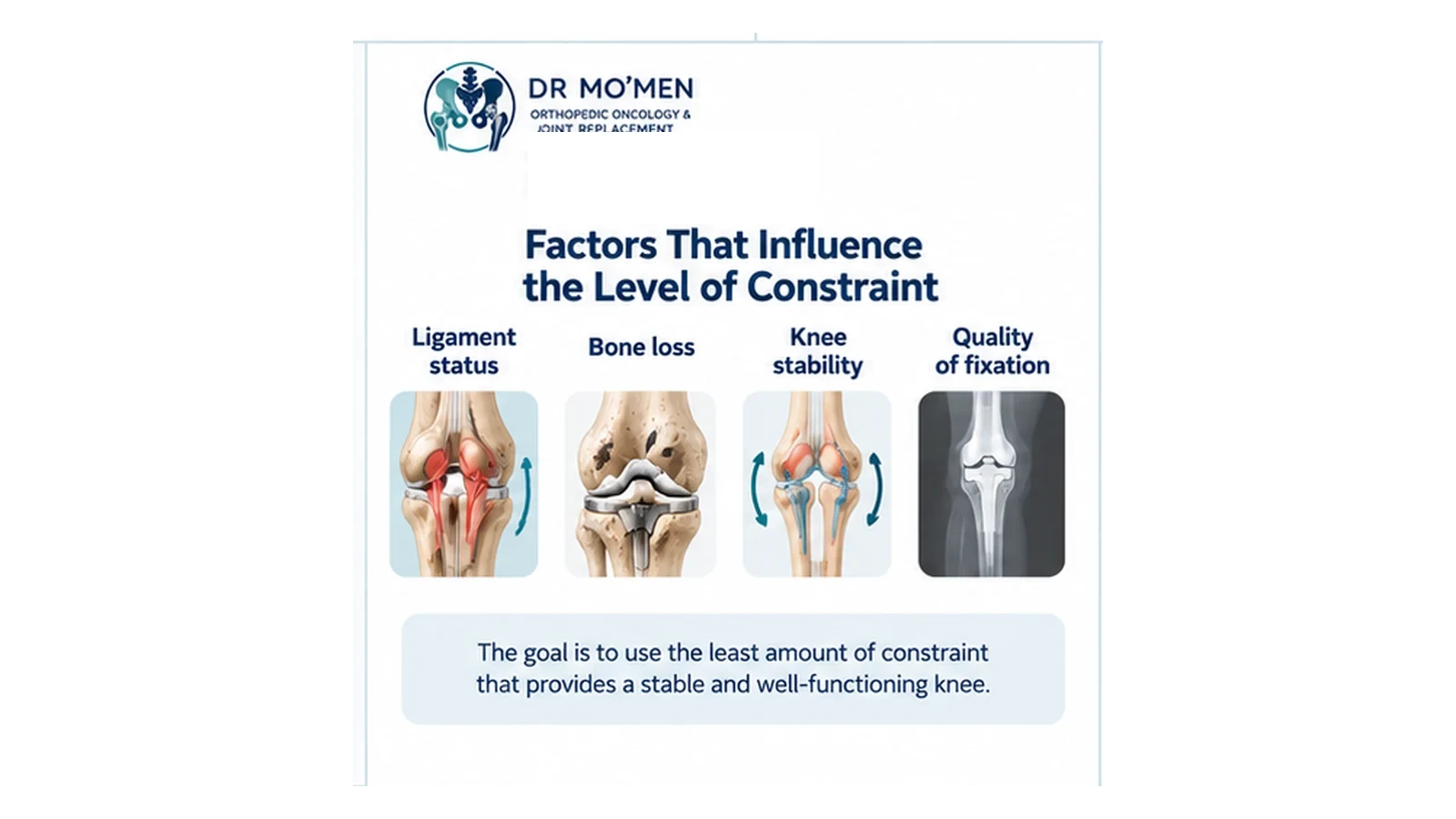
Not every total knee replacement requires the same level of implant constraint. Most primary TKAs can be stabilized without a highly constrained prosthesis, but complex cases - particularly revision total knee arthroplasty (rTKA) - may involve ligament insufficiency, major bone loss or severe instability that makes a conventional implant inadequate.
Two important options are the Constrained Condylar Knee (CCK) and the Rotating Hinged Knee (RHK). The goal is not to use the “strongest” implant available, but to use the least amount of constraint that reliably produces a stable, balanced knee, because increasing constraint also increases stresses at the implant-bone interface. [1]
What Does Constraint Mean in Knee Replacement?
A stable knee depends on the joint geometry, collateral ligaments, capsule, muscles and soft-tissue balance. A prosthesis can provide additional mechanical stability when these structures are insufficient.
Constraint describes how much the implant itself limits abnormal movement between the femur and tibia. Greater ligament deficiency generally requires greater implant constraint.
What Is a CCK?
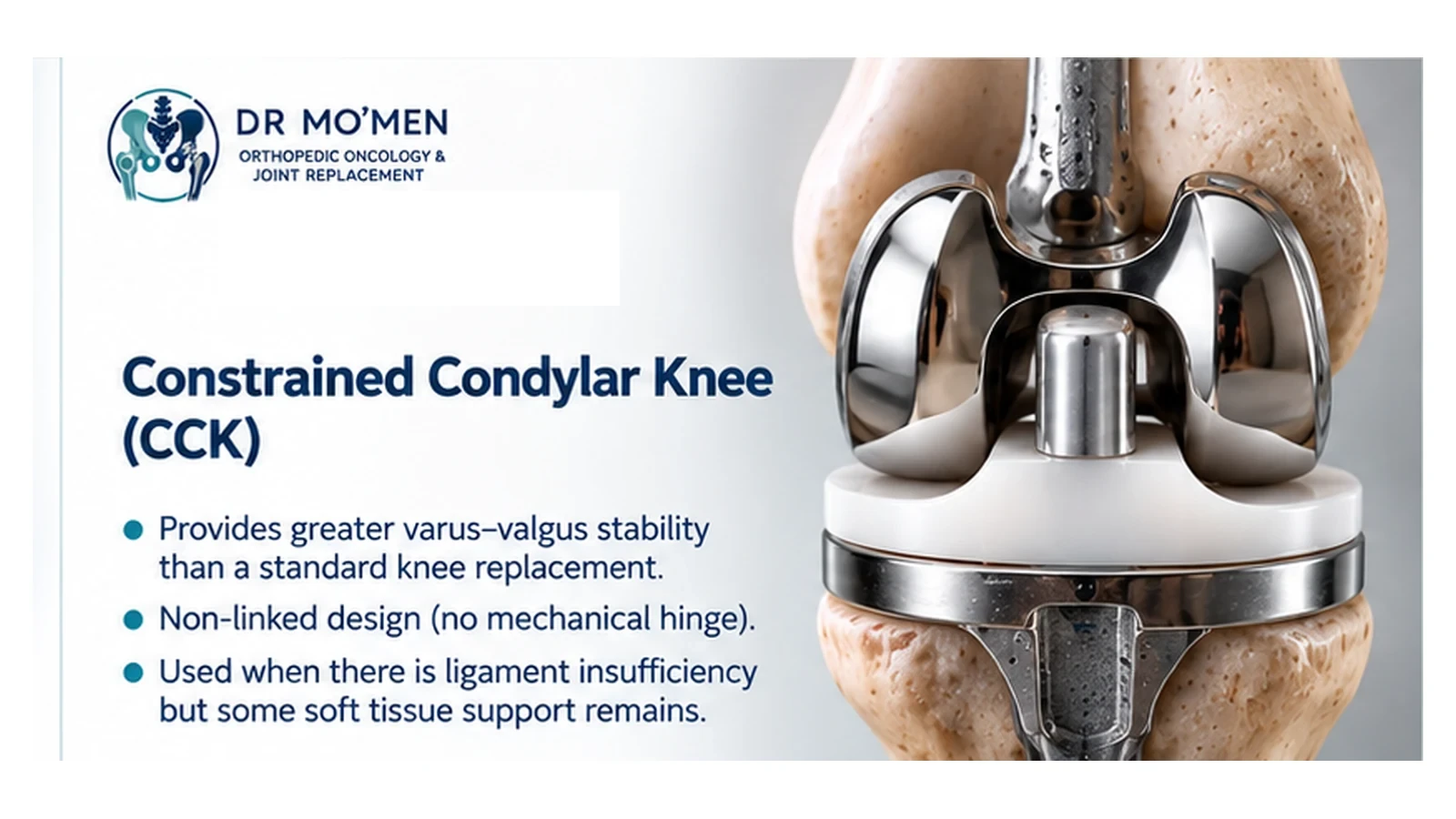
CCK means Constrained Condylar Knee. These designs provide greater resistance to varus-valgus and rotational instability than standard knee-replacement designs, but the femoral and tibial components are not mechanically linked together like a true hinge. [1]
A 2025 minimum 10-year follow-up study of 345 revision TKAs using CCK implants reported favorable long-term survivorship with appropriate patient selection and surgical technique. [2]
What Is a Rotating Hinged Knee?
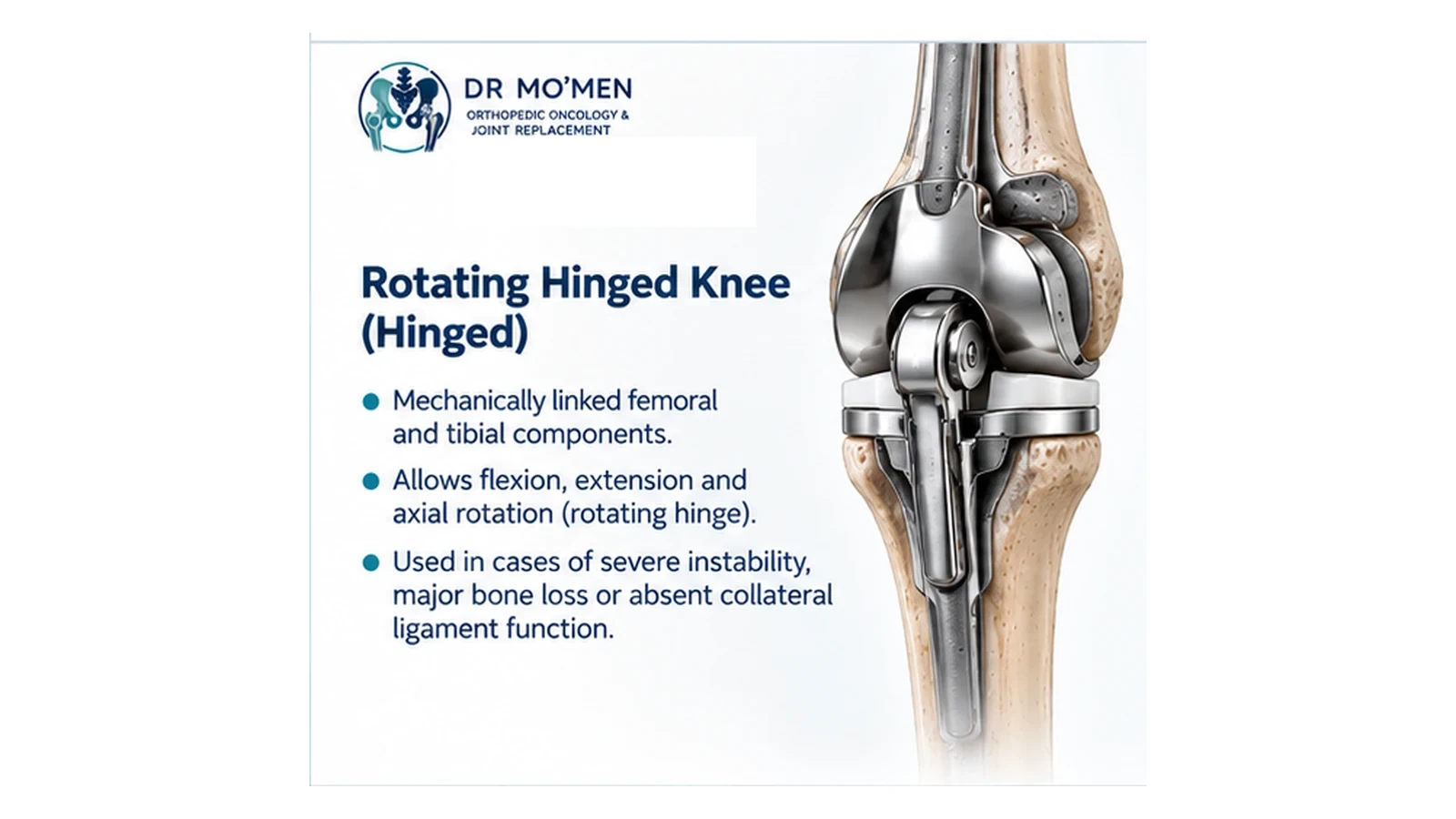
A hinged knee mechanically links the femoral and tibial components to provide a high level of stability. Modern rotating-hinge designs allow axial rotation in addition to flexion and extension, representing an important evolution from older fixed-hinge designs. [3]
A rotating hinge is generally considered when a less constrained implant cannot provide reliable stability, for example with major collateral-ligament failure or severe bone and soft-tissue deficiency.
CCK vs Rotating Hinge: The Core Difference
| CCK | Rotating Hinged Knee |
|---|---|
| High constraint | Higher constraint |
| Nonlinked construct | Mechanically linked femoral and tibial components |
| Requires adequate residual soft-tissue support | Can address severe/global ligament insufficiency |
| Useful in many complex revision TKAs | Used for more severe instability and reconstructive deficits |
| Preserves a lower level of constraint when sufficient | Provides stability when a CCK is inadequate |
This is an educational comparison, not an automatic implant-selection rule. Final selection depends on examination, imaging, ligament competence, bone loss, fixation and intraoperative findings.
How Much Constraint Is Actually Needed?
| Reconstructive situation | What matters most | Possible constraint direction |
|---|---|---|
| Ligaments function adequately after reconstruction | Stable balanced knee with secure fixation | A less constrained construct may be sufficient |
| Partial collateral insufficiency but useful soft-tissue support remains | Whether a nonlinked constrained implant can provide reliable stability | CCK may be considered |
| Severe or global ligament insufficiency / gross instability | Whether stability can be achieved without a linked construct | Rotating hinge may be considered |
| Major bone loss | Fixation, metaphyseal support and ligament attachments | Bone loss alone does not automatically determine CCK versus hinge |
| Infection, fracture or previous revision | The underlying failure mechanism plus bone and soft-tissue reconstruction | Constraint is selected after the cause and reconstruction needs are defined |
When Is a CCK Used?
A CCK may be considered when more stability is required than a conventional implant can provide, but a fully linked hinge is not necessary. Examples include:
- collateral-ligament attenuation or insufficiency;
- instability after a previous knee replacement;
- selected bone-loss patterns that compromise ligament balance;
- selected complex primary TKAs with severe deformity or difficult soft-tissue balancing.
Related primary reconstruction guide: knee replacement for severe bow legs or knock knees.
Before increasing constraint, the cause of instability must be identified. Component malposition, rotational error, flexion-extension gap imbalance, polyethylene or implant problems and bone loss may all contribute. A constrained implant cannot compensate for a mechanical problem that has not been corrected.
When May a CCK Be Insufficient?
If there is severe or global ligament failure, or instability cannot be controlled using a nonlinked construct, a rotating hinge may be required. [1][3]
When Is a Rotating Hinge Considered?
Selected indications may include:
- severe or complete collateral-ligament insufficiency;
- gross or global instability;
- major bone loss involving ligament attachment sites;
- multiply revised knees with progressive bone and soft-tissue compromise;
- selected infection-related revisions when adequate stability cannot be reconstructed after debridement;
- selected periprosthetic fractures with major bone loss or loose components;
- major tumor resections where a megaprosthetic reconstruction relies on a hinge mechanism.
Infection or fracture alone does not automatically mean that a hinge is required.
If revision is being considered because of infection, read: Infected Knee Replacement Treatment
Is a Hinged Knee Better Because It Is More Stable?
No. More constraint is not automatically better. As constraint increases, loads transferred to the implant, stems, metaphyseal fixation and host bone also increase. Revision surgeons therefore aim to use the least constraint needed to achieve reliable stability. [1]
A 2023 systematic review and meta-analysis found broadly similar survivorship and clinical outcomes between CCK and rotating-hinge implants when both designs were technically suitable and indicated for the case. [4]
How Does Bone Loss Affect the Decision?
Revision TKA may involve defects in the distal femur, proximal tibia or both. Bone loss can compromise implant fixation and may also affect the attachment sites of the collateral ligaments.
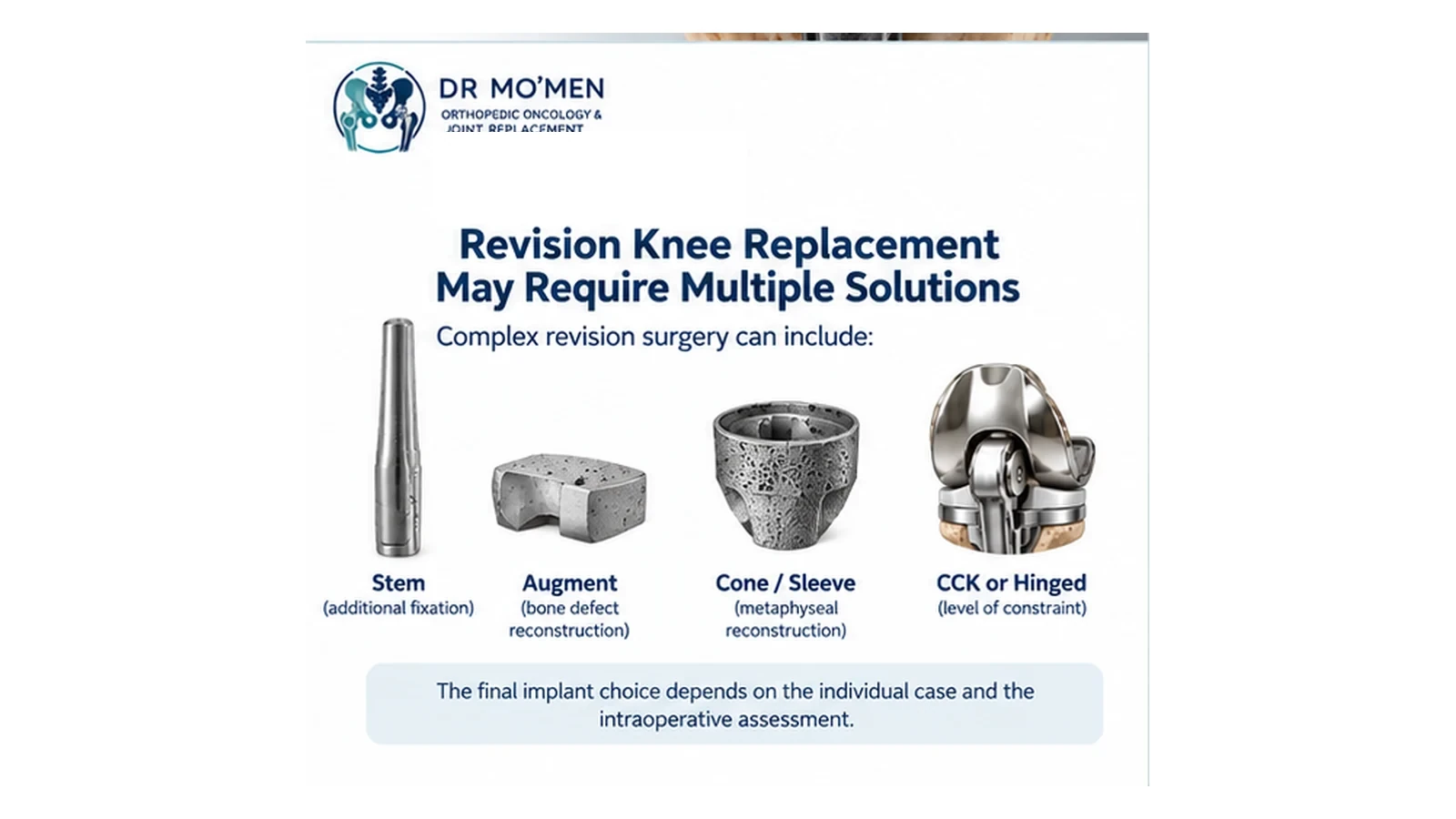
Reconstruction may require stems, augments, metaphyseal cones or sleeves. These technologies address bone loss and fixation, while CCK versus hinge primarily addresses mechanical stability and constraint. A systematic review and meta-analysis supports porous metaphyseal implants as effective options for selected moderate-to-large revision bone defects. [5]
What Are Stems, Augments, Cones and Sleeves?
Stem
An extension of the femoral or tibial component into the intramedullary canal to improve load transfer and fixation.
Augment
A metal block or wedge used to replace a defined area of missing bone and help restore the reconstruction.
Metaphyseal Cone or Sleeve
A porous metal construct used to obtain metaphyseal support in selected bone defects.
These are not alternatives to CCK or hinge. Complex revisions may require both bone reconstruction and an appropriate level of implant constraint.
How Does the Surgeon Choose Between CCK and Hinge?
A single X-ray is rarely enough. Preoperative assessment may include:
- why the previous knee replacement failed;
- whether infection is possible;
- implant loosening or malposition;
- the amount and location of bone loss;
- collateral-ligament competence;
- fracture assessment;
- extensor-mechanism and soft-tissue status.
Depending on the case, evaluation may include standing radiographs, full-length alignment imaging, CT for component rotation or bone detail, inflammatory markers and joint aspiration when infection is suspected.
The Final Implant Choice May Change During Surgery
Even with careful preoperative planning, the final level of constraint may only become clear after the old components are removed, remaining bone stock is assessed, defects are reconstructed, flexion and extension gaps are balanced, and ligament stability is tested.
Complex revision surgery should therefore be planned with appropriate implant and reconstruction options available if the intraoperative findings differ from the preoperative plan.
Does Using a CCK Mean the Revision Is Simple?
No. The implant label does not define the complexity of the operation. Revision TKA may require removal of previous components and cement, management of bone loss, stems, augments, cones or sleeves, restoration of joint line and alignment, treatment of instability, and multiple tissue samples when infection is a concern.
What Are the Risks of CCK and Hinged Revision Knee Surgery?
Risks depend heavily on the underlying problem and the patient’s health. Potential complications include infection, blood clots, wound problems, stiffness, persistent pain, recurrent instability, periprosthetic fracture, loosening, uncommon neurovascular injury and the need for further surgery. Revision TKA is generally more complex than uncomplicated primary TKA.
What Does LCCK Mean?
LCCK is a name/abbreviation used for some constrained condylar knee systems. Having an LCCK implant does not itself mean that the knee has failed. A separate LCCK revision-after-infection example is available in the Case Library. The relevant questions are why extra constraint was needed, whether the implant is stable and well fixed, whether infection is present, and whether component position and alignment are appropriate.
What If a CCK or Hinged Knee Is Painful?
A painful revision knee needs a structured assessment. Possible causes include infection, loosening, instability, fracture, patellofemoral or extensor-mechanism problems, stiffness, malalignment and causes outside the implant itself.
Simply increasing constraint again is not an automatic treatment for unexplained pain. The cause should be established first.
When Should You Seek Specialist Review?
A revision-knee assessment is particularly appropriate for persistent pain, recurrent swelling, giving-way or instability, progressive walking difficulty, new deformity, suspected infection, radiographic loosening, a periprosthetic fracture, multiple previous knee operations, or when a CCK or hinged revision has been proposed and a second opinion is desired.
Role of Dr. Mo’men in Complex Revision Knee Cases
The key question is not simply “Which implant should be inserted?” It is “Why did the previous knee fail, how much bone and ligament function remain, and what is the least amount of constraint that can create a stable reconstruction?”
Assessment may include review of previous and current X-rays, operative reports and implant information, alignment and instability, bone-loss assessment, infection work-up and planning for stems, augments, cones or sleeves where required.
For appointments or imaging review: 01021690693
Patients who already have a knee replacement should bring previous X-rays, operative reports and implant information when available. For patients outside Egypt, existing imaging and reports can be reviewed through the second-opinion pathway before arranging travel.
For more patient education on joint reconstruction, visit the Joint Replacement hub. Patients planning treatment from abroad can also review the International Patients pathway.
For the surgical decision and reconstruction options, read: When Is Revision Knee Replacement Necessary?
Stiffness alone does not determine implant constraint; see: When stiffness needs MUA, arthrolysis or revision
Medical References
- Crawford DA, Lombardi AV Jr. Ligament Balancing and Constraint in Revision Total Knee Arthroplasty. J Knee Surg. 2021;34(13):1382-1387. PMID: 34507365. PubMed 1
- Greenberg A, Braunstein D, Abughaduma NR, et al. Survivorship and Complications in Revision Total Knee Arthroplasty With a Constrained Condylar Knee Implant: A Minimum 10-Year Follow-Up Study. J Arthroplasty. 2025;40(12):3240-3245. PMID: 40447233. PubMed 2
- Wignadasan W, Kirschbaum SM, Perka C, et al. Contemporary insights into hinged knee arthroplasties: biomechanics, indications, and outcomes in complex primary and revision total knee arthroplasty. Bone Joint J. 2025;107-B(12):1254-1262. PMID: 41319698. PubMed 3
- Stroobant L, de Taeye T, Byttebier P, et al. Condylar constrained and rotating hinged implants in revision knee arthroplasty show similar survivorship and clinical outcome: a systematic review and meta-analysis. Knee Surg Sports Traumatol Arthrosc. 2023;31(12):5365-5380. PMID: 37747534. PubMed 4
- Byttebier P, Dhont T, Pintelon S, et al. Comparison of Different Strategies in Revision Arthroplasty of the Knee with Severe Bone Loss: A Systematic Review and Meta-Analysis of Clinical Outcomes. J Arthroplasty. 2022;37(6S):S371-S381.e4. PMID: 35271982. PubMed 5
This article is for patient education and does not replace clinical examination or review of appropriate imaging and investigations.