The diagnostic evaluation must distinguish implant-related failure from muscle weakness, neuropathic or referred pain, and problems that may respond to treatment without extensive revision.
Revision knee replacement—or revision total knee arthroplasty—is surgery performed to replace or reconstruct part or all of a previous knee replacement.
What Is Revision Knee Replacement?
During primary total knee replacement, damaged knee joint surfaces are replaced with prosthetic components. During revision surgery, the surgeon may need to:
- replace one component;
- replace several components;
- remove and reconstruct the entire knee replacement;
- address bone loss;
- use longer stems;
- use augments, cones or sleeves;
- increase implant constraint when ligament support is inadequate.
Revision TKA is therefore not one standardized operation. The reconstruction must be designed around the cause of failure, remaining bone stock, ligament function and condition of the surrounding soft tissues.
Why Do Knee Replacements Need Revision?
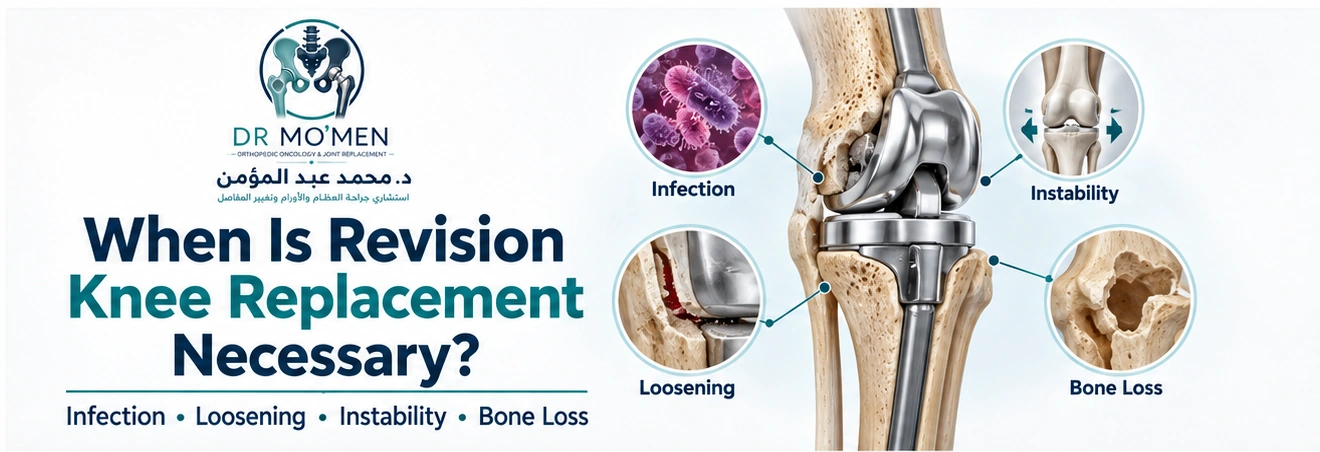
Periprosthetic joint infection, aseptic loosening and instability remain major causes of revision TKA. The pattern of failure may differ between earlier and later postoperative periods.[1][2]
1. Periprosthetic Joint Infection
Infection around a knee replacement is one of the most important diagnoses to exclude when evaluating an unexplained painful prosthetic knee.
Possible symptoms include increasing or persistent pain, swelling or warmth, redness, wound drainage, fever in some patients, or sudden deterioration in knee function.
A chronic low-grade infection may occur without fever or obvious drainage. Assessment may therefore require clinical examination, radiographs, inflammatory markers and joint aspiration with appropriate laboratory testing and cultures.[3]
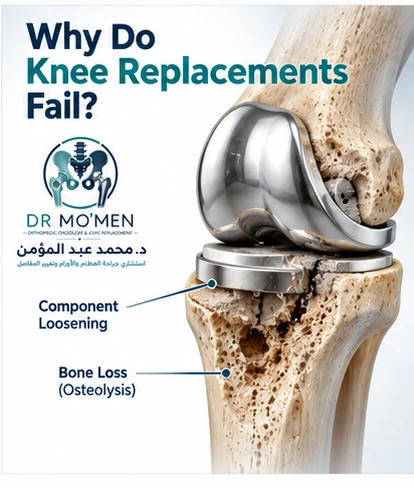
2. Aseptic Loosening
A prosthetic component can gradually lose fixation to the surrounding bone without infection. Patients may experience weight-bearing pain, progressive pain after a period of satisfactory function, reduced walking tolerance or discomfort when initiating movement.
Radiographs may show changes around the implant, but infection should be appropriately excluded before labeling the problem as aseptic loosening.
3. Knee Replacement Instability
Some patients describe that the knee gives way while walking, feels unstable on stairs, shifts abnormally or requires increased support from a railing or walking aid.
Instability may be related to ligament insufficiency, soft-tissue imbalance, implant position or progressive changes around the prosthesis. Clinically important instability that limits function can be an indication for revision.
4. Stiffness After Knee Replacement
Not every stiff knee requires revision. Management depends on how long stiffness has been present, available range of motion, when the stiffness developed, component position, presence of instability and presence or absence of infection.
Selected patients may be treated with physiotherapy, manipulation under anesthesia or arthrolysis. Revision may be considered when there is a correctable mechanical cause or when appropriate less invasive treatment has failed.
5. Periprosthetic Fracture
A fracture may occur around the femoral or tibial side of a knee replacement. Treatment depends on fracture location and pattern, quality of the remaining bone, whether the prosthesis is still securely fixed, amount of bone loss and the patient’s overall condition.
Some fractures can be treated with fixation, whereas others require revision reconstruction.
6. Component Malposition or Malalignment
Incorrect position or rotation of prosthetic components may contribute to pain, reduced motion, instability, patellar tracking problems or abnormal loading.
Revision should not be based on a minor radiographic abnormality alone. The imaging findings need to correspond with the patient’s symptoms and clinical examination.
7. Wear, Osteolysis or Mechanical Failure
Later problems may include polyethylene wear, osteolysis, mechanical failure of a prosthetic component, patellar problems or extensor mechanism problems.
The surgeon determines whether a limited component revision is appropriate or whether more extensive reconstruction is required.
The Failure Mechanism Determines the Revision Plan
Clinical principle: Revision is not one standardized operation: infection, loosening, instability, stiffness, fracture and malposition require different strategies for component retention or removal, fixation, bone loss, soft tissues and implant constraint.
| Failure mechanism | Main reconstructive question | Possible revision direction |
|---|---|---|
| Infection | Can infection be controlled while retaining implants, or is exchange required? | DAIR or one-/two-stage exchange in selected cases according to the full PJI picture |
| Aseptic loosening / osteolysis | Which components are loose and how much bone support remains? | Revise loose components and rebuild fixation/bone defects as needed |
| Instability | Is the cause ligament imbalance, component position, wear or global soft-tissue deficiency? | Correct the cause and use only the level of constraint required for stability |
| Stiffness | Is scar tissue the main issue, or is there a structural cause? | MUA/arthrolysis in selected situations or revision when a correctable mechanical problem exists |
| Periprosthetic fracture | Is the prosthesis stable and can the fracture be reconstructed? | Fixation, revision components or distal femoral reconstruction depending on stability and bone stock |
| Malposition / malalignment | Does component position explain the patient’s symptoms and mechanics? | Revise the clinically relevant malposition rather than revising a well-functioning component without a defined reason |
Is Pain Alone Enough Reason for Revision?
No. Unexplained pain after knee replacement requires a structured diagnostic workup. Performing revision surgery without identifying the true cause of failure may not solve the original problem.
The evaluation may therefore investigate:
- infection;
- loosening;
- instability;
- component position;
- fracture;
- stiffness;
- patellofemoral or extensor mechanism problems;
- non-knee sources of pain when clinically appropriate.
For a symptom-first diagnostic guide before revision is considered, read: Pain After Knee Replacement: Causes and Diagnostic Work-up
Can Nerve Pain Cause Pain After Knee Replacement?
Yes. Persistent pain after knee replacement is not always caused by implant loosening, infection, instability, or malposition. Neuropathic pain, local nerve irritation or compression, a postoperative neuroma, lumbar radiculopathy, hip pathology, and other extra-articular sources can sometimes mimic or coexist with pain from the replaced knee.
Features that may raise suspicion of a neuropathic component include burning, electric or shooting pain; marked sensitivity to light touch; numbness or tingling; focal tenderness around a scar; pain radiating below the knee; or weakness that follows a nerve distribution. Common peroneal nerve symptoms may include sensory change over the outer leg or dorsum of the foot and, in more significant cases, weakness of ankle dorsiflexion. Irritation or neuroma involving superficial sensory branches around the knee can produce highly localized tender pain.
The evaluation should therefore include a focused neurological examination when the symptom pattern suggests it, together with assessment of the hip and lumbar spine when referred pain is possible. Additional tests—such as electrodiagnostic studies, targeted imaging, or a diagnostic injection/nerve block—are selective and should answer a specific clinical question rather than being ordered routinely.
Revision surgery should not be performed simply because a knee replacement is painful. If the implant is well fixed and no correctable mechanical or infectious failure has been demonstrated, non-implant causes of pain should be considered before another major reconstruction. For the broader diagnostic approach, see Pain After Knee Replacement: Causes and Diagnostic Work-up.
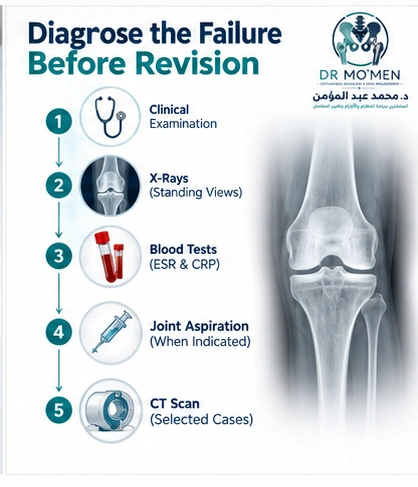
How Is a Painful Knee Replacement Investigated?
Medical History
Important questions include when the original replacement was performed, whether the knee initially improved, whether pain began immediately or years later, whether pain is related to weight bearing, whether there is swelling or instability, any history of wound drainage or infection, and the number of previous operations.
Clinical Examination
The examination may assess range of motion, ligament stability, site of tenderness, wound condition, swelling or effusion, patellar tracking, extensor mechanism, muscle strength, gait and overall limb alignment.
Plain Radiographs
High-quality radiographs are essential to assess component position, signs of loosening, alignment, fractures, osteolysis and bone loss. Additional imaging may be required depending on the suspected problem.
Blood Tests
When infection is suspected, tests may include inflammatory markers such as ESR and CRP. These results should not normally be interpreted in isolation.
Joint Aspiration
When periprosthetic joint infection is a concern, aspiration may be required to obtain synovial fluid for cell analysis, culture and other appropriate investigations. The timing of antibiotic treatment and specimen collection should be clinically coordinated.
CT Scan
CT may be useful selectively for assessing component rotation, characterizing bone loss, evaluating some fractures and surgical planning. It is not required for every painful knee replacement.
Does Revision Always Mean Replacing the Entire Knee?
No. A surgeon may sometimes revise only one part of a well-fixed knee replacement. In other cases, complete component removal is necessary. The decision depends on the reason for failure, fixation of existing components, infection status, bone quality, ligament integrity and position of the existing prosthesis.
What does recent evidence show? Two 2026 systematic reviews of isolated-component versus full-component revision for aseptic loosening reached different pooled conclusions. A Journal of Arthroplasty review found no statistically significant difference in rerevision rates and generally shorter operating time with isolated revision, while a JBJS Reviews meta-analysis reported higher all-cause failure following isolated-component revision. Because the underlying evidence is predominantly observational and affected by patient selection, neither result proves which procedure is best for an individual patient. Retaining a component should be considered only when it is genuinely well fixed, appropriately aligned and compatible, and when the indication and remaining bone/ligaments make retention safe. These comparisons should not be generalized to infection, global malposition or extensive multi-component failure. J Arthroplasty 2026 · JBJS Reviews 2026.
Why Is Revision Knee Surgery More Complex?
After previous surgery there may be less available bone, altered ligaments and significant scar tissue. Revision may require specialized reconstruction.
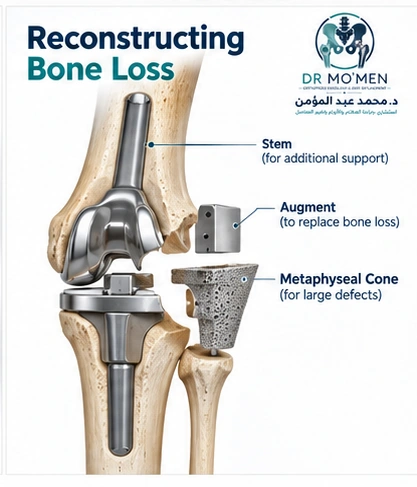
Stems
Longer intramedullary stems can help transfer load to stronger regions of the femur or tibia.
Augments
Metal augments can replace localized areas of missing bone.
Cones and Sleeves
Metaphyseal fixation may be used in selected patients with significant bone loss.
Constrained Condylar Knee
A CCK design may provide additional stability when greater constraint is required but some soft-tissue support remains.
Rotating Hinge Knee
A rotating-hinge design may be considered in selected knees with major ligament insufficiency or severe structural compromise.
The most constrained implant is not automatically the best implant. The objective is generally to use the degree of constraint necessary to achieve a stable reconstruction while respecting the patient’s anatomy and bone quality.
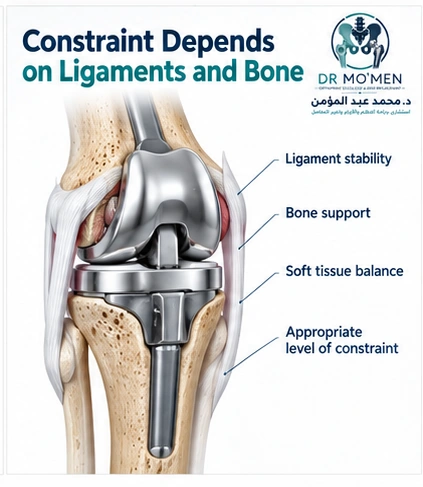
For more detail on choosing implant constraint, read: CCK vs Hinged Knee Replacement
What Happens When There Is Major Bone Loss?
Bone loss is a central part of revision planning. The surgeon evaluates the location and extent of the defect, quality of remaining bone, ligament support and ability to obtain durable fixation.
- bone cement;
- metal augments;
- stems;
- cones;
- sleeves;
- more specialized reconstruction in selected complex cases.
Does Every Infected Knee Replacement Need Complete Implant Removal?
No. Selected acute infections may sometimes be treated with DAIR — Debridement, Antibiotics and Implant Retention — with surgical debridement, appropriate antimicrobial treatment and exchange of modular components while retaining well-fixed implants. Other infections may require one-stage or two-stage exchange. The appropriate approach depends on infection chronicity, organism, implant fixation, soft tissues and patient factors.[3]
For the infection-specific treatment pathway, read: Infected Knee Replacement — DAIR, One-Stage or Two-Stage Revision
Risks of Revision Knee Replacement
Revision knee surgery is generally more complex than primary knee replacement. Potential complications include:
- infection;
- blood clots;
- wound-healing problems;
- bleeding or transfusion;
- fracture;
- nerve or vascular injury;
- persistent stiffness;
- recurrent instability;
- later loosening;
- extensor mechanism problems;
- the possibility of further surgery.
These are potential risks rather than predicted outcomes for any individual patient.
Recovery After Revision Knee Replacement
There is no single recovery timetable. Recovery depends on the reason for revision, presence or absence of infection, severity of bone loss, type of reconstruction, presence of fracture, preoperative muscle function, general medical condition and postoperative weight-bearing restrictions.
A limited component revision can be very different from major reconstruction for infection or severe bone loss.
What Should Patients Prepare Before Revision Knee Surgery?
Bring previous operative reports and implant details if available, older and recent knee radiographs, previous infection workup (such as ESR/CRP or aspiration results when obtained), and a current medication and allergy list. Inform the team about diabetes, cardiovascular disease, anticoagulants, prior wound problems and any other major medical conditions. The treating team decides which investigations and optimization steps are appropriate; do not stop prescribed medicines without medical advice. Plan for transport, support at home, rehabilitation and any expected walking aids or weight-bearing restrictions after the procedure.
When Should You Seek Specialist Assessment?
Specialist review is reasonable when a patient with a knee replacement develops:
- increasing pain after a period of good function;
- persistent or recurrent swelling;
- significant instability;
- severe function-limiting stiffness;
- persistent wound problems or drainage;
- a fracture around the prosthesis;
- radiographic loosening or bone loss;
- a recommendation for revision and a desire for a second opinion;
- persistent problems after a previous revision.
When Is Emergency Department Assessment Needed?
Go to an emergency department immediately for suspected fracture with new deformity or inability to bear weight, a cold/pale foot or new loss of sensation or movement, or a hot swollen painful prosthetic knee accompanied by fever, shaking chills, confusion or feeling systemically unwell. These concerns should not wait for a routine appointment or WhatsApp reply.
When Is Prompt Specialist Review Appropriate?
Arrange timely orthopedic assessment for new or persistent drainage, increasing swelling, recurrent instability or progressive pain, even without fever. Persistent drainage warrants especially prompt evaluation for periprosthetic joint infection, with emergency escalation if the patient becomes systemically unwell.
Dr. Mo’men's Role in Complex Revision Knee Cases
In complex revision knee surgery, the first step should be identifying why the existing replacement has failed, rather than choosing a new implant before the diagnosis is established.
- reviewing pre- and postoperative imaging;
- evaluating for periprosthetic joint infection;
- assessing component fixation and position;
- evaluating ligament competence;
- defining the degree of bone loss;
- deciding between limited and full revision;
- planning stems, augments, cones or sleeves when required;
- selecting appropriate constraint, including CCK or hinged constructs when indicated.
For patients outside Egypt, X-rays and reports can be reviewed as part of an initial orthopedic second opinion before travel. A definitive surgical decision still depends on complete clinical assessment, imaging and investigations.
Before choosing revision for stiffness alone, also see: Stiff Knee After Replacement: evaluation, MUA and arthrolysis
Medical References
- Datta S, et al. Why Are Primary Total Knee Arthroplasties Failing? A Systematic Review and Meta-Analysis. J Arthroplasty. 2025. PMID 40349863. https://pubmed.ncbi.nlm.nih.gov/40349863/
- Stroobant L, et al. Revision Knee Arthroplasty in a Tertiary Center: Infection Remains the Leading Cause for Primary Revisions, While Aseptic Loosening Led Causes for Rerevisions. J Arthroplasty. 2025. PMID 39983932. https://pubmed.ncbi.nlm.nih.gov/39983932/
- American Association of Hip and Knee Surgeons (AAHKS). Infection and Your Knee Replacement. Revised 2023. https://hipkneeinfo.org/knee-care/infection-and-your-knee-replacement/
- Cooper AM, Connolly K, Penna S, Parvizi J. Evaluation and Management of a Painful Knee After Total Knee Arthroplasty. Orthopedics. 2021. PMID 34618636. https://pubmed.ncbi.nlm.nih.gov/34618636/
- Suresh R, et al. Neuromas and Persistent Postoperative Pain Following Total Knee Arthroplasty. Ann Plast Surg. 2025. PMID 40600805. https://pubmed.ncbi.nlm.nih.gov/40600805/
- Sheth ND, et al. Isolated Versus Full-Component Revision Total Knee Arthroplasty for Aseptic Loosening: Systematic Review and Meta-Analysis. J Arthroplasty. 2026. PMID 42580496. PubMed.
- Hajiaghajani S, et al. Isolated Tibial or Femoral Component Revision Is Associated with Greater Revision Failure Rate Compared with Full Component Revision in Aseptic Revision Total Knee Arthroplasty. JBJS Rev. 2026. PMID 42520142. PubMed.
- AAOS OrthoInfo. Revision Total Knee Replacement. Patient guide.