What Is a Periprosthetic Knee Fracture?
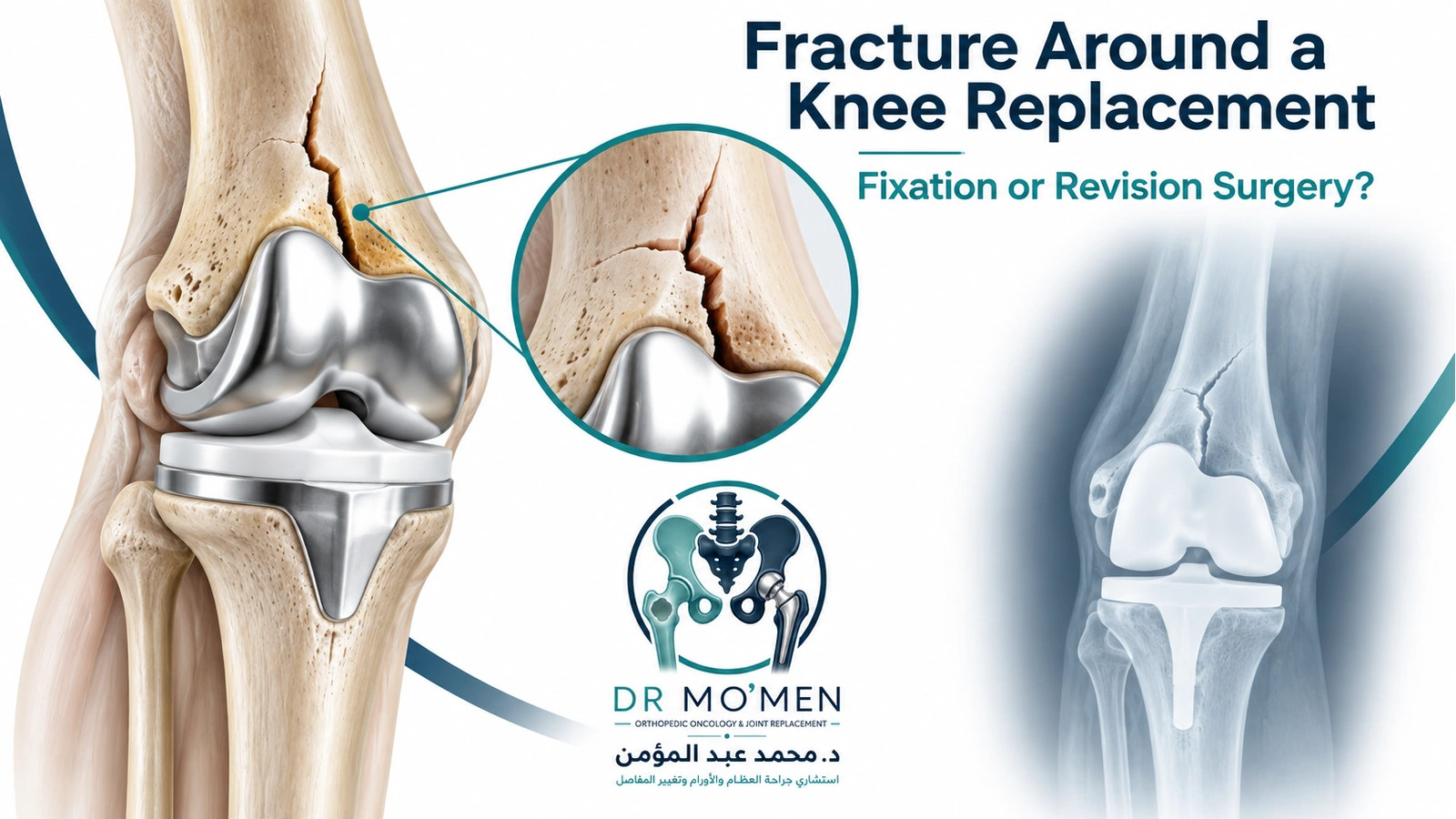
A periprosthetic fracture is a bone fracture occurring next to an orthopedic implant. After total knee replacement, fractures can occur around the distal femur, proximal tibia, or patella.
These are not ordinary fractures because there is already metal inside the bone. The surgeon must treat the broken bone + the existing prosthesis + the surrounding ligaments + the patient's bone quality.
Symptoms and Red Flags
Symptoms may include:
- sudden severe pain around the knee or thigh;
- inability to stand or bear weight;
- swelling or deformity;
- shortening or abnormal rotation of the leg;
- severe pain with movement;
- or inability to straighten the knee.
A patient with a knee replacement should seek urgent assessment after a fall if there is inability to stand or walk, visible deformity, severe thigh or knee pain, an open wound, new numbness or weakness in the foot, loss of pulse, or significant medical deterioration.
International travel should not delay emergency treatment.
Why Do These Fractures Occur?
Potential contributing factors include falls, osteoporosis, poor bone quality, previous revision surgery, long-stem implants, previous fractures, bone loss around the prosthesis, implant loosening, and other mechanical factors.
The fracture may occur around a previously well-functioning knee replacement, or around an implant that was already failing. That distinction matters.
Was the Knee Painful Before the Fall?
A previously pain-free and functional knee replacement is more likely to have been well fixed before the injury. Increasing pain, instability, swelling, deformity or declining function before the fall raises concern for pre-existing loosening, infection, polyethylene failure, bone loss or another prosthetic problem.
The Key Question: Is the Implant Stable?
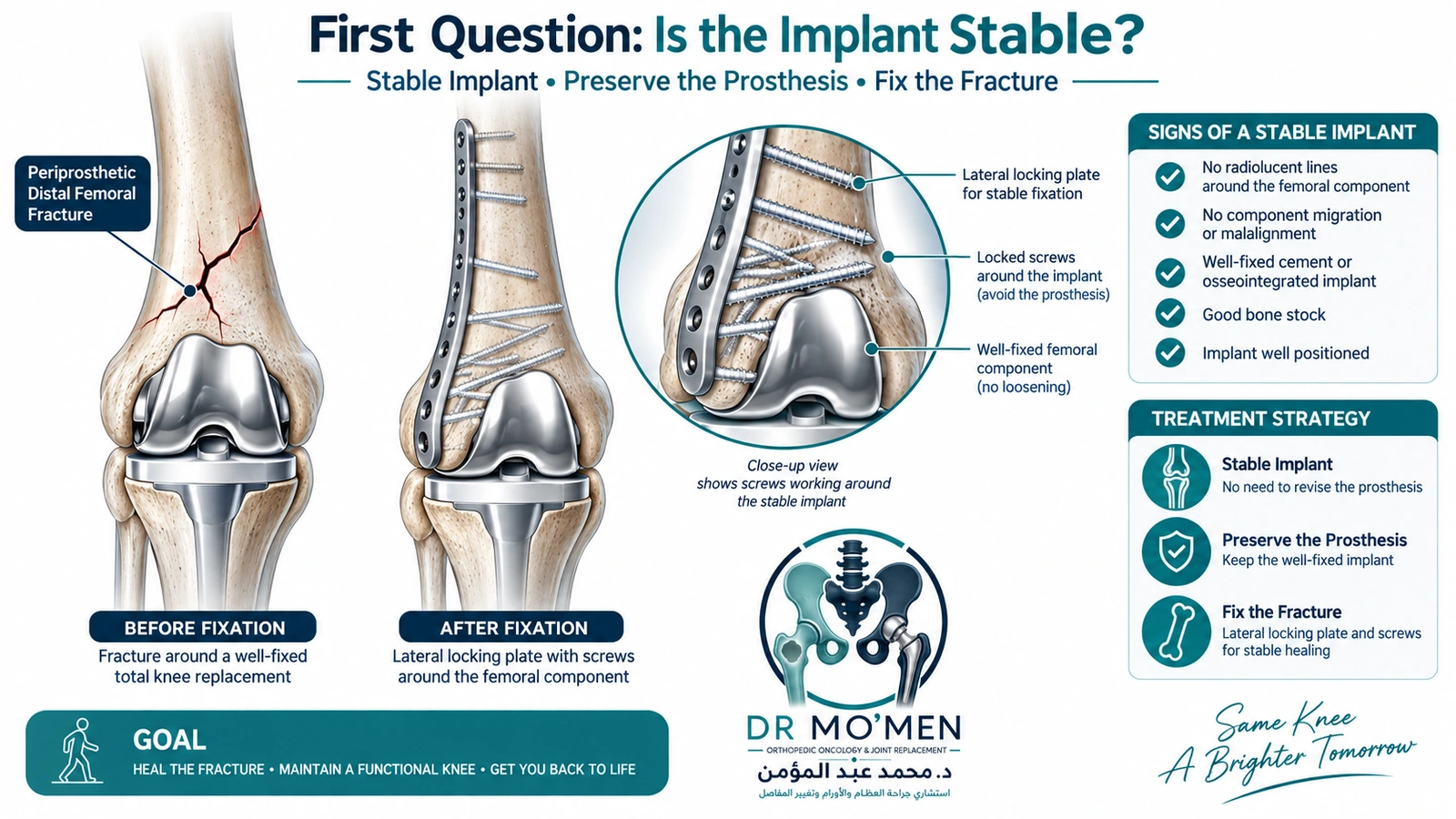
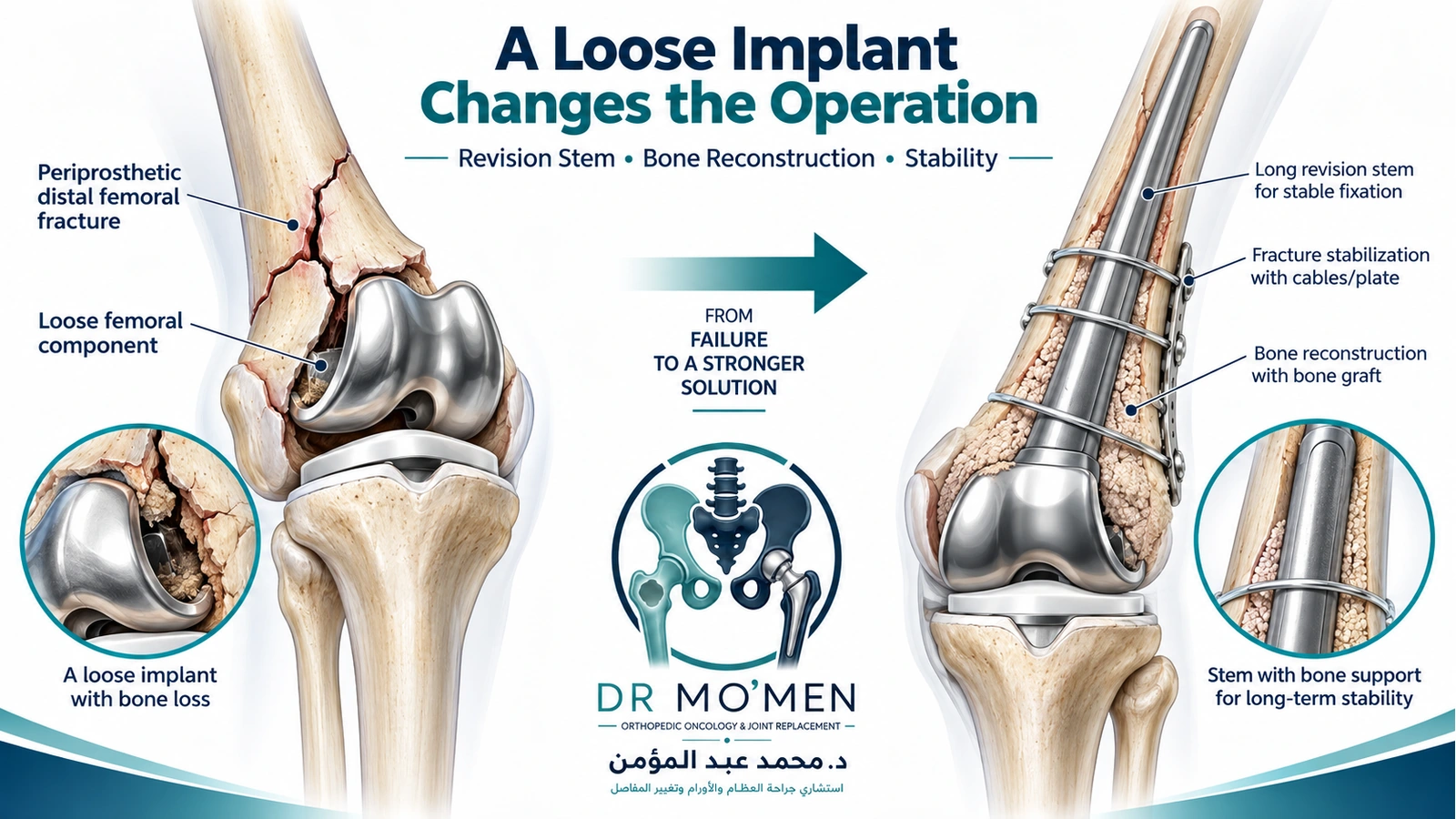
If the implant is well fixed and the fracture can be reconstructed, the prosthesis can often be retained. If the implant is loose, fixation of the fracture alone may not solve the mechanical problem.
Assessment may include previous symptoms, old and current X-rays, CT in selected cases and, when necessary, direct intraoperative assessment of component stability.
Periprosthetic Distal Femoral Fracture
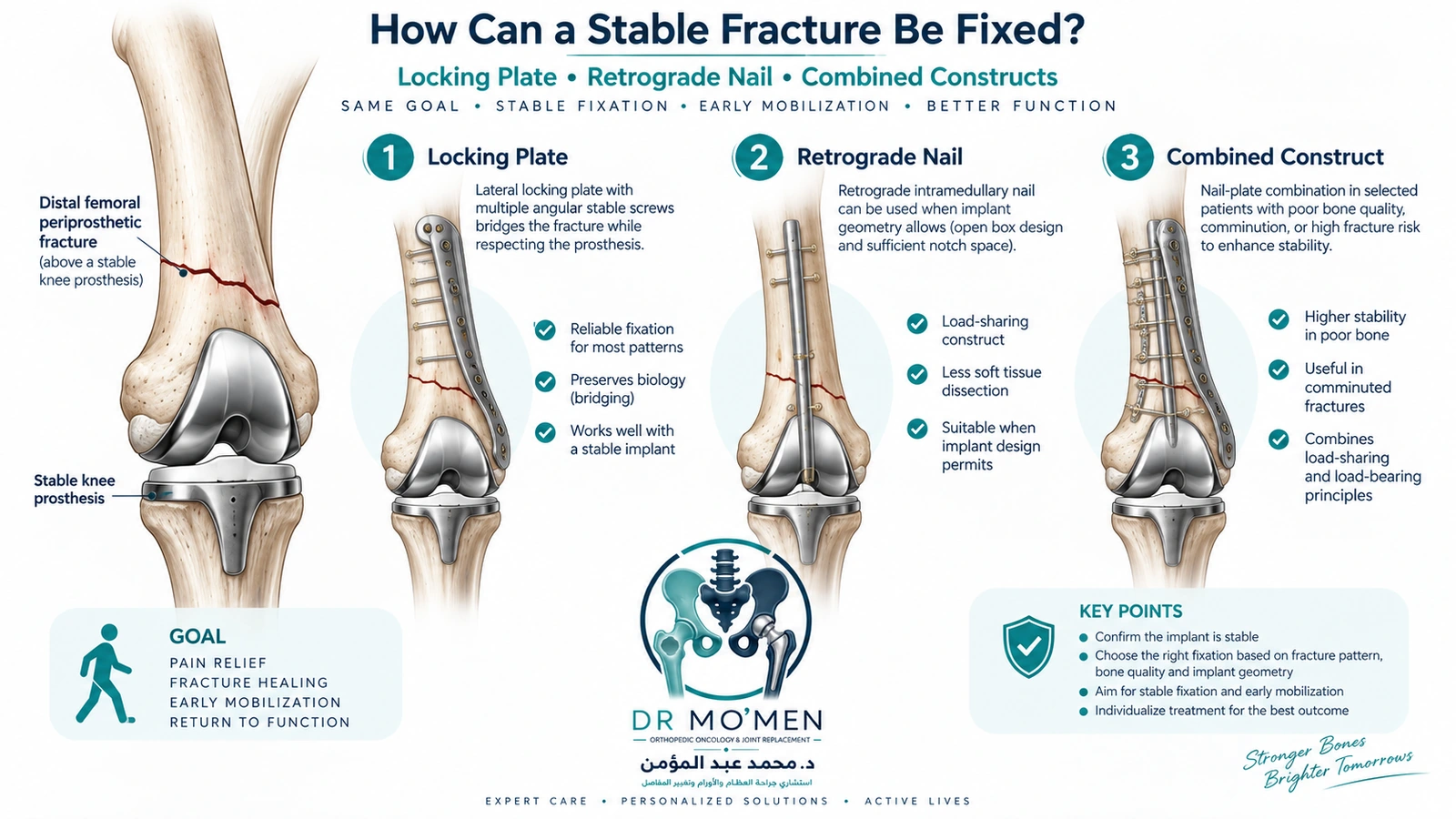
A fracture just above the femoral component is one of the most important patterns after total knee replacement. Treatment options can include locking plate fixation, retrograde intramedullary nailing, combined nail-and-plate fixation, revision total knee arthroplasty, or distal femoral replacement depending on implant stability, fracture pattern, bone stock and patient factors.
When Can a Locking Plate Be Used?
A locking plate may be appropriate when the femoral component is stable, adequate bone remains for fixation, fracture morphology permits reconstruction, and stable fixation can be obtained.
Locking plates are particularly useful in distal or comminuted fractures and in osteoporotic bone where multiple screw trajectories are needed around the existing prosthesis.
When Can a Retrograde Nail Be Used?
A retrograde intramedullary nail may be useful when the knee prosthesis is stable, the femoral component design allows nail passage, the fracture is not too distal, and there is adequate bone for distal locking.
Not every knee replacement permits a retrograde nail, because component geometry and the intercondylar box can prevent safe passage.
Plate, Nail or Combined Construct?
There is no single best method for every stable-implant fracture. The choice depends on fracture level, prosthesis design, distal fragment size, bone quality, comminution, and the required mechanical stability.
In selected difficult fractures, particularly in poor bone, a combined nail-and-plate construct can be considered to increase construct stability and distribute load.
When Does the Knee Replacement Need Revision?
Revision becomes more relevant when there is a loose femoral component, prosthetic instability, component malposition, severe bone loss, a very distal fracture that cannot be fixed reliably, failure of previous fixation, or infection involving the prosthesis.
Revision surgery may involve longer stems, augments, cones or sleeves, constrained components, or, in selected highly destructive fractures, distal femoral replacement.
What Is Distal Femoral Replacement?
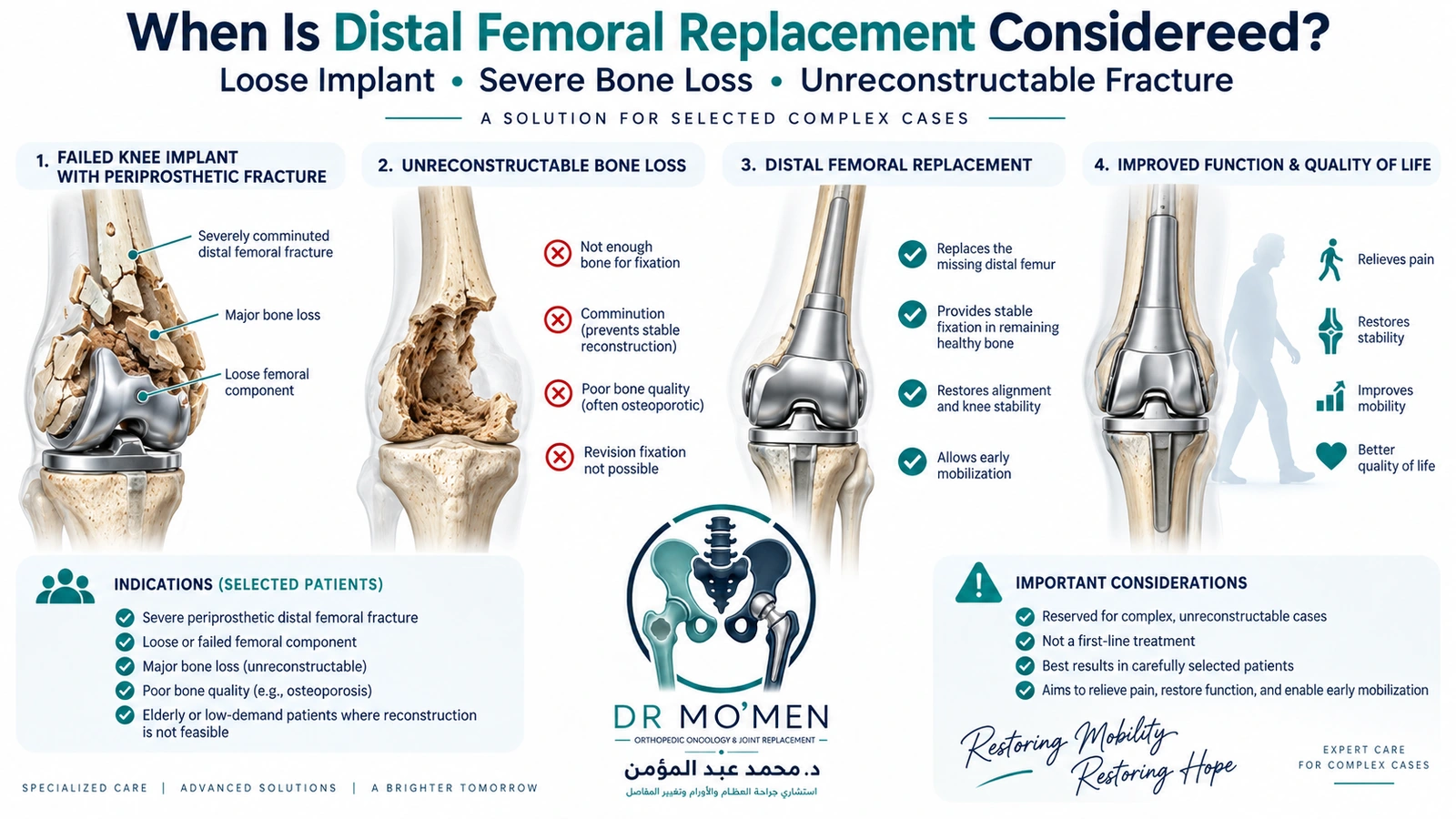
A distal femoral replacement (DFR) replaces the damaged lower portion of the femur with a modular prosthetic reconstruction. It can bypass severe comminution, massive bone loss, and fractures where conventional fixation is unlikely to succeed.
Because it does not depend on fracture union in the same way as plate or nail fixation, DFR may allow earlier weight bearing in selected patients. However, it is a much larger revision reconstruction and should not be treated as the default option for every fracture.
Possible indications include a loose femoral component, very poor distal femoral bone stock, severe comminution, failed previous fixation, or inability to achieve stable internal fixation.
Is Distal Femoral Replacement Better Than Fixation?
Not universally. Both fixation and DFR are valid strategies in selected patients. Fixation preserves the patient's own bone but depends on fracture healing. DFR provides immediate structural reconstruction but introduces a larger prosthesis with its own risks, including infection, loosening and future revision.
The choice should therefore be individualized rather than based on a single X-ray or a universal rule.
What About Tibial and Patellar Fractures?
Periprosthetic tibial fractures require the same basic questions: where is the fracture, is the tibial component stable, how much bone remains, and can reliable fixation be obtained?
Patellar fractures behave differently. Important factors include patellar component stability, extensor mechanism integrity, the ability to actively extend the knee, displacement and remaining patellar bone stock. Many stable patellar fractures with an intact extensor mechanism can be managed without surgery, while loosening or extensor mechanism disruption may require operative treatment.
Could Infection Be Part of the Problem?
Yes. A fracture does not automatically mean infection, but infection should be considered when there is unexplained loosening, previous prosthetic joint infection, chronic swelling, wound problems, multiple revisions, elevated inflammatory markers or unexplained pain before the fracture.
When infection is suspected, the work-up may include laboratory tests and joint aspiration when clinically appropriate. Treating an infected prosthesis as a purely mechanical fracture can lead to failure.
Related: Infected Knee Replacement: DAIR, One-Stage or Two-Stage Revision?
What If the Patient Has Very Poor Bone Quality?
Osteoporotic bone can affect screw fixation, fracture stability, healing and future fracture risk. Management may therefore include fixation adapted to weak bone plus bone-health evaluation and treatment when indicated.
How Soon Can the Patient Walk?
There is no universal weight-bearing protocol. Some stable fixation constructs permit early weight bearing, while others require partial or protected loading. DFR can permit earlier weight bearing in selected cases, but postoperative mobility still depends on the reconstruction, wound, muscle function and medical stability.
Why Is Early Mobilization Important?
Many patients with periprosthetic fractures are older and medically vulnerable. Prolonged immobility increases the risk of DVT, pulmonary complications, muscle loss, pressure injury, loss of independence and deconditioning.
A major treatment goal is therefore to achieve a reconstruction stable enough to permit safe mobilization as early as reasonably possible.
Can the Fracture Be Treated Without Surgery?
Occasionally. Non-operative treatment may be considered in selected stable and minimally displaced fractures, certain patellar fractures, or when the patient's medical condition makes surgery inappropriate. For most displaced distal femoral periprosthetic fractures, prolonged immobilization, nonunion and malunion are important concerns.
Main Surgical Risks
Potential complications include infection, nonunion, malunion, fixation failure, implant loosening, wound complications, blood loss, DVT or pulmonary embolism, stiffness, instability, nerve or vascular injury, repeat fracture, and the need for further revision surgery.
The individual risk varies substantially according to the fracture, implant and patient.
When Is a Specialist Second Opinion Useful?
Specialist assessment can be particularly useful when:
- different surgeons disagree about implant stability;
- revision has been proposed;
- distal femoral replacement has been recommended;
- there is severe bone loss;
- previous fixation has failed;
- there have been multiple knee operations;
- infection is suspected;
- or the family wants to understand whether the existing prosthesis can be preserved.
A useful second opinion should clarify fracture location, implant stability, remaining bone stock, feasibility of fixation, the need for revision, and the level of reconstruction required for safe rehabilitation.
For Patients Outside Egypt
An acute displaced fracture with severe pain and inability to walk is an urgent local medical problem. International travel should not delay initial assessment and stabilization.
After stabilization, a remote second-opinion review can be useful for complex planning. Helpful records include current knee and full-femur X-rays, previous postoperative X-rays, CT if obtained, operative reports, implant details, prior revision reports, relevant laboratory tests and medical history.
Role of Dr. Mohammed Abdelmoemen Abuelhadid
Management of a fracture around a knee replacement combines fracture reconstruction principles with revision arthroplasty principles. Assessment focuses on fracture location, component fixation, bone stock, implant design, ligament stability, previous symptoms, infection risk and medical fitness.
The final strategy may range from locking plate fixation, to retrograde nail, to combined fixation, to revision knee replacement, or, in selected highly destructive fractures, distal femoral replacement.
For appointments or X-ray/report review: 01021690693
Medical References
- Management of distal femoral periprosthetic fractures after total knee arthroplasty: fixation versus revision reconstruction. 2026 review. PubMed
- Palanisami DR, et al. Periprosthetic Distal Femoral Fractures: Current Concepts. 2025. PubMed
- Chantelot C, et al. Revision total knee arthroplasty with periprosthetic distal femoral fracture. Orthop Traumatol Surg Res. 2024. PubMed
- Distal femoral replacement for periprosthetic distal femoral fractures around TKA: a meta-analysis. PubMed
- Fix or Replace? Comparable Outcomes With Internal Fixation and Distal Femoral Replacement for Periprosthetic Distal Femur Fractures. 2025. PubMed
- Distal femoral replacement carries higher infection and revision risk than ORIF for distal femoral periprosthetic fractures in elderly patients. 2026 retrospective database study. PubMed
- Patella Fracture After Total Knee Arthroplasty: A Review. 2024. PMC