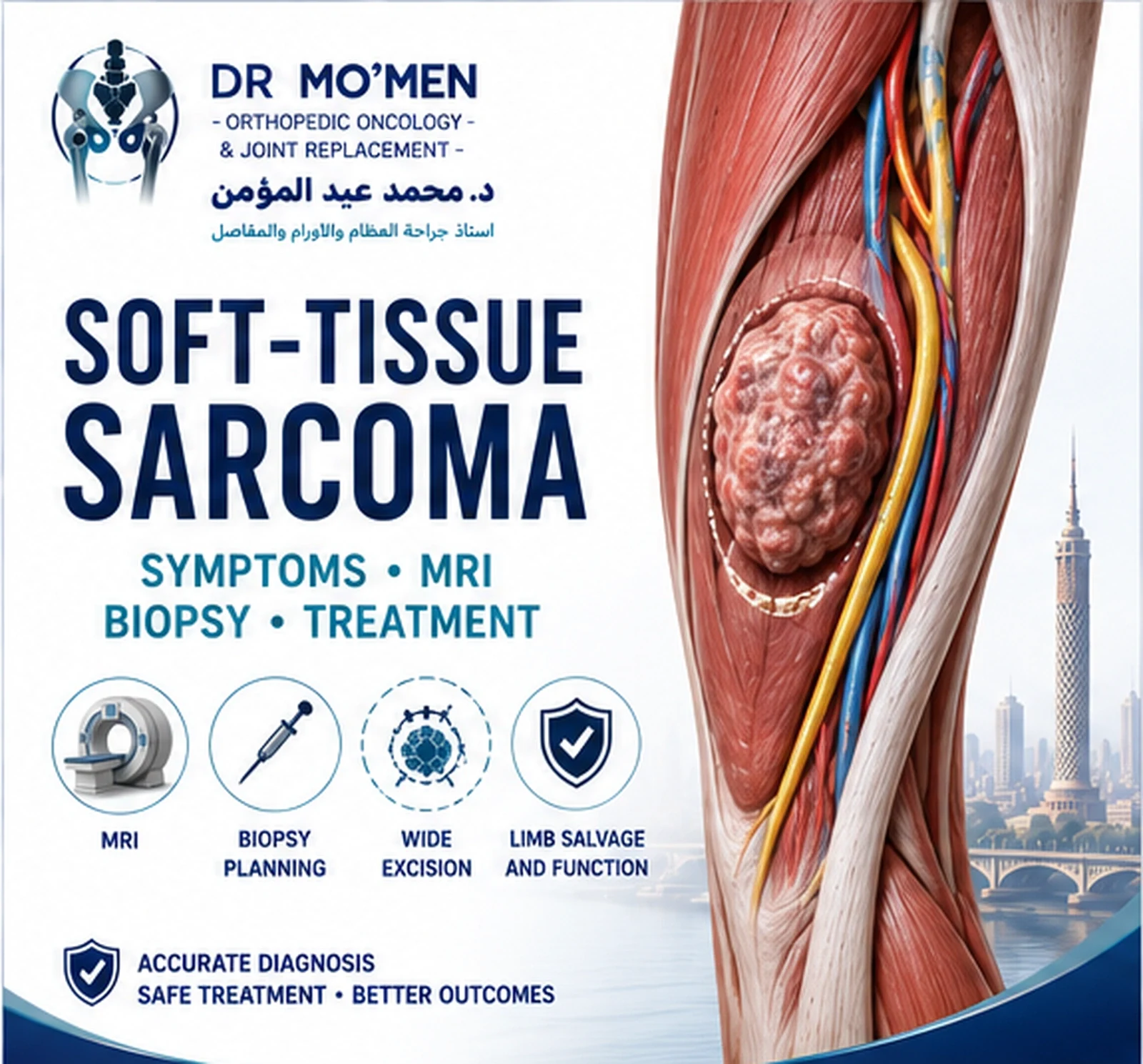
Finding a new lump in the thigh, shoulder, arm, buttock or another part of the body can be worrying.
Most soft-tissue masses are not sarcomas. However, some tumors require specialist assessment because their behavior, diagnosis and surgical planning are very different from ordinary benign lumps.
Patients commonly ask: When should a soft-tissue lump be investigated? Does every mass need MRI? Should it be removed first or biopsied first? Can soft-tissue sarcoma be treated without amputation?
The safest approach is based on accurate diagnosis before definitive surgery.
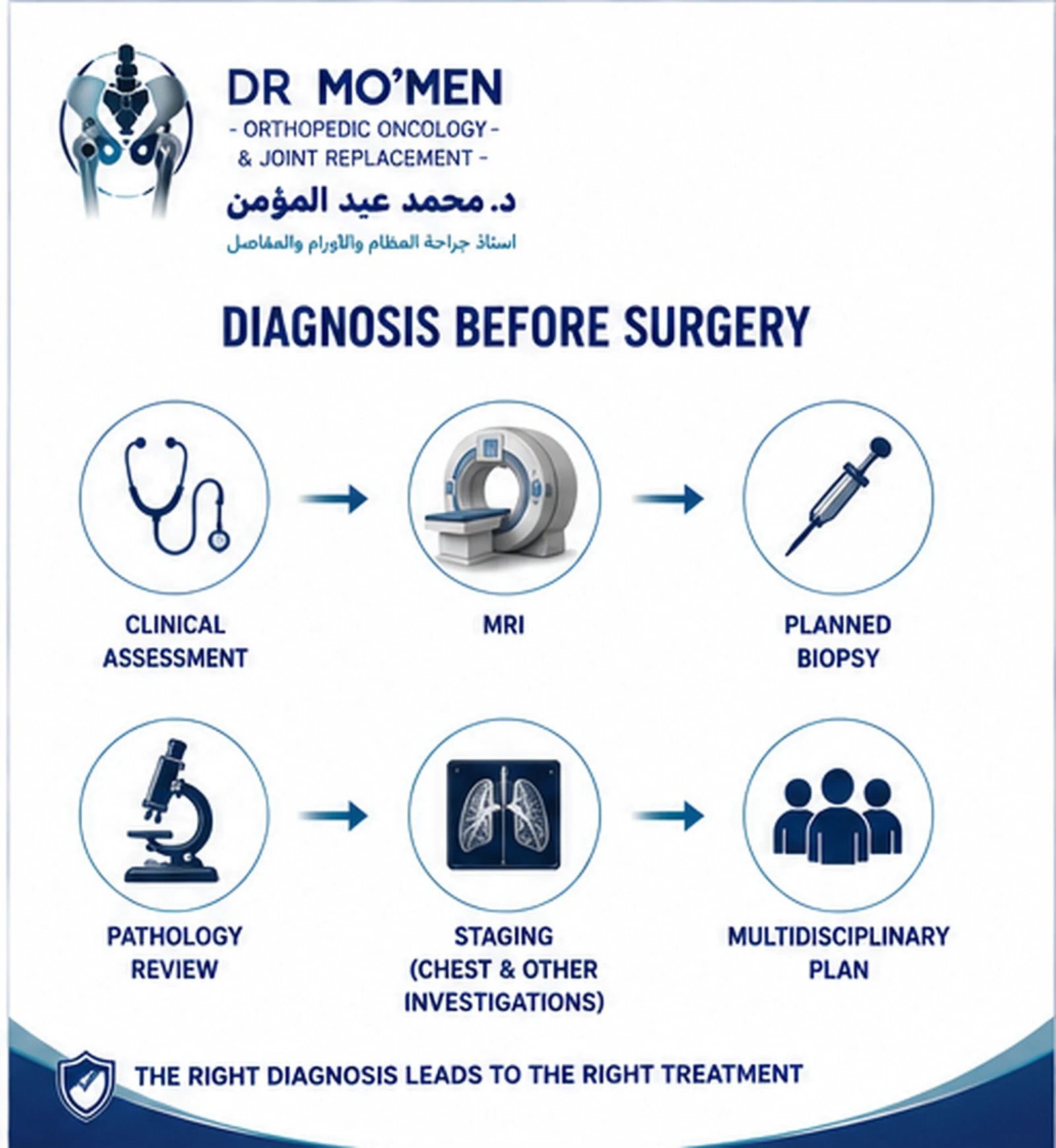
When sarcoma is suspected, management may involve clinical examination, MRI, appropriate staging, carefully planned biopsy, specialist pathology, multidisciplinary review, and surgery, radiotherapy and/or systemic therapy according to the exact diagnosis.
Key principle
Do not perform an unplanned excision of a suspicious soft-tissue mass before the diagnosis and surgical strategy are clear.
What Is a Soft-Tissue Sarcoma?
Soft-tissue sarcoma is a group of malignant tumors that can arise from tissues such as muscle, fat, fibrous tissue, blood vessel-related tissue, nerve-associated tissue and other connective tissues.
There are many different histological subtypes. This means that “soft-tissue sarcoma” is not one single disease.
Treatment depends on subtype, grade, tumor size, anatomical location, depth, relationship to nerves and blood vessels, presence or absence of metastatic disease, and whether the tumor has already been operated on.
Where Can Soft-Tissue Sarcoma Occur?
Sarcomas can occur almost anywhere in the body. Orthopedic oncology commonly evaluates tumors in the thigh, buttock, shoulder, upper arm, forearm, lower leg, pelvis and trunk.
The thigh is a particularly important location because large deep soft-tissue tumors may grow substantially before becoming obvious.
What Are the Warning Signs of a Soft-Tissue Mass?
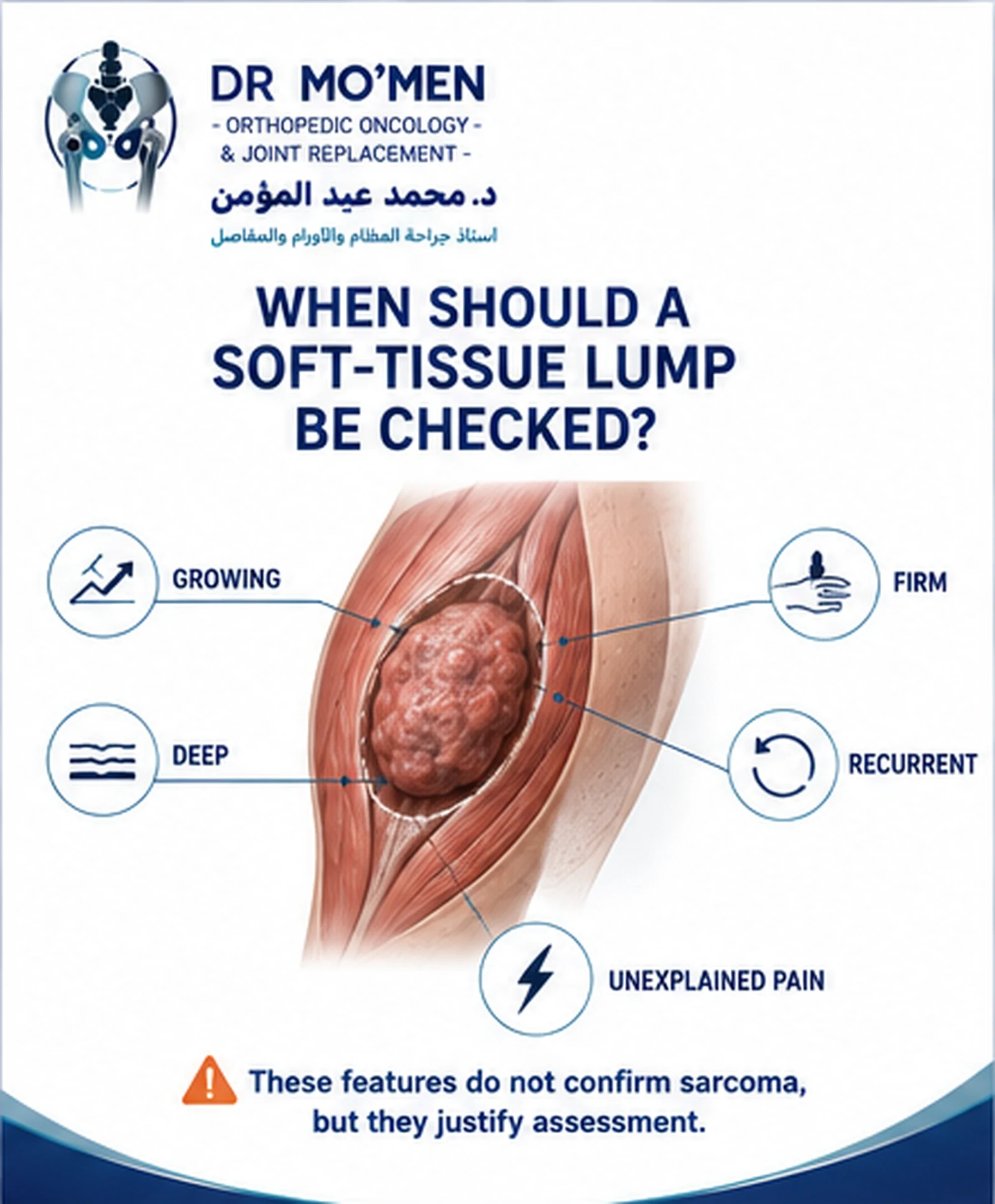
Many benign lumps are small, superficial and stable. Features that deserve more careful assessment include progressive enlargement, deep location, firmness, recurrent growth after previous removal, unexplained pain, neurological symptoms, a mass fixed to deeper tissues, atypical imaging or a large lesion.
Size matters, but a small lump is not automatically benign. Likewise, not every large mass is malignant. The decision should be based on the whole clinical picture.
Does Pain Mean a Lump Is Sarcoma?
No. Sarcomas may be painful or painless. Pain alone cannot distinguish benign tumor, sarcoma, hematoma, infection, muscle injury or a nerve-related lesion.
Persistent or enlarging masses need clinical and imaging assessment rather than diagnosis based on symptoms alone.
Why MRI Is Important
MRI is often the key local imaging study for a suspicious soft-tissue tumor.
It can help determine tumor size, depth, anatomical compartment, relationship to muscles and fascia, relationship to nerves and major blood vessels, relationship to bone, surrounding edema and internal heterogeneity.
MRI is also central to surgical planning.
Should MRI Be Done Before Biopsy?
Whenever clinically feasible, yes. MRI before biopsy can provide a cleaner assessment of the untreated tumor.
A biopsy can cause bleeding, edema, inflammatory change and local tissue distortion. These changes may make later imaging more difficult to interpret.
The sequence should therefore often be: Clinical assessment → MRI → biopsy planning, rather than random biopsy followed by imaging.
Can MRI Diagnose Sarcoma by Itself?
No. MRI can show whether a lesion appears benign, indeterminate or aggressive, but MRI alone does not reliably determine the exact histological subtype.
Tissue diagnosis may still be required. The final diagnosis integrates imaging, clinical information, pathology and sometimes molecular testing.
When Is Biopsy Needed?
Biopsy may be appropriate when the mass appears suspicious on imaging, is deep or enlarging, has an uncertain diagnosis, could require major surgery, could represent sarcoma, or would be treated differently depending on histology.
The biopsy should be planned with definitive surgery in mind.
Why Biopsy Route Matters
This is critical in sarcoma surgery. The biopsy tract may potentially become contaminated by tumor cells.
For that reason, the biopsy should ideally be placed directly, through the appropriate anatomical compartment, away from major neurovascular structures when possible, and in a position that can be removed during definitive surgery if required.
A poorly positioned biopsy may force the surgeon to remove additional normal tissue later.
Read more about bone tumor biopsy planning before definitive tumor surgery.
Core Needle Biopsy or Open Biopsy?
A core needle biopsy is frequently used for soft-tissue tumors when appropriate. Potential advantages include minimally invasive sampling, less tissue disruption and access to representative tissue.
Open biopsy may still be necessary in selected cases. The important issue is not simply the instrument. It is planning, representative sampling, correct route and specialist pathology.
Why Pathology Review Matters
Soft-tissue sarcoma contains many subtypes, including tumors arising from adipocytic tissue, muscle lineage, fibrous tissue, vascular structures, nerve-associated tissues and undifferentiated sarcoma categories.
Some diagnoses require immunohistochemistry, molecular testing, genetic rearrangement testing or specialist sarcoma pathology review.
A rare or unexpected diagnosis may justify second pathology review before major treatment.
How Is Soft-Tissue Sarcoma Staged?
Staging depends on subtype, grade, site and clinical context.
Assessment may include MRI of the primary tumor, chest imaging and additional staging studies when appropriate.
The purpose is to determine whether disease appears localized, regionally advanced or metastatic. This influences treatment planning.
Why the Lungs Matter
The lungs are an important metastatic site for many soft-tissue sarcomas. This does not mean every patient will develop lung metastases.
Chest assessment is part of staging because it may change surgical strategy, systemic therapy decisions and multidisciplinary planning.
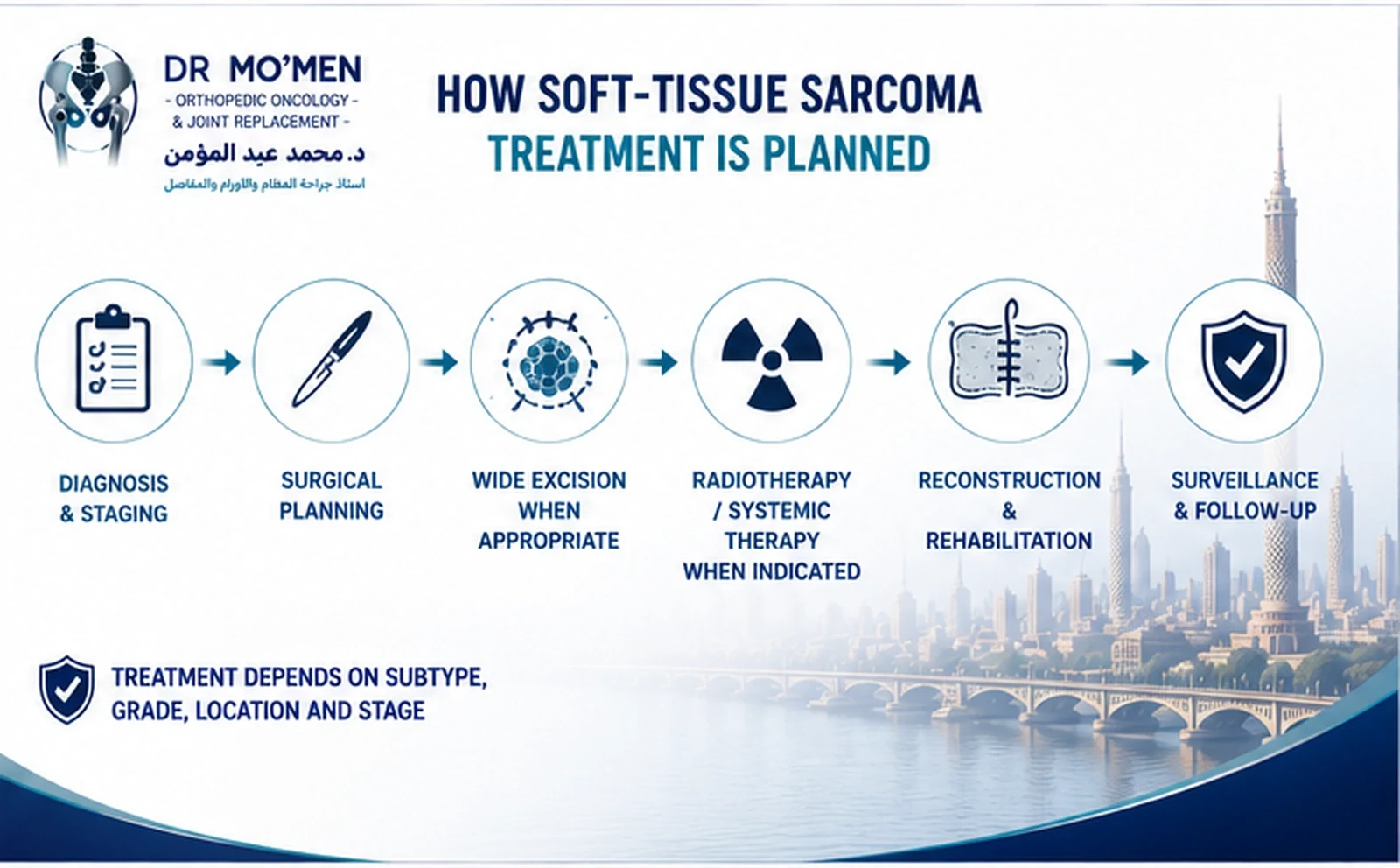
How Is Soft-Tissue Sarcoma Treated?
Treatment depends on the exact diagnosis. Potential components include surgery, radiotherapy, systemic therapy and surveillance in selected situations.
For many localized extremity sarcomas, surgery remains central. However, the order and combination of treatments vary.
What Is Wide Excision?
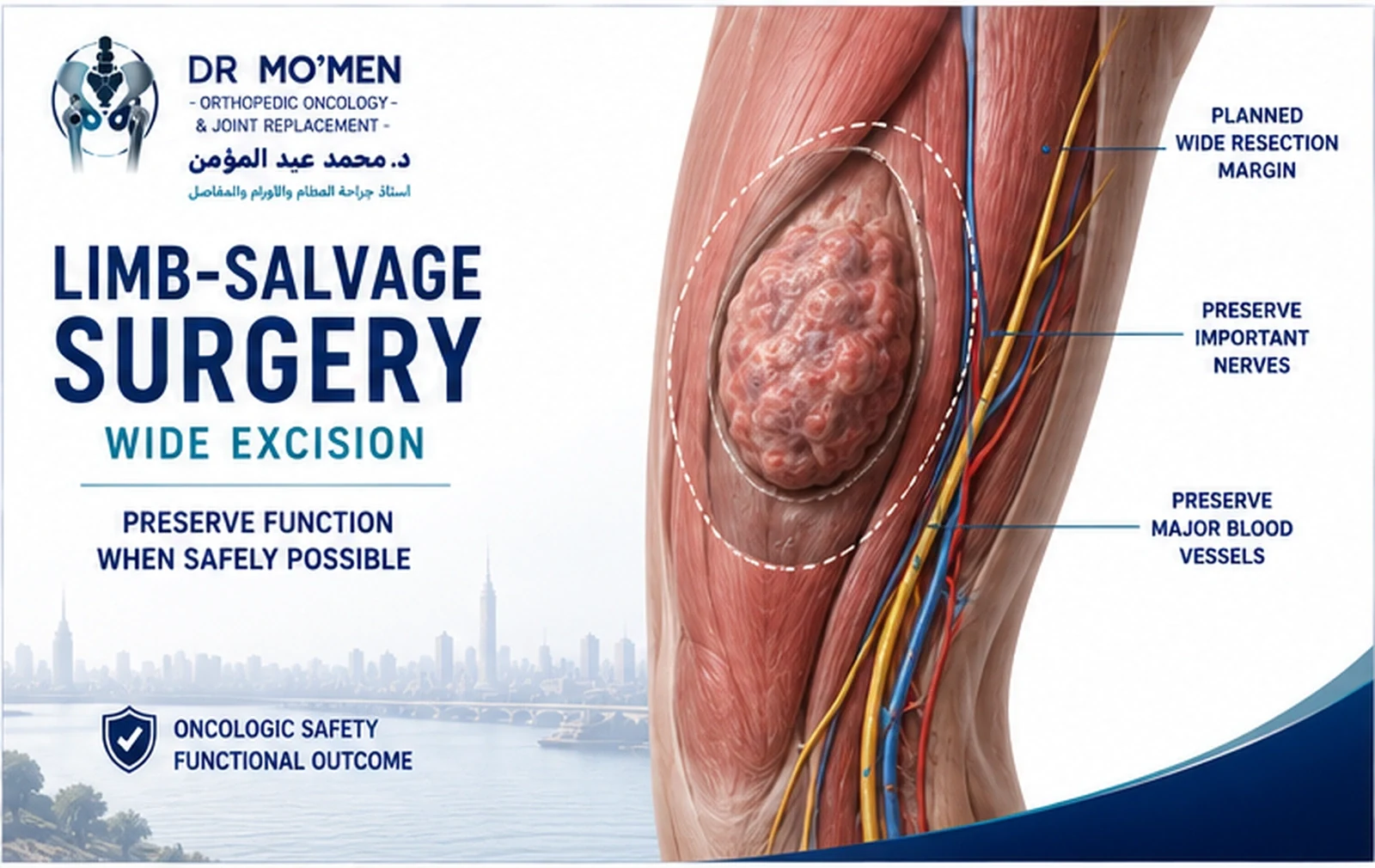
Wide excision means removing the tumor together with an appropriate surrounding margin.
The surgeon plans the resection based on MRI, anatomy, biopsy tract, tumor grade, relationship to nerves and vessels and expected reconstruction.
The operation is not simply “removing the lump.” It may require removal of fascia, part of a muscle, multiple muscle compartments in selected cases, the biopsy tract, previous surgical scar or involved structures.
Can the Limb Be Preserved?
In many extremity soft-tissue sarcomas, limb-salvage surgery may be feasible.
Limb salvage aims to achieve adequate tumor removal and acceptable function. It may involve preserving or reconstructing nerves, vessels, muscles, tendons, skin and soft-tissue coverage.
However, limb preservation should not compromise oncological safety.
What If the Tumor Is Close to a Major Nerve?
The surgeon must determine whether the nerve is displaced, adjacent, partially involved, completely encased or directly invaded.
If a major nerve can be preserved safely, limb salvage may remain feasible. If the tumor directly involves critical structures, surgery becomes more complex.
The decision depends on both tumor control and expected function.
What If Major Blood Vessels Are Involved?
Selected tumors may involve or closely surround major vascular structures, including femoral or popliteal vessels.
Management may require vascular surgical input. In selected cases, vascular reconstruction can be part of limb-salvage surgery.
Why Plastic Surgery May Be Needed
After wide excision, the soft-tissue defect may be too large for simple closure.
Reconstruction may require a local flap, muscle flap, free flap or skin graft.
The objective is durable coverage, wound healing, protection of vessels or implants and acceptable function. This is especially important in previously operated or irradiated fields.
When Is Radiotherapy Used?
Radiotherapy may play an important role in local control. It may be considered before surgery, after surgery or as definitive local treatment in selected situations.
The decision depends on tumor grade, size, anatomical site, margins, expected local recurrence risk, prior radiotherapy and planned surgery.
Radiotherapy should be coordinated with the sarcoma multidisciplinary team.
Preoperative or Postoperative Radiotherapy?
Both approaches can be used in selected sarcoma pathways.
The balance may involve different considerations such as wound healing, treatment volume, long-term tissue effects and surgical timing.
There is no single approach that is automatically correct for every patient.
Is Chemotherapy Needed?
Not every soft-tissue sarcoma requires chemotherapy.
The role of systemic therapy depends on histological subtype, grade, stage, patient age, metastatic risk, resectability and multidisciplinary assessment.
Some sarcoma subtypes are more chemotherapy-sensitive than others. Treatment should therefore be diagnosis-specific.
What If the Tumor Was Already Removed Without Planning?
This is a major clinical issue. If sarcoma is diagnosed only after a mass has been removed, the patient should not simply undergo another routine excision.
The case may require pathology review, the original operative report, MRI of the surgical bed, staging, multidisciplinary review and planned tumor-bed re-excision.
Related guide: unplanned excision of a soft-tissue sarcoma: what should happen next?
Why Unplanned Excision Is a Problem
The original operation may have exposed tumor cells to surrounding muscle, fascia, skin, a drain tract or the surgical cavity.
This can enlarge the area that must be treated later. The goal after an unexpected sarcoma diagnosis is to reconstruct what was removed, what tissues were exposed and whether residual disease remains.
Can Limb Salvage Still Be Possible After Unplanned Surgery?
Often, yes. However, definitive surgery may need to be more extensive.
The patient may require wider re-excision, removal of the previous scar, removal of a drain tract, plastic reconstruction, vascular reconstruction or radiotherapy.
The final plan depends on the individual surgical field.
What If the Sarcoma Recurs?
Local recurrence requires reassessment. The next steps may include MRI, pathology review, restaging, review of previous surgery and multidisciplinary assessment.
Repeat surgery may still be possible. However, recurrence surgery is often more complex because of scar tissue, prior radiotherapy, reduced soft tissue and previous reconstructions.
For a structured recurrence framework, see recurrent tumor assessment.
Does Local Recurrence Automatically Mean Amputation?
No. Repeat limb-salvage surgery may still be possible in selected patients.
Amputation may be considered when safe resection cannot otherwise be achieved, critical neurovascular structures are extensively involved, reconstruction would produce very poor function, severe infection complicates the field, or repeated recurrence has severely compromised the limb.
The decision should be individualized.
Follow-Up After Soft-Tissue Sarcoma Treatment
Follow-up aims to detect local recurrence, metastatic disease, treatment-related complications and functional problems.
Surveillance may include clinical examination, local imaging, chest imaging and rehabilitation assessment.
The schedule depends on subtype, grade, treatment, recurrence risk and time since treatment.
Warning Signs After Treatment
Patients should seek assessment for a new enlarging mass, increasing swelling, unexplained persistent pain, new neurological symptoms, new wound problems or a sudden decline in function.
Not every symptom means recurrence, but new changes deserve evaluation.
When to seek urgent care
Seek urgent local medical assessment for severe bleeding, rapidly progressive neurological or vascular symptoms, serious infection, or sudden major loss of limb function. An online message is not a substitute for emergency assessment.
When Should You Seek a Sarcoma Second Opinion?
A second opinion may be particularly useful when a sarcoma diagnosis has just been made, biopsy is being planned, major limb surgery has been proposed, radiotherapy timing is unclear, pathology subtype is uncertain, the tumor is close to a major nerve or vessel, the tumor was already removed without planning, recurrence has occurred, amputation has been proposed, or treatment recommendations differ between centers.
International Patients: What Should You Send Before Travelling?
Useful records include MRI, ultrasound if available, CT, chest staging, pathology report, pathology slides or blocks if available, biopsy report, operative report if surgery has already been performed, radiotherapy details, systemic therapy summary and current medical reports.
If biopsy has not yet been performed, specialist review before biopsy may be particularly helpful.
Send Your Imaging Before You Travel
A preliminary review may help determine whether MRI is adequate, whether biopsy planning needs review, whether pathology review is useful, whether staging is complete, whether limb-salvage surgery appears feasible, whether plastic or vascular reconstruction may be required, and whether travel to Cairo is appropriate.
Remote assessment does not replace examination, biopsy, pathology, staging or multidisciplinary sarcoma treatment planning.
International Patients | Request an Orthopedic Oncology Second Opinion
About Dr. Mohammed Abdelmoemen Abuelhadid
Dr. Mohammed Abdelmoemen Abuelhadid is an Orthopedic Oncology & Joint Replacement Surgeon and Lecturer of Orthopedic Surgery at Ain Shams University.
His clinical areas include soft-tissue tumors, orthopedic oncology, limb-salvage surgery, wide tumor resection, complex reconstruction, recurrent tumors, metastatic bone disease, megaprosthetic reconstruction and second opinions for complex orthopedic cases.
Clinical principle
The most important principle in suspected soft-tissue sarcoma is accurate diagnosis and proper planning before definitive surgery.
Have You Been Diagnosed With a Soft-Tissue Sarcoma?
Specialist review may help clarify whether MRI is adequate, whether biopsy was appropriately planned, whether pathology review or staging is needed, whether limb-salvage surgery appears feasible, and whether plastic, vascular, radiotherapy or systemic treatment input may be required.
For appointments or medical-record review: +20 102 1690693
Frequently Asked Questions
Is every soft-tissue lump a sarcoma?
No. Most soft-tissue masses are benign. Enlarging, deep or atypical masses should be assessed properly rather than removed without diagnosis.
Does every suspicious lump need MRI?
Not necessarily, but MRI is often the most useful local imaging study for a suspicious deep soft-tissue tumor.
Should biopsy be done before removing the tumor?
When sarcoma is suspected, planned biopsy before definitive excision is usually an important part of the pathway.
Can soft-tissue sarcoma be treated without amputation?
Often, yes. Many extremity sarcomas can be treated with limb-salvage surgery when adequate margins and useful function can be achieved.
Is radiotherapy always required?
No. Its role depends on tumor grade, size, location, margins and multidisciplinary assessment.
Is chemotherapy always needed?
No. Chemotherapy is highly dependent on sarcoma subtype, stage and individual treatment strategy.
What should I do if the mass was already removed and pathology says sarcoma?
Collect the pathology, original imaging and operative report, and seek specialist sarcoma review before another operation.
How this article was reviewed
This patient-education article was reviewed for clinical accuracy, patient safety and decision-making clarity by Dr. Mohammed Abdelmoemen Abuelhadid. It is intended to support, not replace, clinical examination, MRI review, planned biopsy, specialist pathology, staging and multidisciplinary sarcoma treatment planning.
Author and medical reviewer
Dr. Mohammed Abdelmoemen Abuelhadid — Orthopedic Oncology & Joint Replacement Surgeon and Lecturer of Orthopedic Surgery at Ain Shams University.
Medical Disclaimer: This article is for patient education and does not replace clinical examination, MRI review, planned biopsy, specialist pathology, staging investigations or individualized multidisciplinary sarcoma treatment.