A megaprosthesis replaces a very large segment of bone and, in many cases, the adjacent joint after tumor resection.
These reconstructions may function for many years, but the connection between the prosthetic stem and the patient's remaining bone remains exposed to repeated mechanical loading throughout life.
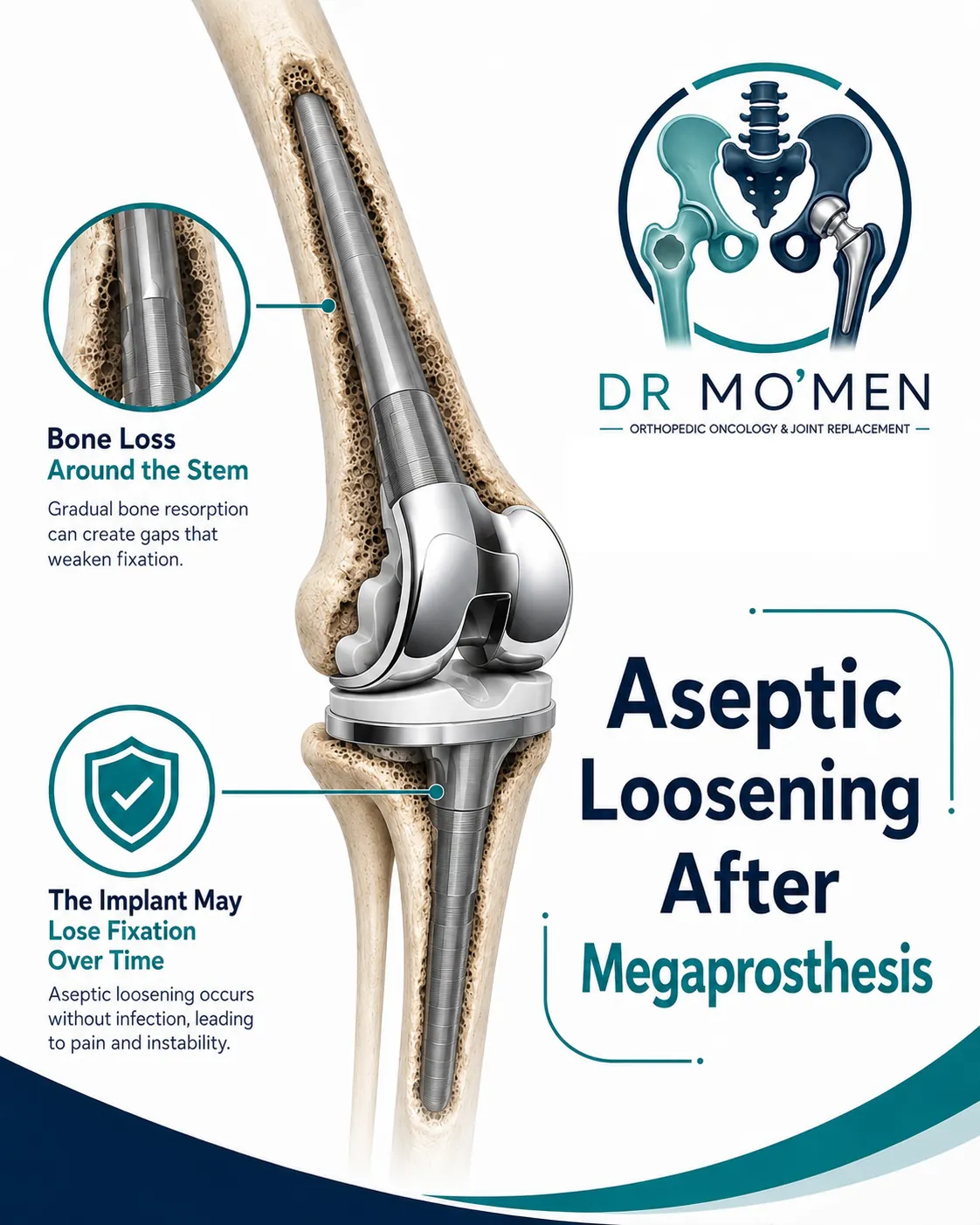
Over time, that fixation can sometimes fail without infection. This is called aseptic loosening.
For the patient, the most common concern is often: “My megaprosthesis has started hurting. Does that mean it is loose—or infected?”
The answer cannot usually be determined from pain alone. Evaluation needs to distinguish aseptic loosening from infection, mechanical or structural failure, fracture, soft-tissue problems and tumor recurrence when clinically relevant.
What does “aseptic loosening” mean?
Aseptic means that loosening occurs without evidence that infection is driving the loss of fixation.
The prosthetic stem should normally remain firmly connected to the remaining bone. Depending on the implant, fixation may rely on bone cement, biological bone ingrowth into a cementless surface, or other fixation strategies.
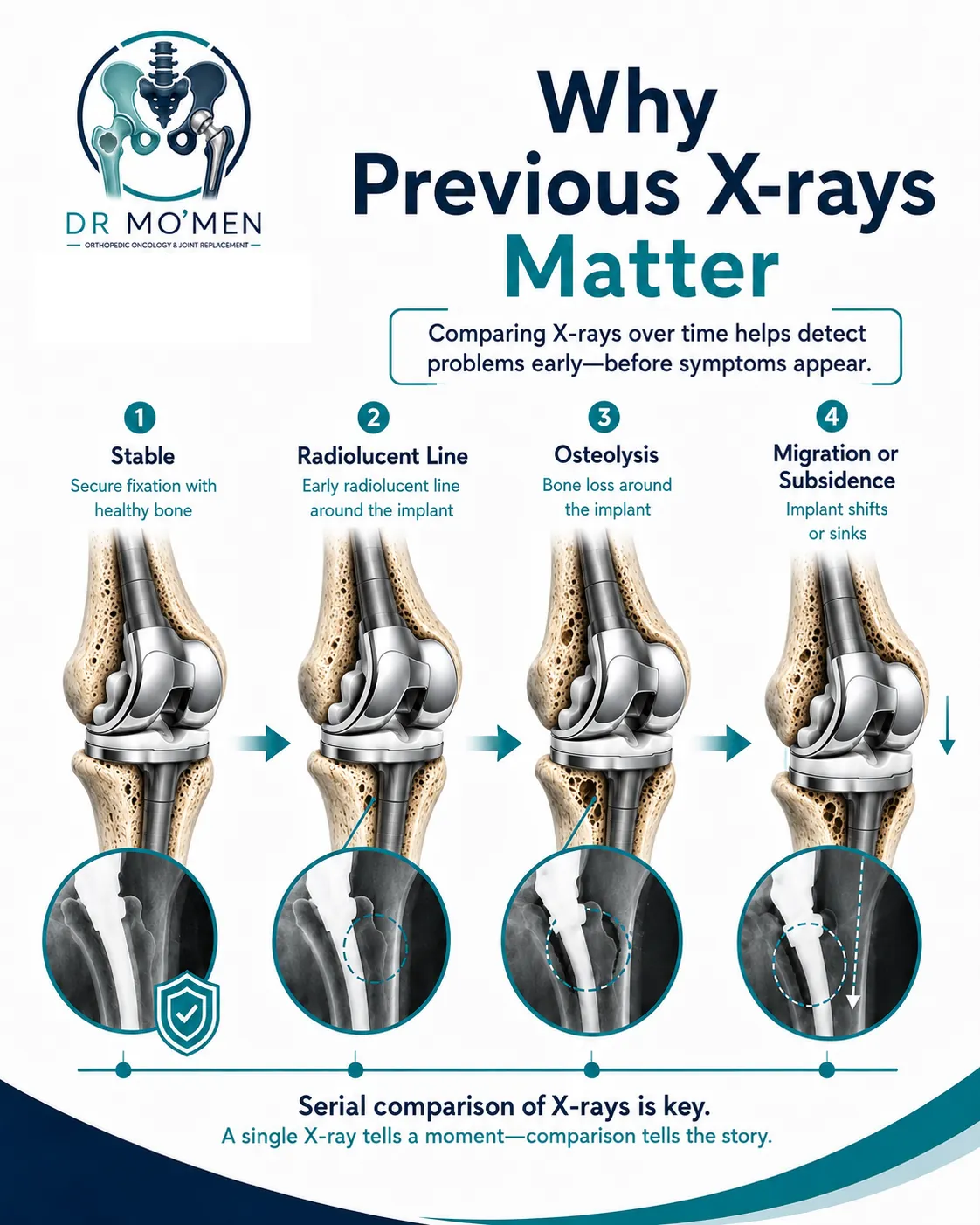
With loosening, the interface between implant and bone gradually becomes less stable. Micromotion may develop, followed by changes such as bone resorption, radiolucent lines, osteolysis, stem migration or subsidence, and progressive load-related pain.
In orthopedic-oncology failure classifications, aseptic loosening is commonly considered a mechanical mode of endoprosthetic failure.
Is aseptic loosening the same as infection?
No. This is one of the most important distinctions.
| Feature | Aseptic loosening | Periprosthetic infection |
|---|---|---|
| Primary problem | Failure of implant-bone or implant-cement fixation without infection established | Microbial infection involving the reconstruction, often with biofilm |
| Symptoms | Often load-related pain or declining function, but presentation can be variable | Pain, swelling, wound problems, drainage or systemic features may occur; presentation can also be subtle |
| Imaging | Progressive migration, subsidence, osteolysis or interface change may support loosening | Imaging may overlap with loosening and cannot reliably exclude infection on its own |
| Laboratory / aspiration role | Used mainly to help exclude infection and investigate other causes | Inflammatory markers, aspiration, cultures and other tests are interpreted together with the clinical picture |
| Treatment implication | Revision planning focuses on restoring durable fixation and managing bone loss | Revision must combine infection control with reconstruction; the strategy depends on timing, organism, soft tissues, fixation and host factors |
Aseptic loosening
The implant loses mechanical fixation without infection being established as the cause.
Periprosthetic infection
Microorganisms infect the tissues around the implant and may form biofilm on prosthetic surfaces.
Both can cause pain, impaired walking, radiographic bone loss and deterioration in function. They can occasionally be difficult to distinguish. A painful apparently loose megaprosthesis should therefore not simply be labelled “aseptic” before infection has been appropriately considered.
Why can a megaprosthesis loosen?
1. Repeated mechanical loading
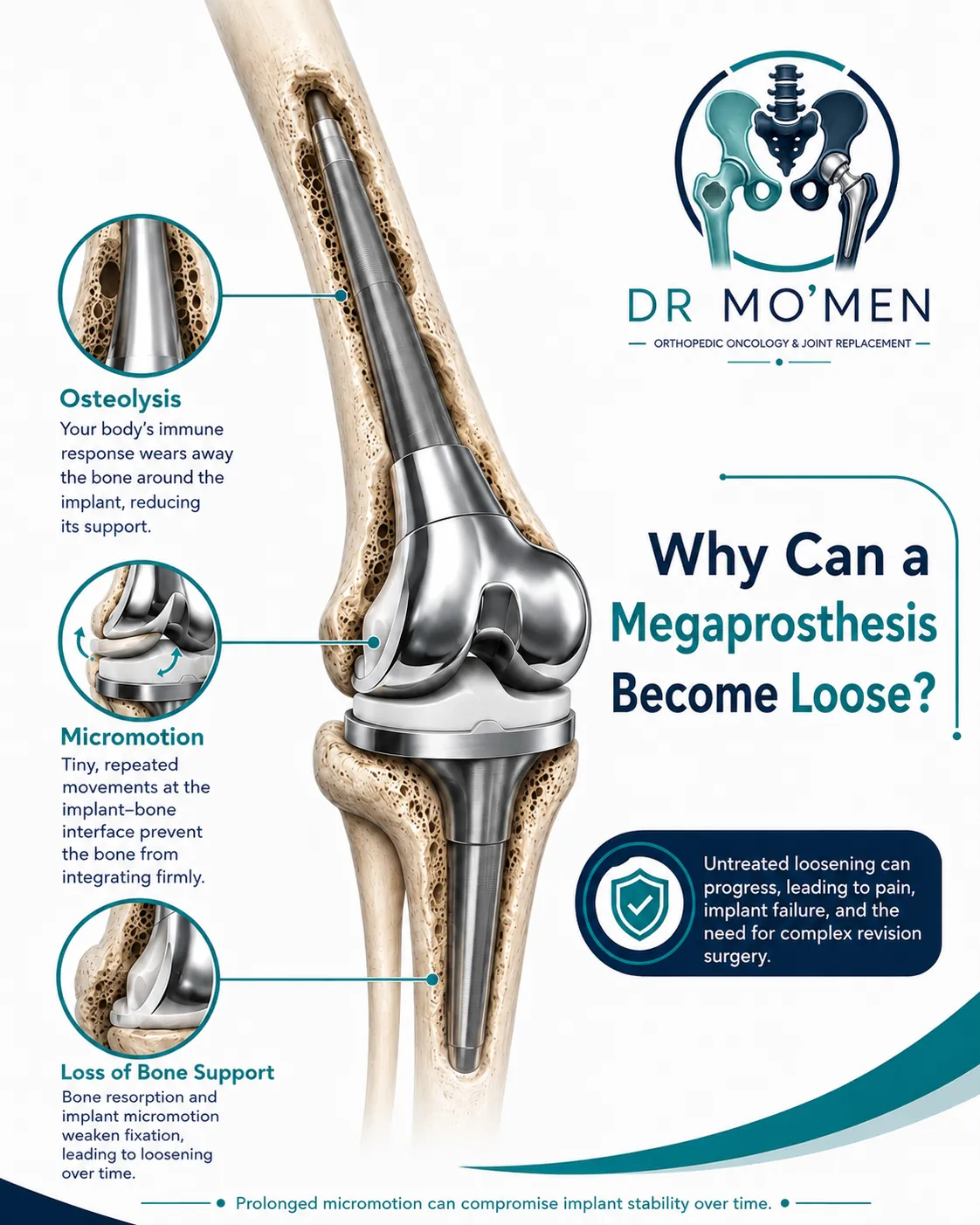
A megaprosthesis may replace a long segment of femur or tibia. Every step transmits forces through the joint, megaprosthesis, stem and remaining bone. Over many years, repetitive loading may affect the implant-bone interface.
2. Micromotion
A small amount of abnormal movement at the stem-bone interface can interfere with stable fixation. If micromotion progressively increases, the interface may become less able to transmit load effectively.
3. Osteolysis
Bone can gradually disappear around parts of the implant. This is called osteolysis. Multiple mechanisms may contribute, including mechanical stress and biological responses to particulate debris in some reconstructions. Progressive osteolysis can reduce the amount of bone supporting the prosthesis.
4. Failure of biological fixation
In cementless implants, long-term stability depends partly on bone integration with the implant surface. If adequate osseointegration does not develop or is subsequently lost, loosening may occur.
5. Problems at a cemented interface
In cemented reconstruction, deterioration can occur at the bone-cement interface, within the cement mantle, or at the cement-implant interface. This may eventually permit stem movement.
Does the amount of bone removed matter?
Potentially, yes. Large tumor resections alter the biomechanics of the reconstructed limb.
Resection length, stem geometry, alignment and the pattern of bone adaptation around the stem may influence mechanical complications. These relationships are complex and should not be interpreted as a single numerical rule that applies to every implant or patient.
Is aseptic loosening more important in younger patients?
Long-term mechanical durability becomes particularly important in younger patients because they may live with the reconstruction for several decades and accumulate a very large number of loading cycles.
Modern implant design has evolved considerably, but long-term surveillance remains important for patients expected to survive many years after tumor treatment.
What symptoms can loosening cause?
Pain with walking or loading
One common pattern is increasing pain during walking, prolonged standing, stair climbing or weight transfer through the limb. Pain may be felt near the stem rather than directly at the joint. For example, a patient with a distal femoral replacement may describe thigh pain.
Progressive reduction in walking ability
A patient who previously walked comfortably may gradually require a walking aid, shorten walking distances, develop a limp or avoid loading the limb.
Mechanical symptoms
Some patients report a sense of movement, instability, clicking or a change in limb alignment. These symptoms are not specific to loosening and may also indicate problems with modular or hinge components.
Can loosening occur without severe pain?
Yes. Radiographic changes may sometimes be identified before symptoms become severe. This is one reason why serial follow-up X-rays can be useful in long-term survivors.
What does loosening look like on X-ray?
Plain radiographs are usually the starting point. Doctors compare current films with previous images rather than interpreting one X-ray in isolation.
Possible findings include:
- progressive radiolucent lines around the stem;
- osteolysis;
- change in stem position;
- subsidence or migration;
- cortical thinning or remodeling;
- reactive cortical thickening or pedestal formation in some situations;
- progressive alignment changes.
Progressive change over time is generally more informative than an isolated appearance on a single radiograph.
Does every radiolucent line mean that the prosthesis is loose?
No. A radiolucent line may occasionally remain stable without meaningful implant migration or major symptoms.
Concern increases when the line progresses, involves more of the interface, is accompanied by osteolysis, is associated with stem migration or subsidence, or corresponds with increasing load-related pain.
An X-ray finding alone does not automatically mean revision surgery is required.
Is CT sometimes needed?
Yes. CT can sometimes help define bone loss, cortical integrity, component position, osteolysis or suspected fracture. Metallic implants can create artifact, so the usefulness of CT depends on the clinical question and the available metal-artifact-reduction techniques.
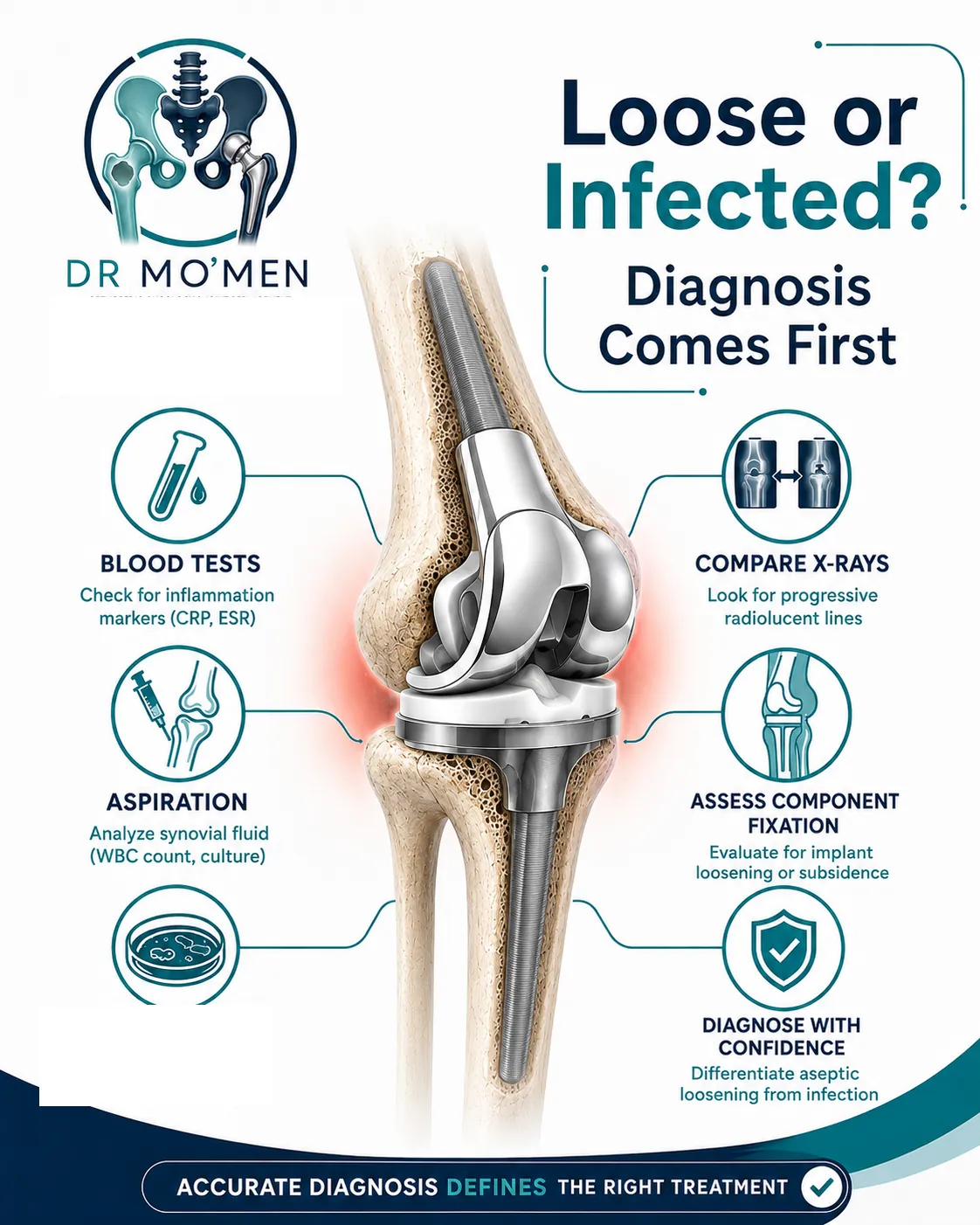
The essential step: rule out infection
Before calling a painful loose megaprosthesis aseptic, infection must be considered.
Evaluation may include clinical examination, wound assessment, CRP, ESR, complete blood count when appropriate, joint aspiration in selected cases, microbiological cultures and other tests when clinically indicated.
Normal inflammatory markers do not absolutely exclude infection, and an elevated CRP does not automatically prove that the megaprosthesis is infected. The findings need to be interpreted together.
Why might aspiration be needed before revision?
If infection is possible, aspiration may help obtain fluid for cell analysis, differential count and cultures. This information can fundamentally change the surgical strategy because revision for true aseptic loosening differs from revision for established megaprosthetic infection.
What other problems can mimic aseptic loosening?
Infection
Periprosthetic infection remains one of the most important differential diagnoses.
Structural implant failure
Problems can develop in bushings, hinge mechanisms, axles, modular junctions or stems.
Metallosis
Mechanical wear can occasionally generate metallic debris and a local tissue reaction. Metallosis can mimic loosening or infection and may sometimes coexist with true component loosening.
Periprosthetic fracture
A fracture can cause sudden pain and inability to bear weight.
Soft-tissue problems
Muscle or tendon failure may affect function despite a stable stem.
Tumor recurrence
New pain or swelling around a previous tumor reconstruction should also be considered in the context of oncological surveillance.
Does aseptic loosening always require surgery?
No. The decision depends on symptoms, progression on serial imaging, implant migration, remaining bone, fracture risk, mechanical stability, age and functional demands, medical condition and oncological status.
When might observation be reasonable?
In selected cases, continued surveillance may be appropriate when symptoms are minimal, radiographic changes are stable, there is no significant migration or impending fracture, infection has not been identified, and the risks of revision outweigh the current benefit.
Follow-up may involve repeat clinical assessment and serial X-rays.
When is revision more likely to be recommended?
Revision becomes more important when there is:
- progressive pain;
- progressive stem migration or subsidence;
- worsening osteolysis;
- significant loss of bone support;
- mechanical instability;
- progressive deformity;
- impending or actual periprosthetic fracture;
- substantial functional deterioration.
When possible, the aim is to address progressive failure before catastrophic mechanical breakdown causes additional bone loss.
What happens during revision surgery?
For the broader reconstruction pathway after loosening, infection or mechanical failure, see revision megaprosthesis surgery.
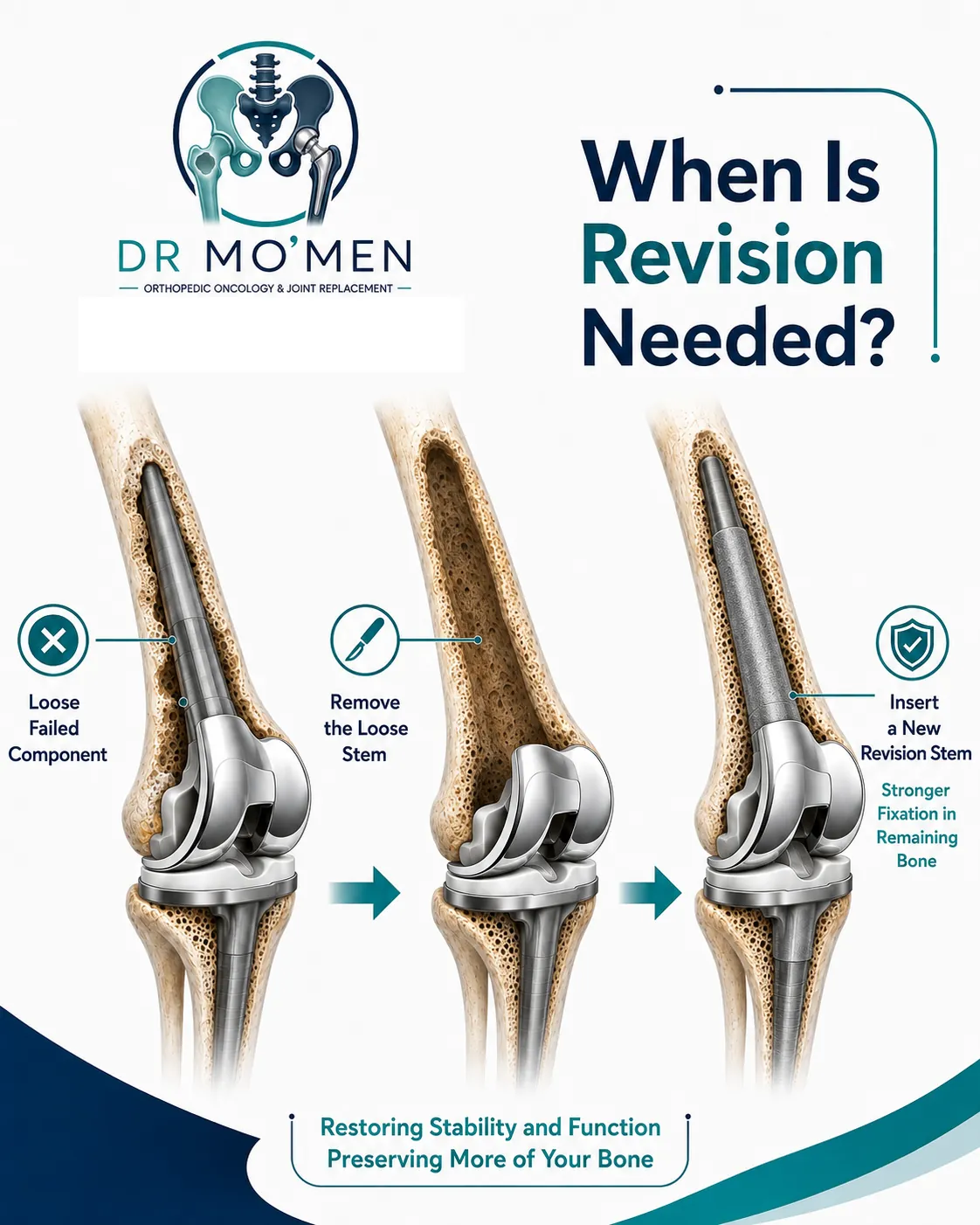
Revision depends on which component is loose and how much bone remains. Possible steps include:
- exposing the previous reconstruction;
- obtaining samples to exclude occult infection;
- removing the loose component;
- removing damaged cement or tissue when appropriate;
- assessing the remaining bone;
- reconstructing the defect;
- inserting a new stem or prosthetic segment;
- restoring alignment and soft-tissue balance.
Some well-fixed modular components may sometimes be preserved, while other situations require replacement of a much larger portion of the reconstruction.
Is the revision stem usually longer?
A revision strategy often seeks fixation in better-quality remaining bone beyond the failed interface. That may require a different stem length, stem diameter, fixation method or implant design.
Small retrospective tumor-prosthesis studies support careful attention to stem dimensions and limb alignment, but implant selection remains individualized rather than determined by one numerical formula.
Cemented or cementless revision?
Both strategies may have roles. The choice depends on anatomical location, remaining bone quality, previous fixation, canal anatomy, bone loss, age, previous treatment and implant system.
Selected complex cases may use porous surfaces, hydroxyapatite-coated collars, custom implants or supplemental fixation. These are specialist reconstructive options rather than universal standards.
Why is bone stock important?
Every revision can potentially reduce available bone. The next implant needs enough remaining bone to obtain stable fixation.
For that reason, revision planning asks not only, “Can we replace the loose stem?” but also, “How can we restore durable fixation while preserving as much useful bone as possible for the future?”
Is revision surgery easier than the original operation?
Usually not. Revision may be more demanding because of scar tissue, previous muscle reconstruction, bone loss, cement removal, long stems, altered anatomy, fracture risk during component removal and the need to exclude infection.
What happens after revision?
Rehabilitation depends on revision fixation, remaining bone, whether a fracture was present, soft-tissue reconstruction, anatomical site and intraoperative findings. Some patients can begin early mobilization, while others require protected weight-bearing.
There is no universal rehabilitation timetable after megaprosthesis revision.
Can aseptic loosening happen again?
Yes. Revision does not guarantee that loosening will never recur. The goal is to achieve the most durable reconstruction possible with the available bone and soft tissue. Long-term radiographic surveillance remains important.
When should review be urgent?
- sudden severe pain;
- sudden inability to bear weight;
- new deformity;
- painful instability;
- rapidly increasing thigh or leg pain;
- new swelling or mass;
- fever or wound drainage;
- a sudden mechanical change in a previously stable prosthesis.
Sudden symptoms raise concern not only for loosening but also for fracture, structural failure or infection.
When is a second opinion useful?
- revision megaprosthesis surgery has been recommended;
- infection has not been confidently excluded;
- there is major bone loss;
- several previous revisions have already been performed;
- stem removal may sacrifice substantial bone;
- a custom implant is being considered;
- amputation has been raised as a possibility;
- symptoms and radiographs do not clearly match.
Role of Dr. Mohammed Abdelmoemen Abuelhadid in complex cases
Evaluation of a painful megaprosthesis requires examination of the whole reconstruction, not simply whether an X-ray contains a radiolucent line.
Assessment may involve:
- reviewing the original tumor and surgery;
- comparing current and previous radiographs;
- assessing stem fixation and alignment;
- excluding infection;
- assessing bone loss;
- looking for mechanical or hinge problems;
- excluding fracture and tumor recurrence;
- determining whether observation or revision is appropriate;
- planning how much of the existing reconstruction can safely be preserved.
Dr. Mohammed Abdelmoemen Abuelhadid evaluates complex tumor megaprostheses, aseptic loosening and revision reconstructions, including patients seeking a second opinion before major revision surgery.
Patients outside Egypt may send current and previous X-rays, CT or MRI when available, operative reports and relevant laboratory results for preliminary review before travelling when appropriate.
For appointments or imaging review: +20 102 1690693
Frequently Asked Questions
Can a loose megaprosthesis be treated without surgery?
Some patients with minimal symptoms and stable radiographic findings may be monitored. Progressive symptomatic loosening usually requires more active consideration of revision.
Can an X-ray prove that loosening is aseptic?
No. X-rays may strongly suggest loosening, but infection still needs to be considered separately.
Does a radiolucent line automatically mean revision?
No. Serial progression, migration, symptoms and bone loss are more important than an isolated stable line.
Can only the loose stem be changed?
Sometimes. Megaprostheses are modular, so selected well-fixed components may occasionally be retained. The decision depends on implant design, infection status, bone loss and the mechanical problem.
Is aseptic loosening an emergency?
Gradual loosening is not always an emergency, but progressive loosening should not be ignored. Sudden pain, inability to bear weight or deformity requires urgent assessment because fracture or structural failure may have occurred.
Medical Disclaimer
This article is for patient education and does not replace clinical examination, specialist medical advice, or review of current and previous imaging and investigations.