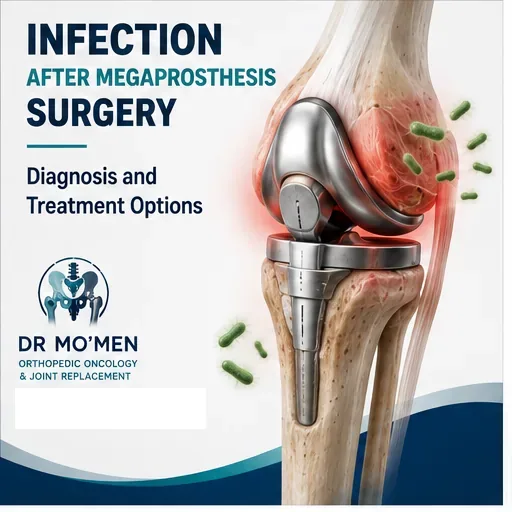
A megaprosthesis can reconstruct a very large bone and joint defect after removal of a bone tumor and can make limb-salvage surgery possible.
However, deep infection around a megaprosthesis is one of the most important complications that requires long-term surveillance.
It is more complicated than a superficial wound infection because bacteria may attach to the metallic implant and develop a biofilm, which can make eradication with antibiotics alone difficult.
Treatment may therefore require a combination of accurate diagnosis, microbiological cultures, surgical debridement, appropriate antibiotics, and component exchange or revision when necessary.
For location-specific reconstruction, see the guides to distal femoral megaprosthesis and proximal tibial megaprosthesis. For diagnosis before tumor surgery, review bone tumor biopsy planning.
Megaprosthetic infection is particularly challenging in orthopedic oncology because these operations involve large implants, extensive dissection, large dead spaces and sometimes compromised soft tissues or systemic cancer treatment.
What is a megaprosthesis infection?
The medical term commonly used is periprosthetic joint infection (PJI). It means that microorganisms have infected tissues surrounding the prosthesis and may also have colonized the implant itself.
The infection may involve the surgical wound, deep soft tissues, the joint, the interface between bone and prosthesis, or modular prosthetic components.
This is different from temporary redness or mild swelling that can normally occur during early postoperative healing.
Why is infection particularly important after tumor megaprosthesis surgery?
Megaprostheses differ from ordinary hip or knee replacements. Tumor surgery may involve removal of a large amount of bone, extensive soft-tissue dissection, long operating times, large metallic implants, muscle or flap reconstruction, previous surgery, chemotherapy in selected tumor types, radiotherapy in selected circumstances, or revision surgery.
This does not mean that infection is expected in every patient. It means that prevention, early recognition and appropriate management are especially important.
When can infection occur?
Early postoperative infection
This appears relatively soon after surgery.
Possible manifestations include persistent wound drainage, increasing redness, wound separation, increasing swelling, fever, or increasing pain rather than gradual improvement.
An early diagnosis is important because some acute infections may still be treatable while retaining well-fixed major prosthetic components.
Delayed or chronic infection
Some infections appear months or even years after surgery.
The patient may notice gradually increasing pain, recurrent swelling, intermittent wound discharge, persistent stiffness, progressive loss of function, or development of a sinus communicating with the implant.
Chronic infection is generally more difficult to eradicate because mature biofilm may be present on the prosthesis.
What are the warning signs?
- persistent or new wound drainage;
- increasing redness;
- increasing warmth around the operation;
- progressive swelling;
- fever associated with wound symptoms;
- worsening pain after initial improvement;
- new difficulty walking;
- sudden deterioration in joint function;
- a new opening or sinus in the wound.
Does pain always mean infection?
No. Pain around a megaprosthesis can have several causes, including infection, aseptic loosening, mechanical wear, instability, periprosthetic fracture, muscle or tendon problems, or tumor recurrence.
How is megaprosthesis infection diagnosed?
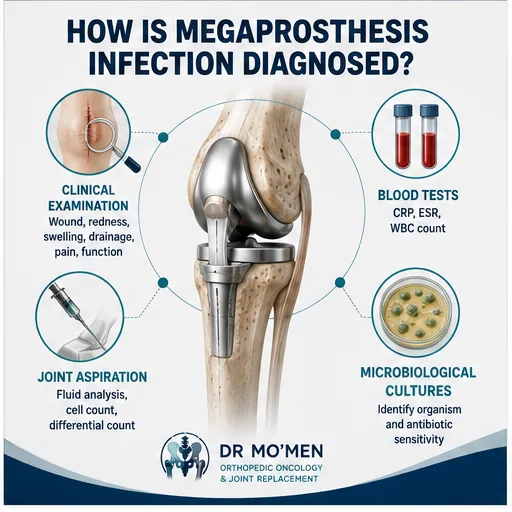
Diagnosis usually requires multiple pieces of information. No single blood test or X-ray reliably confirms or excludes infection in every patient.
Clinical examination
The surgeon evaluates wound condition, swelling, skin temperature, drainage, sinus formation, tenderness, joint movement and implant function.
Blood tests
Tests may include inflammatory markers such as CRP, ESR and complete blood count. These results must be interpreted carefully, especially in tumor patients.
Aspiration and cultures
In selected patients, fluid may be aspirated from around the joint or prosthesis for analysis and culture. During surgery, several deep-tissue specimens are often obtained from separate locations.
Should antibiotics be started before cultures?
This depends on the patient’s clinical condition. For a stable patient, starting antibiotics before appropriate cultures may reduce the ability to identify the responsible organism. For a patient who is systemically unwell or septic, urgent treatment may be necessary and should not be delayed.
How is infection treated?
There is no single operation that is appropriate for every megaprosthesis infection. The decision depends on whether the infection is acute or chronic, the duration of symptoms, organism, antibiotic susceptibility, implant stability, soft-tissue condition, presence of a sinus, previous infection surgery, remaining bone, oncological status and general health.
- DAIR
- DAIR with modular component exchange
- one-stage revision in highly selected situations
- two-stage revision
- salvage procedures when infection cannot otherwise be controlled
What is DAIR?
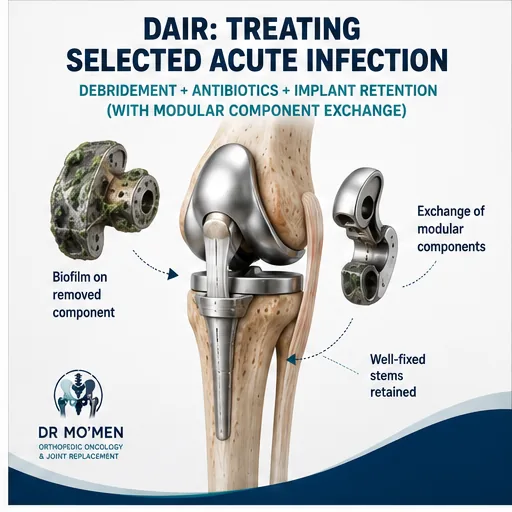
DAIR means Debridement + Antibiotics + Implant Retention. During surgery, infected or nonviable tissue is removed and the area is thoroughly cleaned while major fixed prosthetic components are retained.
DAIR is generally considered more appropriate for carefully selected acute infections where symptoms have been present for a relatively short period, the prosthesis remains well fixed, soft tissues can be adequately treated, there is no established long-standing sinus, and the organism and host factors are suitable.
What is DAIR-plus?
A megaprosthesis is usually modular. Therefore, during debridement it may be possible to exchange accessible modular components while retaining well-fixed stems. This can remove additional surfaces potentially covered by biofilm without sacrificing well-fixed stems and large amounts of bone.
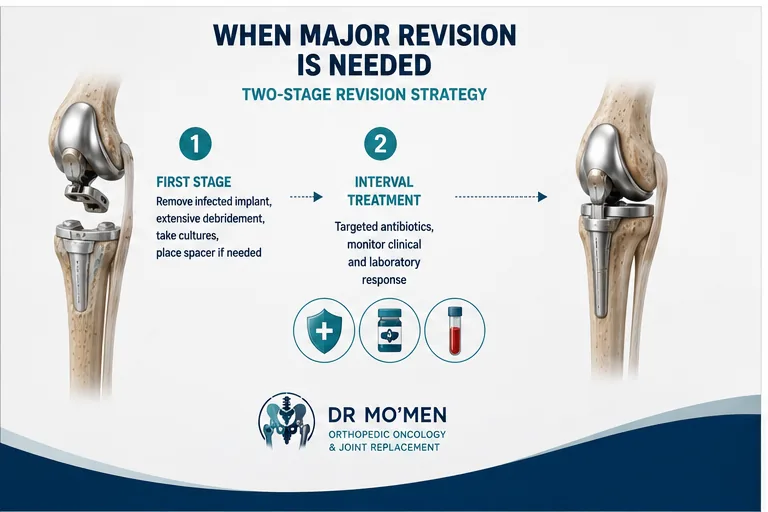
What is a two-stage revision?
First stage
The infected prosthetic components may be removed, followed by extensive debridement, removal of infected tissue, multiple cultures, temporary reconstruction or spacer when appropriate, and targeted antimicrobial therapy.
Interval treatment
The patient is monitored clinically and with laboratory investigations. Antibiotic choice and duration are individualized.
Second stage
If infection is considered adequately controlled and reconstruction remains appropriate, a new megaprosthesis may be implanted.
Is one-stage revision possible?
In selected circumstances, surgeons may remove the infected implant, perform extensive debridement and implant a new reconstruction during the same operation. It is not a default option for every patient.
For the broader reconstruction pathway when revision is being considered for infection, loosening or mechanical failure, see revision megaprosthesis surgery after bone tumor reconstruction.
What role do antibiotics play?
Antibiotics are essential, but they are rarely the only treatment for established deep implant infection. Treatment should ideally be based on culture results, organism susceptibility, allergies, kidney and liver function, interactions with cancer therapies and the surgical strategy.
What about soft-tissue reconstruction?
Soft tissue is crucial. If the prosthesis does not have durable, vascularized coverage, infection eradication becomes substantially more difficult. Depending on the defect, treatment may require muscle flap coverage, local tissue advancement, or reconstructive plastic surgery.
Does infection mean amputation is inevitable?
No. Many megaprosthetic infections can be managed while preserving the limb. Amputation is generally considered when infection cannot be controlled safely, reconstruction is no longer feasible, or the limb has become severely compromised.
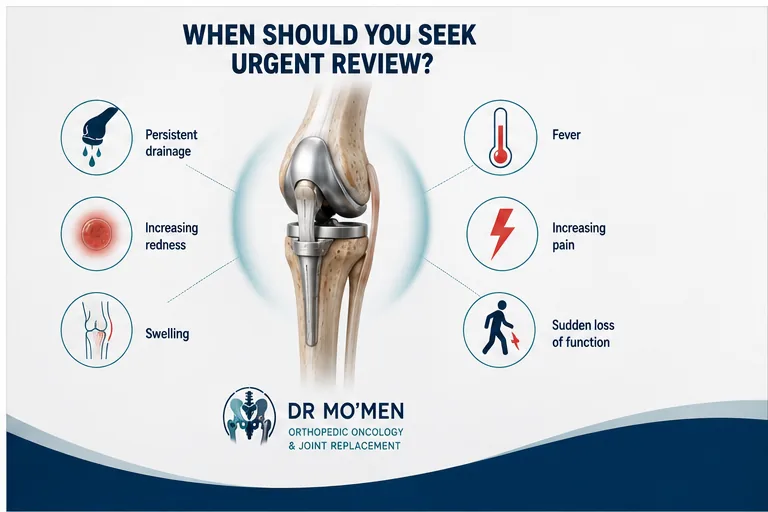
When should a patient seek urgent medical assessment?
- persistent or rapidly increasing wound drainage;
- wound opening;
- fever with redness or swelling;
- rapidly progressive pain;
- severe swelling;
- sudden inability to bear weight;
- new systemic illness after megaprosthesis surgery.
Complex recurrent infection or major revision decisions may also be reviewed through the second-opinion pathway.
Role of Dr. Mohammed Abdelmoemen Abuelhadid in complex cases
Infection after tumor megaprosthesis surgery requires evaluation of the entire reconstruction rather than treating laboratory results in isolation.
- reviewing the original tumor diagnosis and resection;
- examining previous operative reports;
- comparing serial X-rays;
- reviewing cultures and previous antibiotics;
- determining whether components are fixed or loose;
- assessing bone and soft-tissue loss;
- evaluating whether implant retention or revision is reasonable;
- integrating the plan with ongoing oncology care.
Dr. Mohammed Abdelmoemen Abuelhadid evaluates complex megaprosthesis and revision cases, including patients seeking a second opinion after recurrent infection or before major revision reconstruction.
For appointments or imaging review: +20 102 1690693
Frequently Asked Questions
Can a megaprosthesis infection be treated with antibiotics alone?
Established deep prosthetic infection frequently requires surgical treatment in addition to antibiotics because bacteria may persist in biofilm on the implant.
Does every infection require removal of the entire megaprosthesis?
No. Selected acute infections may be treated using debridement with retention of well-fixed stems and exchange of accessible modular components. Chronic or recurrent infections are more likely to require major revision.
What is the difference between DAIR and two-stage revision?
DAIR attempts to control infection while retaining major fixed components. Two-stage revision removes infected components, treats the infection and later performs reconstruction if appropriate.
Can an infection return after treatment?
Yes. Reinfection or relapse can occur after any treatment strategy, which is why long-term surveillance is important.
Does infection always mean the limb will be lost?
No. Many infections can be treated while preserving the limb, although severe recurrent infection can occasionally make limb salvage impossible.
Medical Disclaimer
This article is for patient education and does not replace clinical examination, specialist medical advice, or review of imaging, laboratory investigations and microbiological cultures.