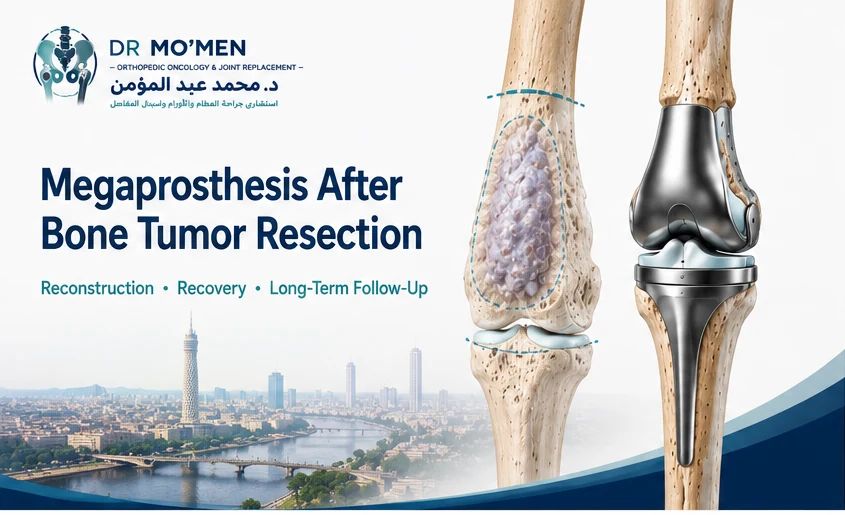
Removing a large bone tumor may leave a major defect in the skeleton.
When the tumor involves the end of a long bone or a major joint, simply removing the lesion may not be enough. The surgeon must also reconstruct the limb so that it can remain stable and functional.
One of the most important reconstruction options in modern orthopedic oncology is the megaprosthesis, also called a tumor prosthesis or endoprosthetic reconstruction.
Patients often ask: What exactly is a megaprosthesis? When can I walk after surgery? How much function can I expect? Can the implant loosen or become infected? How long will it last?
There is no single answer that applies to every patient. Recovery depends on the location of the tumor, the amount of bone and muscle removed, the type of reconstruction, the condition of the soft tissues, systemic cancer treatment where applicable, and the patient’s general health.
A megaprosthesis can allow limb preservation after major tumor resection, but it is also a complex reconstruction that requires structured rehabilitation and long-term follow-up.
What Is a Megaprosthesis?
A location-specific guide is also available for proximal tibial megaprosthesis after bone tumor resection.
For a location-specific reconstruction pathway, see distal femoral megaprosthesis after bone tumor resection.
A megaprosthesis is a large modular orthopedic implant designed to replace a substantial segment of bone and, frequently, the adjacent joint.
It is different from a standard hip or knee replacement. In routine joint replacement, the surgeon primarily resurfaces or replaces the damaged joint surfaces while preserving most of the surrounding bone. In tumor surgery, however, a significant segment of bone may need to be removed to obtain an appropriate oncological margin.
The megaprosthesis replaces that missing segment. Depending on the location, it may replace part of the femur, part of the tibia, the hip region, the knee region, the proximal humerus, or several segments of bone in particularly complex cases.
The implant is usually modular, allowing the surgeon to adapt the reconstruction to the amount of bone removed.
Why Is a Megaprosthesis Used After Bone Tumor Surgery?
The primary objective of bone tumor surgery is appropriate tumor removal. If a malignant or locally aggressive tumor requires wide resection, the resulting skeletal defect may be too large for conventional fixation.
A megaprosthesis can restore skeletal continuity, limb length, joint stability, mechanical alignment, the ability to mobilize, and a platform for rehabilitation.
This reconstruction can be particularly useful when tumors involve the ends of long bones close to major joints.
Related article: Limb salvage surgery for bone tumors
Which Bone Tumors May Require Megaprosthetic Reconstruction?
Megaprosthetic reconstruction may be considered after major resection for selected cases involving osteosarcoma, chondrosarcoma, Ewing sarcoma, aggressive giant cell tumor of bone, metastatic bone disease, recurrent bone tumors, or other locally aggressive or malignant skeletal tumors.
The diagnosis alone does not determine whether a megaprosthesis is required. The decision depends mainly on tumor location, extent of bone involvement, joint involvement, required surgical margin, remaining bone stock, patient age, expected function, and other reconstruction options.
Where Are Megaprostheses Used?
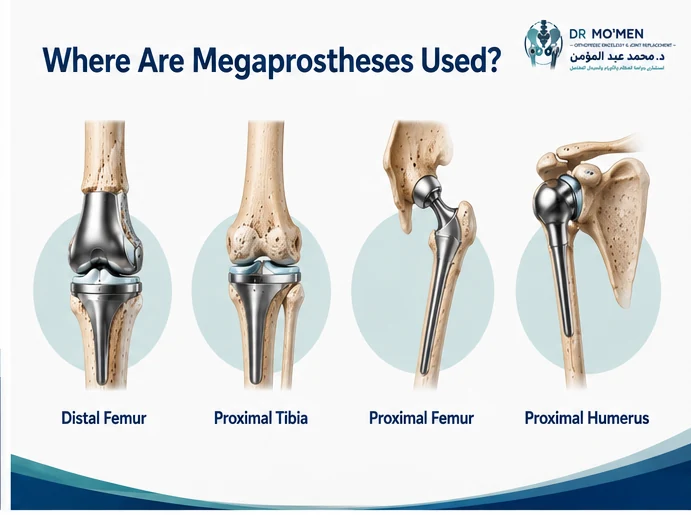
Common anatomical reconstructions include distal femoral replacement, proximal tibial replacement, proximal femoral replacement, proximal humeral replacement, total femoral replacement in selected complex situations, and custom or modular reconstructions in unusual anatomical defects.
Each location has its own functional challenges and complication profile.
Distal Femoral Megaprosthesis
The distal femur is a common site for primary bone tumors. If a tumor extends close to or involves the knee joint, adequate resection may require removal of the distal femur and knee surface.
A distal femoral megaprosthesis can replace the removed distal femur, the knee articulation, and the missing segment of bone. The reconstruction connects the remaining femur to the proximal tibia through a modular prosthetic knee mechanism.
What Function Can Be Expected After Distal Femoral Replacement?
The aim is usually to restore a stable limb that allows meaningful walking and everyday activity. Functional recovery depends on quadriceps preservation, amount of muscle removed, nerve function, wound healing, implant stability, rehabilitation, systemic treatment, and complications.
Some patients achieve good independent daily function, while others have permanent limitations. Individual expectations should be discussed before surgery.
Proximal Tibial Megaprosthesis
Tumors affecting the proximal tibia present different reconstructive challenges because the knee extensor mechanism is closely related to the proximal tibia.
Following tumor resection, reconstruction may involve not only replacement of bone but also careful restoration of patellar tendon attachment, knee extension mechanism, and soft-tissue coverage. Rehabilitation may be modified to protect the repaired extensor mechanism during early healing.
Proximal Femoral Replacement
A proximal femoral megaprosthesis can be used after removal of a large portion of the upper femur. This may be considered for primary bone tumors, metastatic destruction, and selected failed previous reconstructions.
Hip stability after proximal femoral reconstruction depends partly on preserving or reconstructing the surrounding soft tissues. The hip abductor muscles contribute to stability, walking, balance, and pelvic control.
Proximal Humeral Megaprosthesis
Megaprosthetic reconstruction may also be used after major resection around the shoulder. The functional result is influenced heavily by rotator cuff preservation, deltoid muscle, axillary nerve function, and the extent of soft-tissue resection.
The primary goal may sometimes be preservation of a stable, painless upper limb rather than restoration of normal shoulder motion.
What Happens During Tumor Resection and Reconstruction?
Phase 1: Tumor Resection
The orthopedic oncology team removes the tumor with the planned margin. This may involve removal of bone, joint, muscle, biopsy tract, surrounding soft tissue, or the previous surgical field in recurrent or unplanned cases.
Phase 2: Reconstruction
The remaining bone is prepared for the modular prosthesis. The surgeon then reconstructs skeletal continuity, joint articulation, limb length, alignment, and soft tissues. The exact operation varies considerably between anatomical regions.
Why Biopsy and MRI Planning Still Matter Before Megaprosthesis Surgery
The reconstruction should never be planned independently of the tumor operation. Before definitive surgery, the team usually needs to understand the exact tumor diagnosis, local extent, intramedullary extent, soft-tissue extension, relationship to vessels and nerves, relationship to the joint, and biopsy tract location.
An inadequately planned biopsy can alter the definitive resection. Related article: Bone tumor biopsy planning.
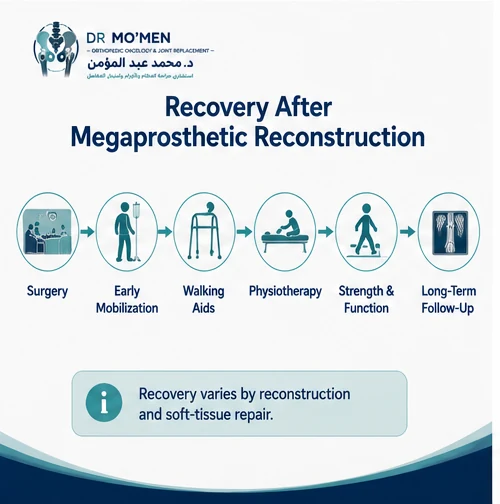
When Can You Start Walking After Megaprosthesis Surgery?
No universal walking timeline
Weight-bearing and mobilization depend on the anatomical reconstruction, implant fixation, soft-tissue repair, wound condition, muscle reconstruction, extensor mechanism repair, bone quality, additional procedures, and the surgeon’s postoperative protocol.
Some megaprosthetic reconstructions provide immediate structural stability that can facilitate relatively early mobilization. However, early implant stability does not mean that all surrounding soft tissues are fully healed.
For example, a patient with proximal tibial reconstruction and extensor-mechanism repair may require more protective rehabilitation than another patient with a different reconstruction. The rehabilitation plan should therefore be individualized.
Rehabilitation After Megaprosthetic Reconstruction
Rehabilitation is a central part of limb-salvage treatment. The initial goals may include pain control, safe transfers, walking with appropriate support, prevention of stiffness, protection of soft-tissue repair, muscle activation, thrombosis prevention, and gradual restoration of independence.
Later rehabilitation may focus on strength, balance, joint movement, gait training, stair climbing, endurance, and return to daily activities. Recovery may continue over an extended period.
What Function Can Patients Expect?
A megaprosthesis is intended to provide a useful reconstruction after removal of a major segment of bone. However, it does not reproduce a completely normal limb.
Function depends on tumor site, amount of bone removed, muscle preservation, nerve preservation, reconstruction type, complications, rehabilitation, systemic therapy, and the patient’s general health.
Many patients can regain useful walking and daily function after lower-limb megaprosthetic reconstruction. However, some activities may remain limited. High-impact activities may not be appropriate for every reconstruction. The patient’s own rehabilitation plan should guide return to activity.
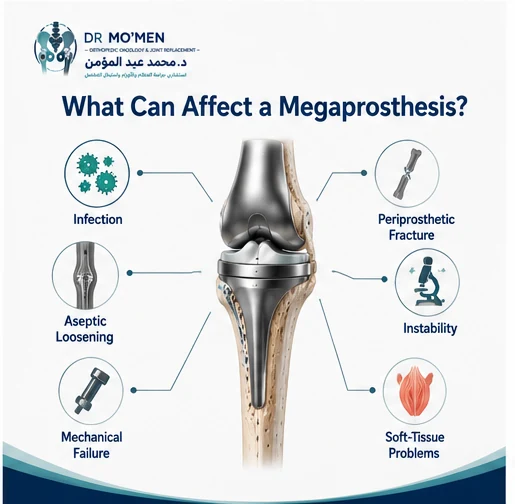
What Can Go Wrong With a Megaprosthesis?
Megaprostheses are complex reconstructions. Long-term follow-up is important because complications may involve both the implant and the previous tumor.
Infection
Read the dedicated guide to infection after megaprosthesis surgery.
Infection is one of the most important complications after major oncologic reconstruction. Risk may be influenced by large surgical exposure, lengthy operations, extensive soft-tissue dissection, previous surgery, chemotherapy or immunosuppression in selected patients, wound problems, and repeated revision surgery.
Signs that may require assessment include increasing pain, redness, swelling, wound discharge, fever, or wound breakdown. Not every painful megaprosthesis is infected. Diagnosis may require clinical examination, blood tests, imaging, and joint or tissue sampling in selected situations.
Aseptic Loosening
Aseptic loosening means the implant loses stable fixation to bone without infection being responsible. Patients may experience progressive pain, pain during weight-bearing, change in function, or radiographic changes around the stem.
Treatment depends on severity, implant design, bone loss, symptoms, and remaining bone. Some cases may eventually require revision surgery.
Mechanical Failure
Because megaprostheses are large mechanical reconstructions subjected to repeated loading, mechanical components can occasionally fail. Possible problems include implant component failure, hinge-related problems, wear, breakage, or failure of modular connections.
Periprosthetic Fracture
A fracture may occur around a megaprosthetic stem. Treatment depends on fracture location, implant stability, available bone, tumor status, infection status, and patient condition.
Instability, Dislocation and Soft-Tissue Failure
Instability can occur in certain megaprosthetic reconstructions, especially around the hip. A megaprosthesis also cannot function independently of the surrounding muscles and tendons. Soft-tissue failure may include tendon detachment, muscle weakness, extensor-mechanism problems, instability, or poor soft-tissue coverage.
Local Tumor Recurrence
Patients often worry that new pain automatically means the tumor has returned. It does not. Pain around a previous tumor prosthesis can have several causes. However, local recurrence must remain part of the differential diagnosis in appropriate patients.
Related article: Recurrent bone tumor: what should you do next?
New Pain Around a Megaprosthesis: What Could It Mean?
New or increasing pain deserves evaluation. Possible causes include infection, aseptic loosening, mechanical failure, periprosthetic fracture, instability, soft-tissue problems, local tumor recurrence, and unrelated musculoskeletal pain.
The investigation should be directed by the clinical presentation and may include clinical examination, X-rays, laboratory tests when infection is suspected, and additional imaging or sampling when appropriate.
How Long Does a Megaprosthesis Last?
No fixed lifespan applies to every patient
Long-term implant performance depends on anatomical location, implant design and fixation, patient age and activity, body weight, remaining bone, soft-tissue reconstruction, infection, mechanical loading, previous surgery, oncological treatment, and subsequent complications.
Some reconstructions can function for many years, while others may require earlier revision. Long-term surveillance is therefore more useful than relying on a single predicted lifespan.
Does a Megaprosthesis Ever Need Revision Surgery?
Revision surgery may be required for infection, aseptic loosening, mechanical failure, instability, fracture, progressive bone loss, soft-tissue failure, or recurrent tumor. The revision may range from replacing one modular component to rebuilding most of the original reconstruction.
Can a Failed Megaprosthesis Be Revised?
In many cases, revision is technically possible. However, revision megaprosthetic surgery can be significantly more complex than the original reconstruction.
The surgeon must assess remaining bone, remaining soft tissue, infection status, neurovascular structures, previous incisions, implant design, fixation, previous complications, and tumor status. Some patients may require another megaprosthesis. Others may need a different reconstruction.
What If the Megaprosthesis Is Infected?
Management of infection around a tumor prosthesis can be challenging. Treatment depends on timing of infection, organism, implant stability, soft-tissue condition, systemic health, tumor status, and previous operations.
Potential strategies may include surgical debridement, antimicrobial treatment, component exchange, staged revision, or more extensive reconstruction. No single infection treatment strategy is appropriate for every patient.
What If the Tumor Comes Back Around the Prosthesis?
Recurrence around a megaprosthesis requires full reassessment. The team needs to distinguish local recurrence, infection, implant failure, and other causes of symptoms.
When recurrence is confirmed, further surgery may involve wider resection, removal of part or all of the prosthesis, revision megaprosthetic reconstruction, additional soft-tissue reconstruction, an alternative limb-salvage procedure, or amputation in selected cases.
Repeat limb salvage may still be technically possible in selected patients.
Long-Term Follow-Up Has Two Separate Goals
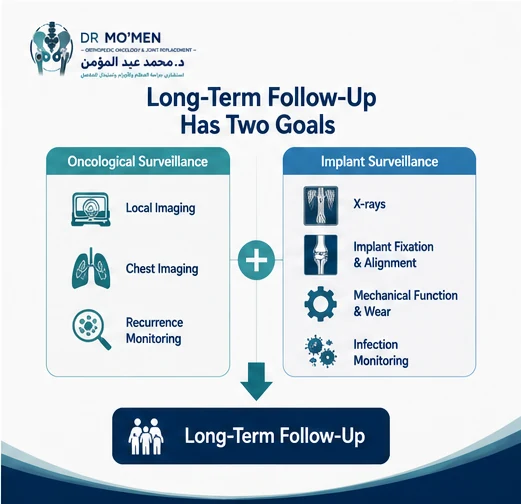
1. Oncological Surveillance
The purpose is to detect local recurrence and metastatic disease. The surveillance schedule depends on tumor type, tumor grade, treatment, and time since surgery. It may include local and chest imaging according to the diagnosis.
2. Reconstruction Surveillance
The purpose is to assess implant fixation, mechanical integrity, wear, fracture, soft tissues, function, and infection.
These two follow-up pathways overlap but are not identical. A patient can have a mechanically well-functioning implant while still requiring oncological surveillance, and a patient can remain tumor-free while developing an implant-related complication.
Warning Signs That Need Prompt Medical Assessment
Seek prompt medical assessment for increasing unexplained pain, inability to bear weight, sudden loss of function, new deformity, rapidly increasing swelling, persistent wound drainage, increasing redness, significant fever, sudden instability, symptoms after a fall or injury, or a new mass near the surgical site.
Urgent symptoms: chest pain, severe shortness of breath, or acute neurovascular changes require immediate local emergency assessment.
When Should You Seek a Second Opinion?
A specialist orthopedic oncology or complex reconstruction opinion may be useful if megaprosthetic reconstruction has been proposed, you want to understand reconstruction alternatives, a megaprosthesis has become painful, infection is suspected, implant loosening has been diagnosed, mechanical failure has occurred, revision surgery has been recommended, a fracture has occurred around the prosthesis, recurrence is suspected, amputation has been proposed after reconstruction failure, or previous revision attempts have failed.
A second opinion does not necessarily mean the previous recommendation is incorrect. Its purpose is to clarify the diagnosis and understand what reconstructive options remain.
Second opinion pathway: Request a specialist orthopedic second opinion
International Patients: What Should You Send Before Travelling?
International patients with an existing megaprosthesis can provide medical records for preliminary specialist review. Useful records include recent X-rays, original postoperative X-rays, serial follow-up X-rays, MRI or CT if performed, tumor pathology report, original operative report, implant name or implant card, previous revision reports, culture results if infection has been suspected, recent blood tests, oncology treatment summary, and current symptoms.
Comparing old and recent imaging can be especially valuable when evaluating loosening, mechanical changes, fracture, or recurrence.
Send Your Records Before You Travel
If you are outside Egypt, you can send existing X-rays, MRI or CT images, pathology reports, operative notes and implant information for an initial specialist review before arranging travel. This preliminary review can help clarify what additional evaluation may be needed and whether an in-person orthopedic oncology or complex-reconstruction consultation is appropriate.
Remote review does not replace physical examination, final diagnosis, infection work-up, pathology review or a definitive surgical plan when those are required.
How to send MRI, CT and X-ray files for review
International Patients Request a Specialist Second Opinion Send the file link by WhatsApp
About Dr. Mohammed Abdelmoemen Abuelhadid
Dr. Mohammed Abdelmoemen Abuelhadid is an Orthopedic Oncology & Joint Replacement Surgeon and Lecturer of Orthopedic Surgery at Ain Shams University. His clinical work includes orthopedic oncology, limb salvage surgery, bone and soft-tissue tumors, megaprosthetic reconstruction, complex tumor reconstruction, joint replacement, revision arthroplasty, evaluation of failed orthopedic reconstructions, and second opinions for complex orthopedic cases.
Patients with tumor prostheses require long-term assessment of both their oncological status and their reconstruction.
Frequently Asked Questions
What is the difference between a megaprosthesis and a normal joint replacement?
A standard joint replacement mainly replaces damaged joint surfaces. A megaprosthesis may replace an entire segment of bone together with the joint after major tumor resection, making it a substantially larger reconstruction.
Can I walk normally after a tumor megaprosthesis?
Many patients regain useful walking function, but the final result depends on the location of surgery, muscles removed, nerve function, reconstruction type, rehabilitation, and complications. Normal function cannot be guaranteed.
When can I put weight on the leg?
There is no universal timeline. Weight-bearing depends on implant fixation, soft-tissue repair, anatomical site, wound healing, and the surgeon’s postoperative protocol.
How long does a megaprosthesis last?
There is no fixed lifespan that applies to every patient. Implant longevity depends on mechanical, biological and patient-specific factors, so long-term monitoring is required.
Does new pain mean the tumor has returned?
No. Pain may also result from infection, loosening, mechanical failure, fracture, instability, or soft-tissue problems. Appropriate evaluation is required.
Can an infected megaprosthesis be treated?
Treatment is possible in many cases, but infection around a tumor prosthesis can be complex. The appropriate strategy depends on timing, organism, implant stability, soft-tissue condition and previous surgery.
Can a failed megaprosthesis be revised?
Often yes, but revision surgery can be complex. Feasibility depends on remaining bone, soft tissues, infection, implant design, previous operations and tumor status.
How this article was reviewed
This patient-education article was reviewed for clinical accuracy, patient safety, and decision-making clarity by Dr. Mohammed Abdelmoemen Abuelhadid. It is intended to support, not replace, clinical examination, pathology review, laboratory evaluation, and review of the actual imaging and reports.
Author and medical reviewer
Dr. Mohammed Abdelmoemen Abuelhadid — Orthopedic Oncology & Joint Replacement Surgeon and Lecturer of Orthopedic Surgery at Ain Shams University.
Medical Disclaimer: This article is for patient education and does not replace clinical examination, review of imaging, pathology, laboratory investigations, or individualized multidisciplinary medical advice.