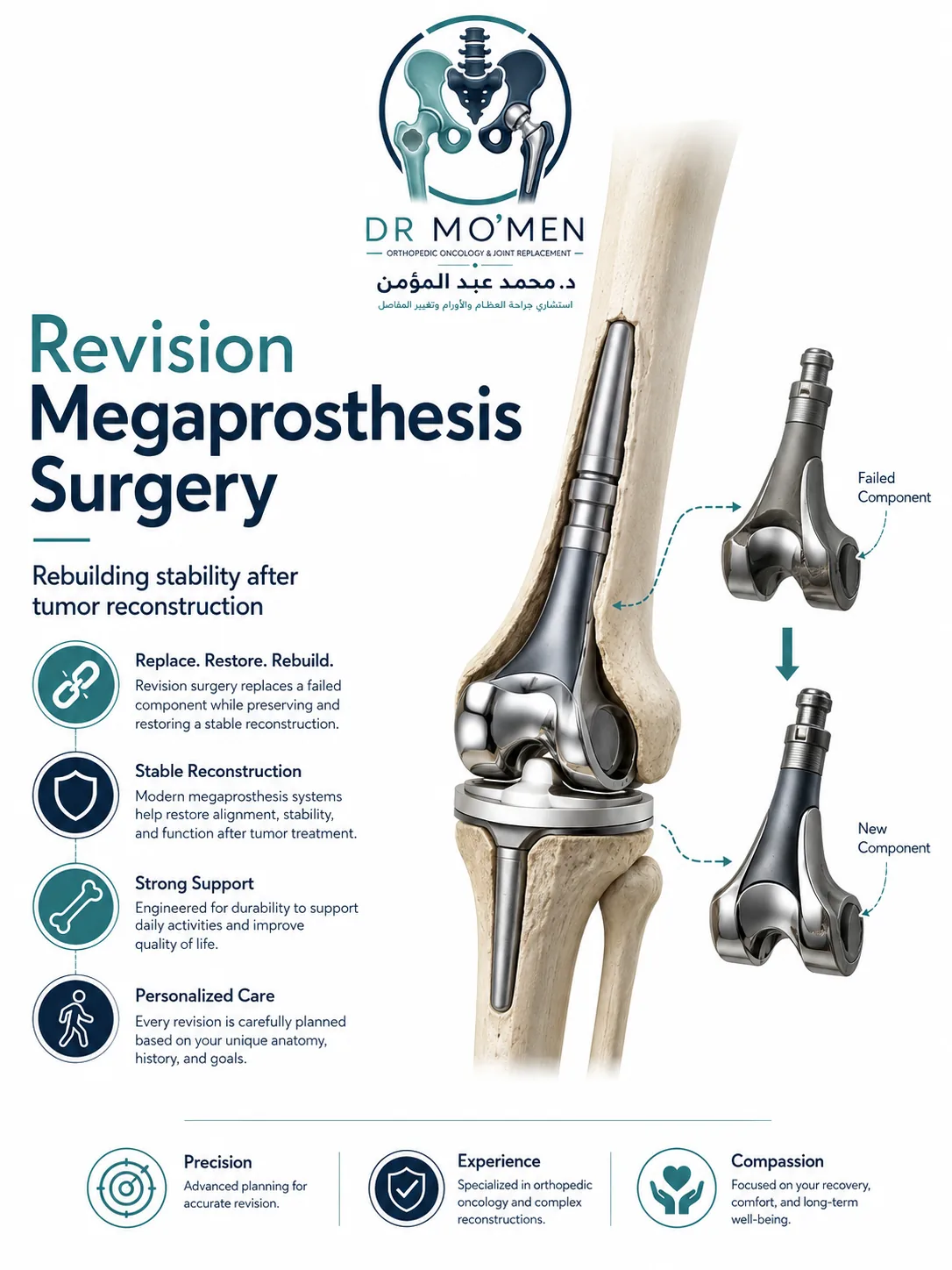
A megaprosthesis may reconstruct a very large skeletal defect after bone tumor resection and can remain functional for many years.
However, a tumor megaprosthesis is a complex mechanical and biological reconstruction. Problems may develop in the implant, its fixation to bone, the hinge or modular components, surrounding muscles and tendons, the soft-tissue envelope, or the original tumor.
When a significant problem develops, the patient may require revision megaprosthesis surgery.
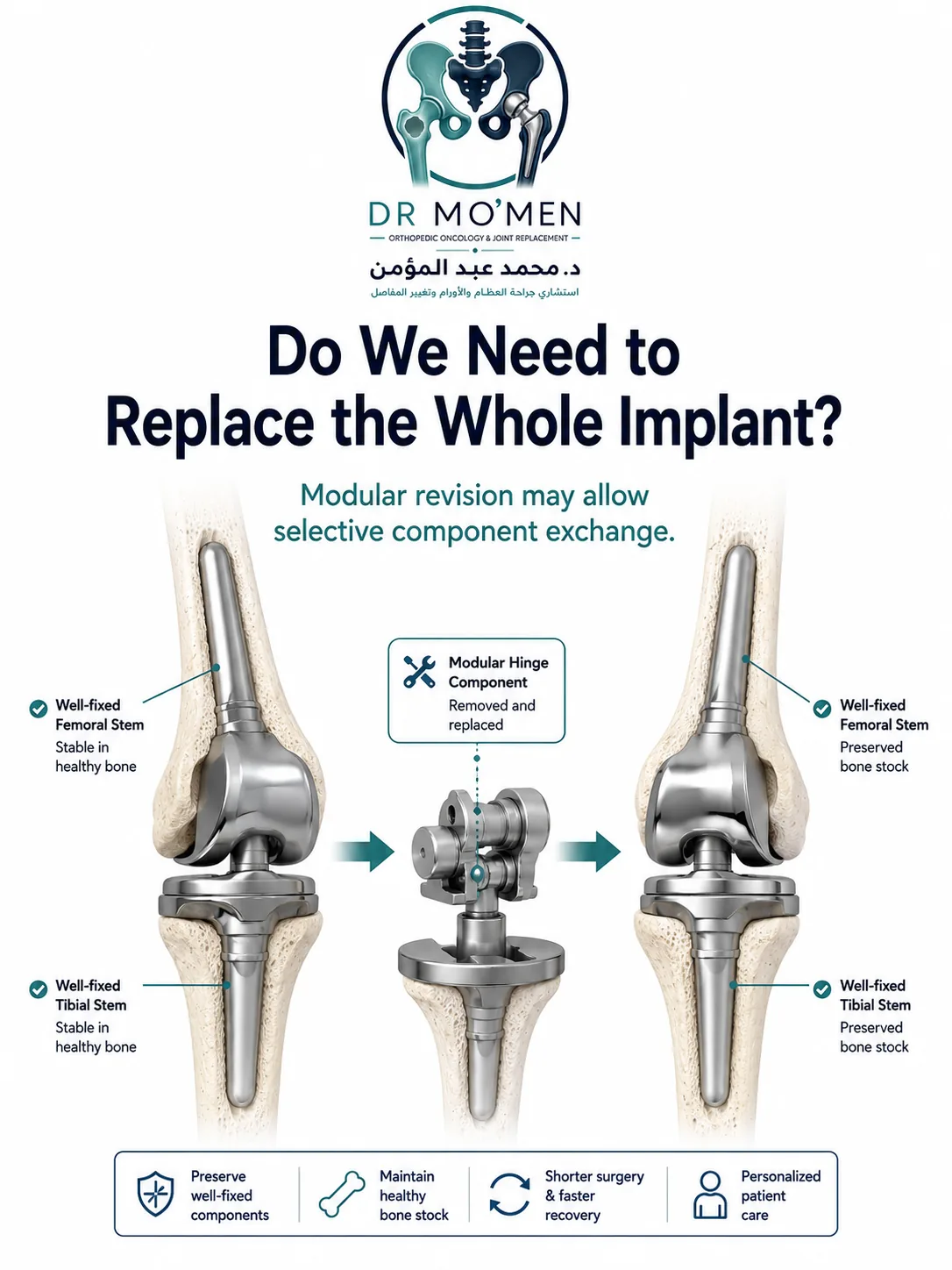
Revision does not necessarily mean replacing the entire implant. Modern megaprostheses are often modular, so selected failures can sometimes be treated by replacing only the damaged component while preserving well-fixed stems and useful bone.
What is revision megaprosthesis surgery?
Revision surgery means operating again on a previous tumor reconstruction because part or all of the reconstruction is no longer functioning adequately or safely. The operation may range from a limited exchange of a modular component to removal and reconstruction of a major portion of the implant.
The exact operation depends on why the reconstruction failed. A loose stem without infection is not treated in the same way as an infected prosthesis, a broken hinge, a periprosthetic fracture, or recurrent tumor.
For site-specific reconstruction background, see distal femoral megaprosthesis after bone tumor resection and proximal tibial megaprosthesis after bone tumor resection. For the broader specialist pathway, see limb-salvage reconstruction and orthopedic oncology.
Why might a megaprosthesis need revision?
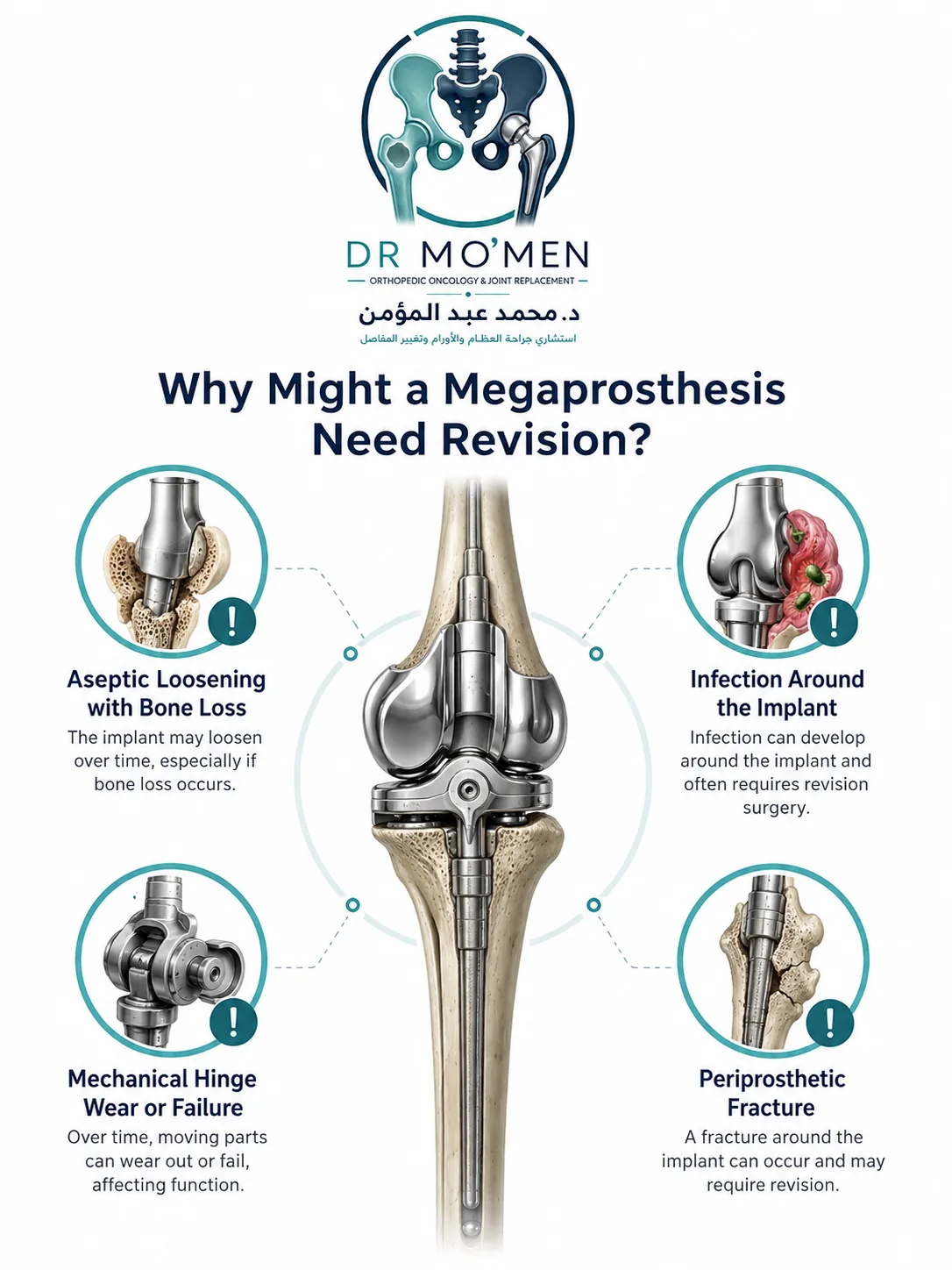
1. Aseptic loosening
The stem may gradually lose fixation within the remaining femur, tibia or humerus without infection. Progressive load-related pain, osteolysis, migration or declining function may eventually make stem revision necessary. Read more about aseptic loosening after megaprosthesis.
2. Infection
Deep periprosthetic infection can require debridement, modular component exchange, staged revision or other individualized strategies depending on timing, organism, fixation and soft-tissue condition. See the detailed guide to infection after megaprosthesis surgery.
3. Structural or mechanical failure
Hinge components, bushings, axles, polyethylene parts, modular junctions or locking mechanisms may wear or fail. If the major stems remain well fixed, limited component exchange may sometimes be possible.
4. Periprosthetic fracture
A fracture may occur around the stem after trauma, osteolysis or weakening of residual bone. Treatment depends strongly on whether the stem remains stable.
5. Soft-tissue failure
Muscle, tendon or extensor-mechanism problems can cause instability, loss of active function, dislocation or wound problems even when the metallic implant remains fixed.
6. Tumor recurrence
New pain, swelling or a mass around a previous tumor reconstruction should be assessed oncologically before assuming that the problem is mechanical. Patients with concern about recurrence may also review what to do when a bone tumor recurs.
A painful megaprosthesis does not automatically mean revision
Pain can arise from infection, aseptic loosening, hinge wear, metallosis, fracture, muscle or tendon dysfunction, nerve problems or tumor recurrence. Revision should therefore not be planned from pain or one X-ray alone.
The first question: why has the reconstruction failed?
The surgeon needs to identify the failure mechanism before choosing the operation.
| Failure mechanism | Main question before revision | Possible reconstructive direction |
|---|---|---|
| Soft-tissue failure | Is instability, extensor failure or inadequate coverage the main problem? | Repair/reconstruction of soft tissues, modular changes or broader revision depending on implant stability and tissue quality. |
| Aseptic loosening | Which fixation interface has failed and how much host bone remains? | Stem/component revision with a fixation strategy matched to remaining bone stock. |
| Structural failure | Has a component, hinge, stem or surrounding bone mechanically failed? | Targeted component exchange or more extensive reconstruction according to the damaged part and bone/soft-tissue condition. |
| Infection | Can infection control be achieved while retaining any components, or is exchange required? | DAIR or staged/exchange reconstruction in selected situations based on timing, fixation, microbiology and host factors. |
| Tumor progression / recurrence | Is further oncological resection feasible and what margin/reconstruction will be required? | Oncological re-resection and reconstruction planning; treatment may differ substantially from revision for mechanical failure alone. |
Clinical examination
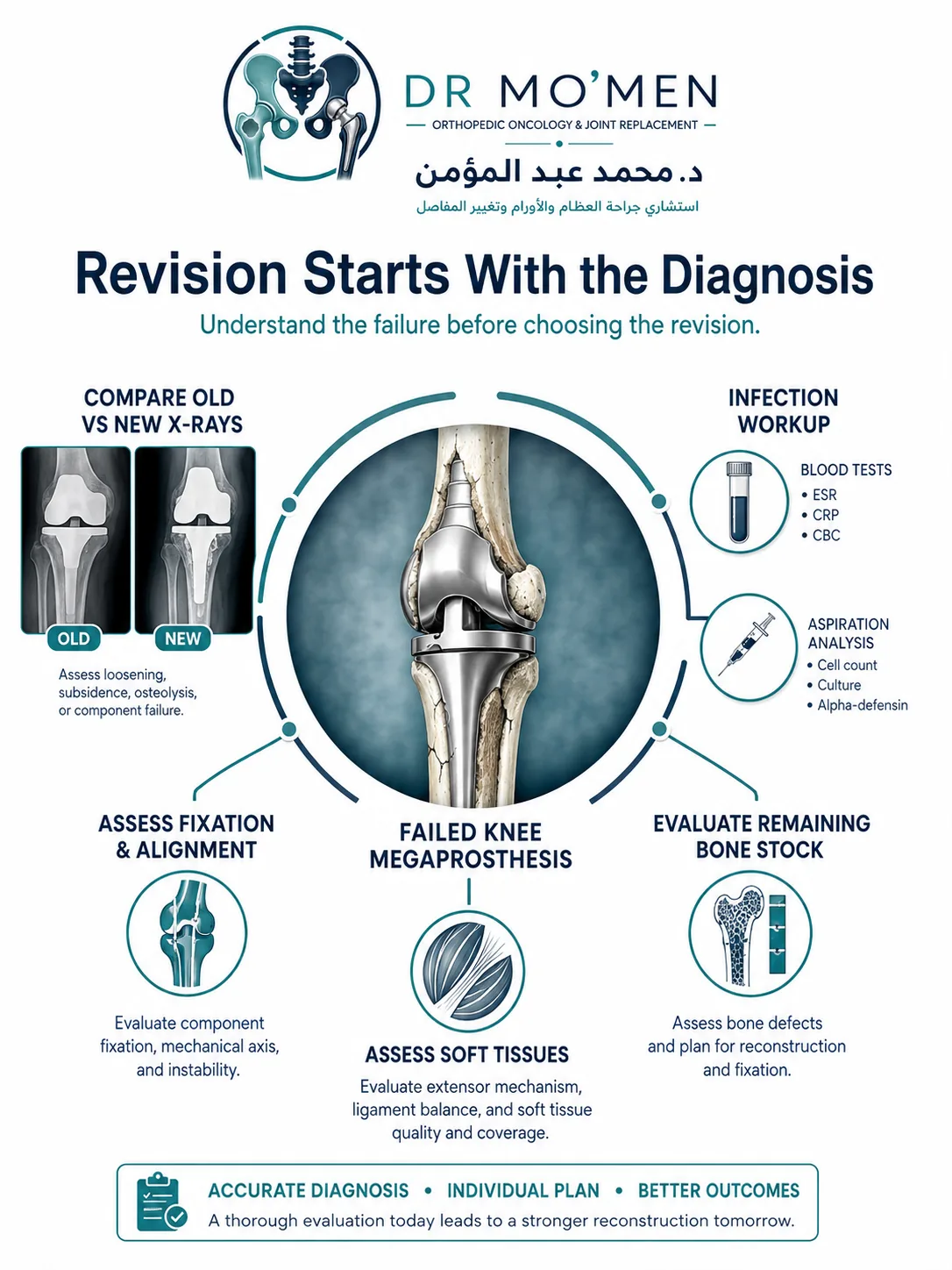
Assessment includes pain location, wound condition, swelling, stability, joint movement, muscle function and gait.
Previous operative reports
Old operation notes may identify the implant manufacturer, stem type, fixation method, component sizes, previous flap or tendon reconstruction, cultures and previous revision procedures. This information can determine whether compatible modular parts remain available.
Old and current imaging
Serial radiographs show how the reconstruction has changed over time. The surgeon looks for stem migration, progressive radiolucency, osteolysis, component wear, alignment change, fracture and hinge position.
A single X-ray shows the current appearance; previous X-rays show the direction and speed of change.
Is CT useful?
CT may be useful in selected cases to define residual bone stock, cortical defects, osteolysis, fracture or component position. Metal artifact can limit image quality, although artifact-reduction techniques may help.
Must infection be excluded before revision?
In many revision cases, yes. This is especially important with unexplained pain, loosening, osteolysis, previous wound problems, previous infection or raised inflammatory markers.
Evaluation may include clinical examination, CRP, ESR, complete blood count when appropriate, aspiration in selected cases and microbiological cultures. A revision planned as “aseptic” can require a very different strategy if infection is identified.
Why may cultures be taken during apparently aseptic revision?
Occult or low-grade infection can sometimes present mainly as pain or loosening. Surgeons may therefore obtain several deep tissue samples during revision when infection remains a realistic differential diagnosis.
Does the whole megaprosthesis always need to be replaced?
No. This is one of the advantages of modular tumor prostheses. Depending on the failure, a surgeon may be able to retain a well-fixed femoral stem, tibial stem or unaffected prosthetic body and replace only the problematic component.
Preserving stable components can reduce additional bone loss and the scale of reconstruction. Limited revision is appropriate only when retained components are genuinely stable, compatible and safe to keep.
What is modular component exchange?
For example, a rotating-hinge tumor knee may have stable femoral and tibial stems but a damaged central hinge or bushing. In a suitable situation, the worn modular component may be replaced while the major stems are retained.
When does the stem need to be revised?
Stem revision may be required with confirmed loosening, significant migration, extensive osteolysis, fracture involving fixation, structural stem failure or infection requiring component removal.
Why is removing a well-fixed stem difficult?
A stem may be cemented, biologically integrated, long, or surrounded by thin residual cortex. Removal can cause bone loss, cortical fracture, perforation and the need for a larger reconstruction. A well-fixed stem should therefore not be removed automatically just because another modular part has failed.
Why is bone stock important?
Bone stock is the useful remaining bone available for reconstruction. Every revision may consume more bone, particularly during removal of long stems or cement.
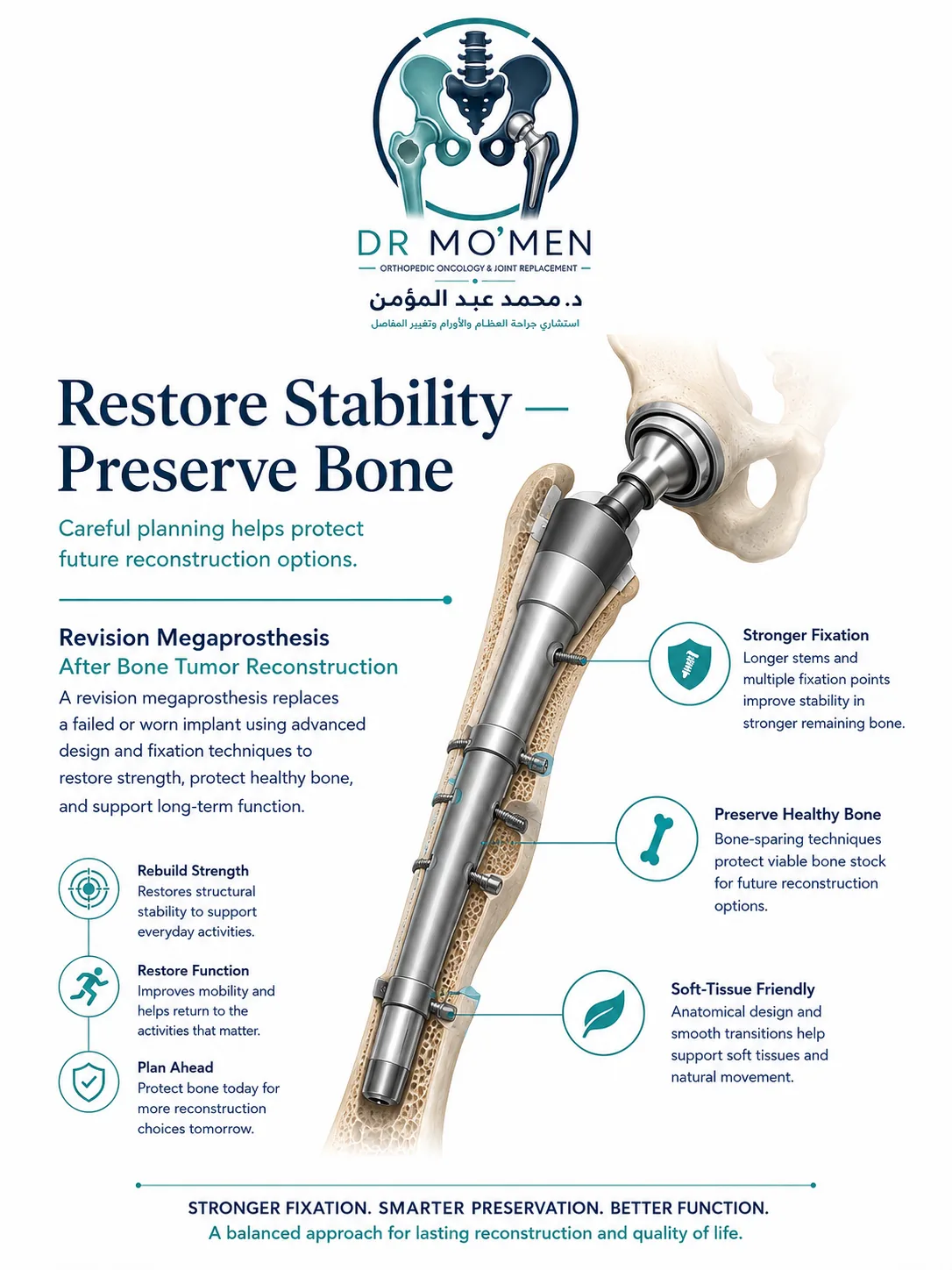
Revision planning should solve today's problem while preserving enough bone for future options, especially in younger long-term survivors.
What happens when bone loss is major?
Options may include longer revision stems, different stem diameters, alternative fixation, supplemental plates, porous or coated surfaces, custom components or more extensive megaprosthetic replacement. These decisions are individualized according to anatomy and remaining bone.
Is a custom implant sometimes needed?
Yes. Patient-specific or custom reconstruction may be considered after multiple previous operations, very short residual bone, severe deformity or unusual bone loss. Detailed preoperative imaging is essential.
What if infection is the reason for revision?
Infection follows different principles. Selected acute infections may be treated with debridement and modular exchange while retaining well-fixed stems, whereas chronic or complex infection may require one-stage or two-stage revision depending on the clinical setting. The detailed diagnostic and treatment pathway is covered in Infection After Megaprosthesis Surgery.
What if the problem is a fracture?
If the stem is stable, some fractures may be reconstructed around the implant. If the stem is loose, revision must address both the fracture and failed fixation.
What if only the hinge has failed?
If the stems remain stable and the failure is confined to the moving mechanism, the modular design may permit limited component exchange. This is why defining the exact failure mechanism is more useful than simply saying, “the megaprosthesis failed.”
Why do soft tissues matter during revision?
Revision re-enters tissue that may already have undergone tumor resection, chemotherapy, radiotherapy in selected cases, flap reconstruction or several surgical approaches. The surgeon may need to reconstruct muscle coverage, tendon attachment, extensor mechanism or joint stability. Reconstructive plastic surgery may be useful in selected complex cases.
Is revision more difficult than the original reconstruction?
It often can be. Scar tissue, bone loss, implant extraction, cement removal, previous flaps, uncertain infection status, distorted anatomy, fractures and reduced soft-tissue reserves can all make revision more demanding.
Can revision still preserve the limb?
Frequently, yes. The usual goal is to restore a stable and functional reconstruction while maintaining oncological safety. Limb preservation, however, cannot be guaranteed in every case.
For the broader principles of preserving the limb after tumor resection, see limb-salvage surgery for bone tumors.
When might limb salvage no longer be feasible?
Uncontrolled infection, severe loss of bone and soft tissue, major neurovascular compromise, uncontrolled tumor recurrence or multiple failed reconstructions may occasionally make further limb-salvage reconstruction unrealistic. Amputation is considered as a salvage option in selected severe cases, not as an automatic consequence of implant failure.
What are the risks of revision megaprosthesis surgery?
- infection or recurrent infection;
- blood loss;
- fracture during implant removal;
- nerve or vascular injury;
- wound problems;
- instability;
- future aseptic loosening;
- mechanical failure;
- thrombosis;
- need for further revision;
- failure of limb salvage in severe cases.
How long does recovery take?
There is no universal timetable. Recovery depends on the anatomical site, reason for revision, amount of implant replaced, fixation, bone loss, fracture, soft-tissue reconstruction, infection treatment and general health.
A simple modular exchange and a complete staged revision are fundamentally different procedures.
When can weight-bearing start?
Weight-bearing is determined by the stability of the new fixation, bone quality, fracture repair, soft-tissue reconstruction and other procedures performed. Some reconstructions permit relatively early loading, whereas others require protected weight-bearing.
Does revision make the limb “new again”?
Not completely. New components may be implanted, but the limb has already undergone tumor resection, previous fixation, scar formation and sometimes bone loss. Long-term surveillance remains necessary.
Can a megaprosthesis be revised more than once?
Yes. Some long-term survivors undergo more than one revision. Each additional operation may become more complex because of decreasing bone stock, more scar tissue and limited soft tissues. Preserving stable components and useful bone during earlier revisions can therefore be valuable.
When should assessment be urgent?
- sudden inability to bear weight;
- sudden severe pain;
- new deformity;
- new instability or obvious mechanical change;
- wound drainage;
- fever with redness or swelling;
- rapidly enlarging swelling or a new mass;
- new neurological or vascular symptoms.
When is a second opinion particularly useful?
- complete megaprosthesis removal has been proposed;
- several previous revisions have failed;
- infection status is uncertain;
- substantial bone stock may be sacrificed;
- custom reconstruction is being considered;
- a staged revision is planned;
- amputation has been discussed;
- symptoms and imaging do not clearly match.
Role of Dr. Mohammed Abdelmoemen Abuelhadid in complex revision cases
Revision megaprosthesis surgery requires simultaneous consideration of the original tumor, current oncological status, reason for implant failure, infection status, component stability, remaining bone stock, soft-tissue condition, and which components can safely be retained.
Dr. Mohammed Abdelmoemen Abuelhadid evaluates complex megaprosthetic reconstructions and revision cases, including infection, aseptic loosening, mechanical failure and difficult limb-salvage reconstruction.
Patients outside Egypt may send current and previous X-rays, CT or MRI where appropriate, operative reports, implant information if available, microbiology results, and pathology or oncology records for preliminary review before travel when appropriate.
For appointments or imaging review: +20 102 1690693
Send Your Records Before You Travel
If you are outside Egypt, you can send existing X-rays, MRI or CT images, pathology reports, operative notes and implant information for an initial specialist review before arranging travel. This preliminary review can help clarify what additional evaluation may be needed and whether an in-person orthopedic oncology or complex-reconstruction consultation is appropriate.
Remote review does not replace physical examination, final diagnosis, infection work-up, pathology review or a definitive surgical plan when those are required.
How to send MRI, CT and X-ray files for review
International Patients Request a Specialist Second Opinion Send the file link by WhatsApp
Frequently Asked Questions
Does revision mean replacing the whole megaprosthesis?
No. If some components remain well fixed and safe to retain, only the failed components may sometimes need replacement.
Is revision always necessary when a megaprosthesis starts hurting?
No. The cause of pain must first be identified because infection, loosening, fracture, mechanical wear, soft-tissue problems and tumor recurrence require different approaches.
Why is infection testing important before revision?
An infected loose prosthesis should not be treated using the same strategy as true aseptic loosening.
Can a revision stem be longer than the original stem?
Yes. Some revisions require fixation in stronger remaining bone beyond the failed interface. The final implant is chosen individually.
Can the limb still be saved after megaprosthesis failure?
Often yes, depending on the reason for failure, available bone, soft tissues, infection status and oncological situation.
This article is for patient education and does not replace clinical examination, specialist assessment, review of imaging, microbiological investigations and previous operative records.