
On this page
- What Is an Orthopedic Second Opinion?
- When Should You Consider a Second Opinion?
- What Should You Send for an Orthopedic Second Opinion?
- Is the MRI Report Enough?
- Can a Second Opinion Be Done Online?
- Should You Tell Your First Surgeon You Are Getting a Second Opinion?
- What Questions Should You Ask During a Second Opinion?
- Situations Where a Second Opinion Should Not Cause Dangerous Delay
- Second Opinion for Bone and Soft-Tissue Tumors
- Second Opinion Before You Travel
- The Role of Dr. Mo’men in Complex Orthopedic Second Opinions
Being told that you may need orthopedic surgery can raise several questions:
Is surgery really necessary?
Is this the correct operation?
Are there reasonable alternatives?
Should the diagnosis be confirmed first?
Is this a routine case—or a complex reconstruction that deserves specialist review?
A second orthopedic opinion does not necessarily mean that the first recommendation was wrong.
Its purpose is to independently review the diagnosis, imaging, treatment options and surgical plan before an important decision is made.
This can be particularly useful when surgery is major, irreversible, technically complex, or when the diagnosis remains uncertain.
What Is an Orthopedic Second Opinion?
A second opinion is an independent assessment by another orthopedic surgeon who reviews the case before a final treatment decision.
The assessment may include:
- symptoms and medical history
- physical examination
- X-rays
- MRI or CT images
- radiology reports
- pathology reports
- previous operative reports
- previous implants
- laboratory investigations
- response to previous treatment
The goal is not simply to say “yes” or “no” to surgery.
A useful second opinion should help answer:
- What is the most likely diagnosis?
- Are additional investigations needed?
- Is surgery currently necessary?
- Are reasonable non-surgical options still available?
- If surgery is required, is the proposed procedure appropriate?
- Is there another surgical strategy worth considering?
- Does the case require a specialist center or multidisciplinary evaluation?
When Should You Consider a Second Opinion?
A second opinion may be particularly valuable in several situations.
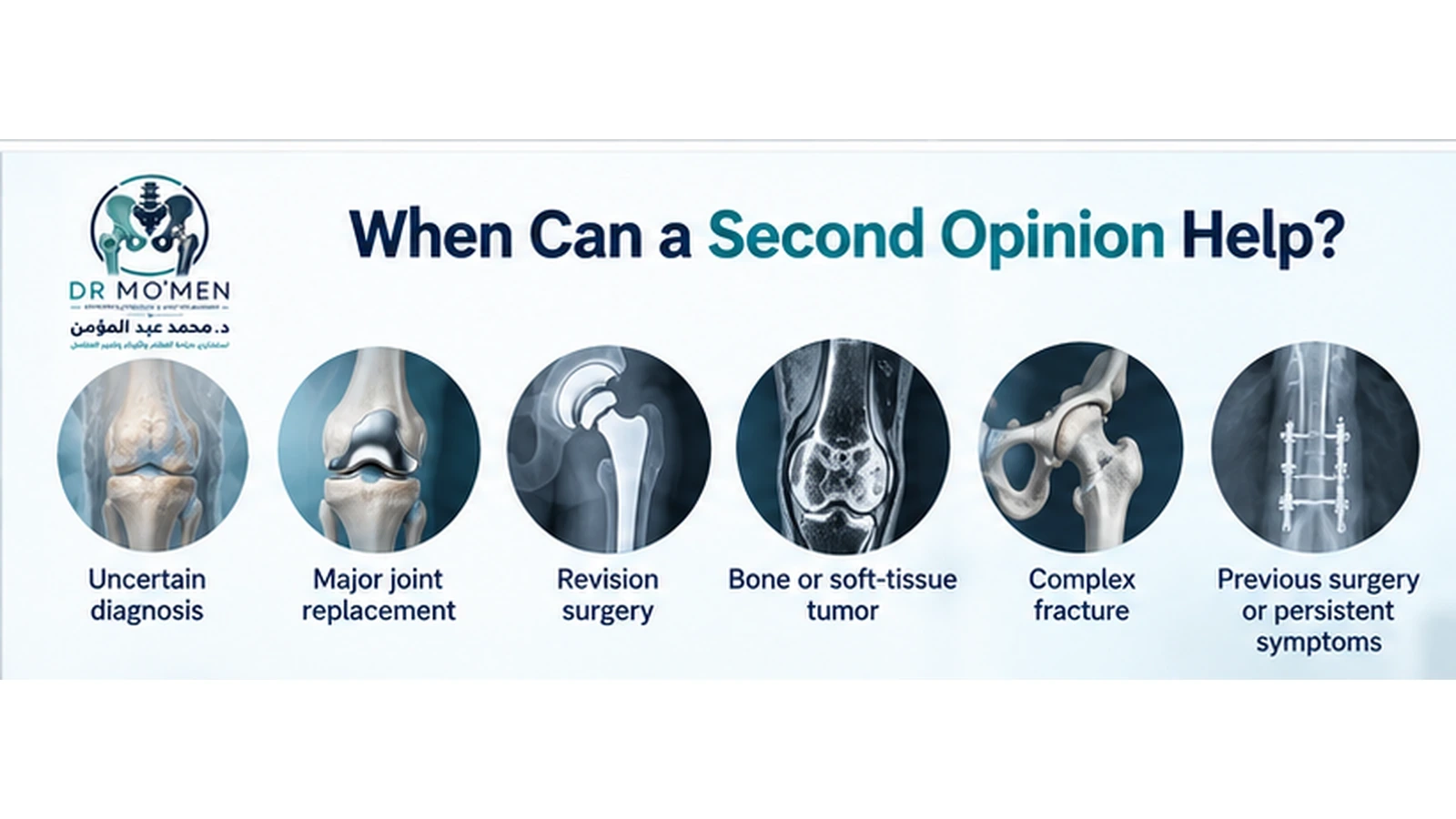
1. You are uncertain whether surgery is really necessary
Patients are sometimes referred for surgery after an abnormal MRI, persistent pain, failure of one treatment, arthritis, a meniscal tear, or a ligament injury. But an abnormal scan does not automatically mean surgery is required.
The important question is whether the imaging findings explain the patient's symptoms and whether treatment alternatives remain reasonable.
For example, an MRI showing a meniscal tear does not by itself determine whether arthroscopy is appropriate. Similarly, severe arthritis on an X-ray does not automatically mean that joint replacement must be performed immediately.
Related article: When Do You Need Knee Replacement?
2. Major Joint Replacement Has Been Recommended
Hip or knee replacement is a major reconstructive operation.
A second opinion may be useful when:
- symptoms and X-rays do not seem to match
- the patient is relatively young
- partial versus total replacement is being considered
- severe deformity exists
- previous surgery has altered the anatomy
- bone loss is present
- another surgeon has recommended a complex implant
- the patient wants to understand non-surgical alternatives
The purpose is not necessarily to delay appropriate surgery. It is to ensure that the indication, timing and reconstruction strategy are appropriate.
Joint Replacement Service: /en/services/joint-replacement/
3. Revision Joint Replacement Has Been Recommended
Revision surgery is usually more complex than a first hip or knee replacement.
Important questions may include:
- Why did the first implant fail?
- Is infection present?
- Is the implant loose?
- Is there instability?
- Is there significant bone loss?
- Is the implant fractured?
- Is the problem actually coming from another source?
Different causes require very different treatment strategies.
Relevant reading:
4. A Bone or Soft-Tissue Tumor Is Suspected
This is one of the most important situations in which specialist review may be appropriate.
When imaging suggests a bone or soft-tissue tumor, the sequence of diagnosis and treatment matters. The case may require appropriate X-rays, MRI, CT in selected cases, staging investigations, biopsy, pathology review, and multidisciplinary planning.
Biopsy should be planned carefully
A biopsy should ideally be planned by, or in coordination with, the team that would perform definitive tumor treatment.
The biopsy tract may need to be removed during later surgery, so its position can affect future limb-salvage options. Unplanned surgery on a suspected tumor can complicate subsequent treatment.
Therefore, if a patient has been advised to undergo excision of an unexplained bone or soft-tissue mass without a clear diagnosis, a specialist orthopedic oncology opinion may be appropriate before surgery.
Related resources:
5. The Diagnosis Is Uncertain
Orthopedic symptoms can sometimes come from more than one source.
Examples include hip arthritis resembling lumbar or groin pathology, lumbar disease producing leg pain, peripheral nerve problems resembling spinal disease, tumor-related pain resembling common musculoskeletal pain, knee pain originating from the hip, or degenerative MRI findings that are not the true cause of symptoms.
A second assessment can help determine whether the diagnosis and imaging findings are clinically consistent.
6. Several Different Operations Have Been Suggested
Different surgeons may occasionally recommend different reasonable strategies.
For knee arthritis these may include continued non-operative treatment, osteotomy, partial knee replacement, or total knee replacement.
For ACL injury, treatment may involve structured rehabilitation, ACL reconstruction, or combined ACL and meniscal surgery.
Related article: ACL Injury: Symptoms, MRI, Treatment and Surgery
For complex hip reconstruction, possible strategies may include fixation, joint-preserving surgery, primary replacement, conversion hip replacement, or revision reconstruction.
A second opinion can help clarify why one strategy may be more appropriate than another.
7. You Have Already Had Several Operations
Previous surgery can significantly change anatomy and treatment options.
Examples include previous fracture fixation, ACL reconstruction, hip or knee replacement, tumor surgery, failed fixation, previous infection, or multiple arthroscopies.
The more complex the surgical history becomes, the more important it may be to review previous operative reports, old X-rays, implant information, microbiology results, pathology, and previous complications.
8. Surgery Has Failed or Symptoms Persist
Persistent symptoms after surgery do not automatically mean another operation is required.
The first step should usually be to determine why the previous treatment did not achieve the intended result.
Possible causes may include incorrect diagnosis, infection, mechanical failure, instability, stiffness, nonunion, implant loosening, recurrent tumor, nerve-related pain, or symptoms originating from another anatomical site.
Revision surgery should ideally target a clearly identified problem.
9. You Have a Complex Fracture
Specialist review may be helpful for acetabular or pelvic fractures, periarticular fractures, pathological fractures, fractures around joint replacements, failed fixation, nonunion, substantial bone loss, or associated joint destruction.
Fracture Service: /en/services/fractures/
10. You Are Considering Treatment Abroad
Patients considering traveling for orthopedic treatment should ideally understand the likely diagnosis and treatment pathway before arranging travel whenever possible.
An initial remote review may help determine whether surgery appears likely, additional investigations are needed, in-person examination is necessary, treatment may potentially be performed locally, or the proposed travel is medically appropriate.
International Patients: /en/international-patients/
What Should You Send for an Orthopedic Second Opinion?
The quality of a remote review depends heavily on the information provided.
Whenever possible, send the actual imaging files, not only the written report.

Useful documents may include:
Clinical information
- age
- main symptoms
- duration of symptoms
- previous injuries
- previous operations
- current medications
- relevant medical conditions
Imaging
- X-rays
- MRI
- CT
- bone scan or PET/CT when relevant
Reports
- radiology reports
- pathology reports
- blood tests
- microbiology results
- operative reports
- discharge summaries
Previous treatment
- physiotherapy
- injections
- medications
- previous surgery
- previous implants
- postoperative complications
Organizing documents chronologically can make review considerably easier.
Is the MRI Report Enough?
Usually not.
Whenever possible, the actual MRI images should be reviewed.
The written report summarizes the radiologist's interpretation, but surgical decision-making may require direct assessment of anatomy, lesion location, cartilage condition, ligament integrity, tumor characteristics, bone loss, implant position, or fracture configuration.
This is particularly important in complex reconstruction and orthopedic oncology.
Can a Second Opinion Be Done Online?
An initial second opinion can often begin remotely when adequate imaging and reports are available.
Remote review may help answer questions such as:
- Does the diagnosis appear consistent with the imaging?
- Are important investigations missing?
- Is surgery likely to be necessary?
- Should a biopsy be performed before surgery?
- Is specialist evaluation recommended?
- Is travel for examination likely to be useful?
However, remote review has limitations and cannot fully replace physical examination, assessment of joint stability, neurovascular examination, direct evaluation of swelling or masses, gait examination, or examination under specific clinical maneuvers.
Therefore, some cases still require in-person assessment before a definitive treatment decision.
Should You Tell Your First Surgeon You Are Getting a Second Opinion?
There is generally no medical reason to conceal it.
Seeking another opinion is a normal part of making major healthcare decisions, particularly for major surgery, irreversible treatment, uncertain diagnosis, revision surgery, tumor surgery, or limb-salvage reconstruction.
The objective should be clarity, not competition between surgeons.
What Questions Should You Ask During a Second Opinion?
Useful questions include:
About the diagnosis
- What is the most likely diagnosis?
- Are you confident that the imaging explains my symptoms?
- Do I need additional investigations?
About surgery
- Do I need surgery now?
- What happens if I wait?
- Are there reasonable alternatives?
- What operation would you recommend and why?
About complexity
- Is this a routine or complex case?
- Does previous surgery change the plan?
- Is bone loss or instability present?
- Is specialist reconstruction required?
About tumors
- Is biopsy necessary?
- Who should plan the biopsy?
- Should staging be completed first?
- Should the case be discussed by a multidisciplinary team?
About recovery
- What is the expected rehabilitation pathway?
- What limitations should I expect?
- What complications need to be considered?
Situations Where a Second Opinion Should Not Cause Dangerous Delay
A second opinion can be useful, but urgent conditions should not be delayed unnecessarily.
Prompt medical evaluation may be required for suspected open fracture, vascular injury, rapidly progressive neurological deficit, severe infection, compartment syndrome, dislocated joint with neurovascular compromise, rapidly deteriorating postoperative condition, or other orthopedic emergencies.
A second opinion should support safer decision-making—not delay emergency treatment.
Second Opinion for Bone and Soft-Tissue Tumors
Orthopedic oncology deserves special emphasis.
Before surgery for a suspicious bone or soft-tissue lesion, the sequence should ideally be:
Clinical assessment → Imaging → Appropriate staging → Planned biopsy when required → Pathology → Multidisciplinary treatment planning
rather than:
Unplanned excision → pathology surprise → referral afterward
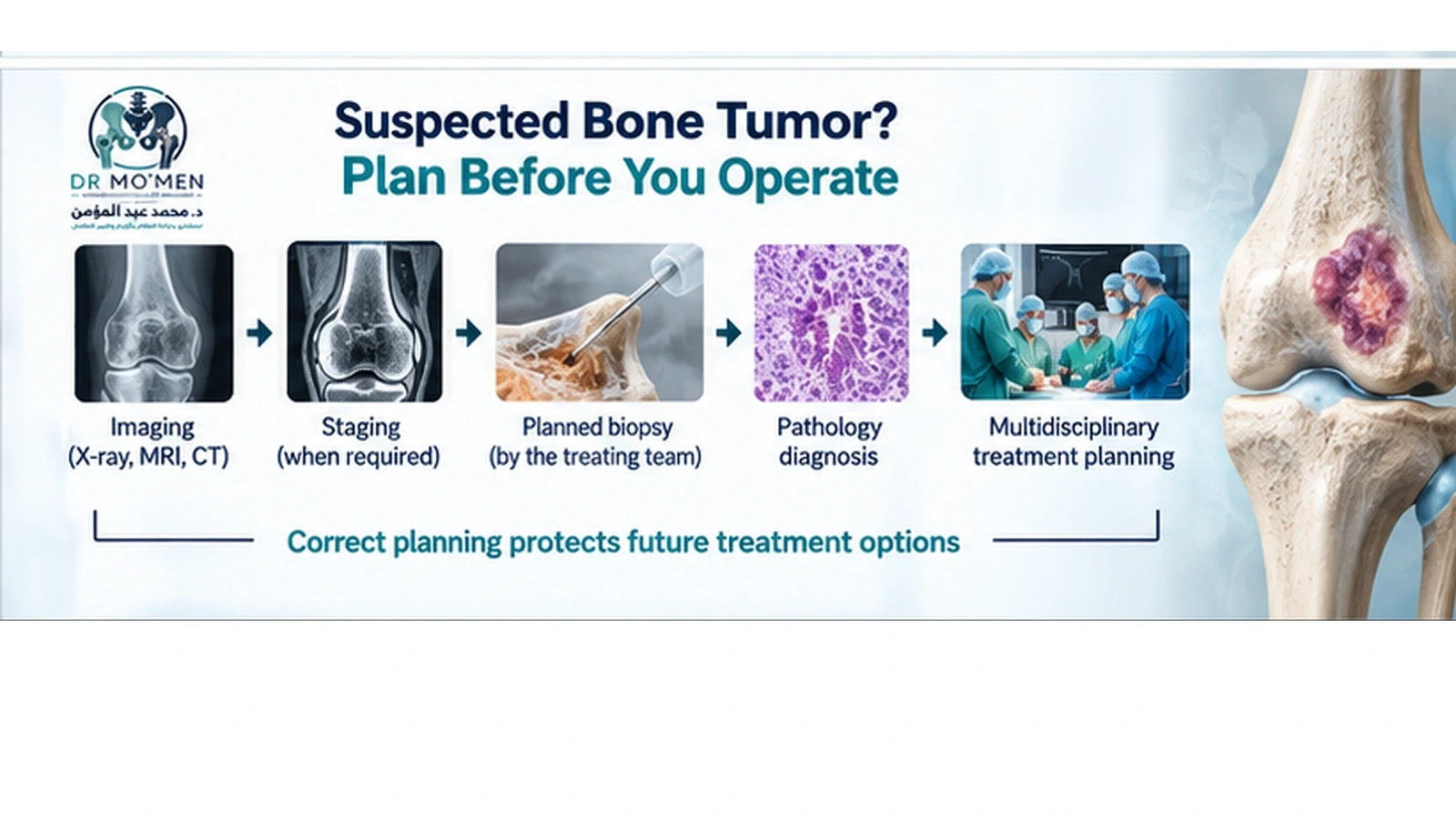
This is particularly important when limb-salvage surgery may eventually be required.
Patients who have already undergone unplanned tumor surgery may still benefit from specialist review to determine pathology certainty, contamination of surgical planes, need for staging, residual disease, re-excision strategy, and reconstruction options.
Second Opinion Before You Travel
Patients outside Egypt may benefit from an initial remote review before making travel arrangements.

A practical pathway is:
Send Records → Specialist Review → Preliminary Assessment → Additional Tests if Required → Travel for Examination When Appropriate → Treatment Planning
The preliminary review does not replace the in-person examination when one is medically necessary.
The Role of Dr. Mo’men in Complex Orthopedic Second Opinions
Dr. Mohammed Abdelmoemen Abuelhadid reviews complex orthopedic cases involving:
- bone and soft-tissue tumors
- suspected tumor requiring biopsy planning
- limb-salvage surgery
- metastatic bone disease
- primary hip and knee replacement
- revision joint replacement
- failed fracture fixation
- periprosthetic fracture
- complex sports injuries
- persistent symptoms after previous surgery
The objective is to determine:
Is the diagnosis correct?
Is surgery actually necessary?
Is the proposed operation appropriate?
Are important investigations missing?
Does the case require a more specialized reconstruction pathway?
Patients outside Egypt can send their available imaging and medical reports for an initial review before deciding whether traveling for in-person assessment is appropriate.
Second Opinion Service: /en/second-opinion/
International Patients: /en/international-patients/
For appointments or review of imaging: 01021690693
Need an independent review before a major orthopedic decision?
Send the available X-rays, MRI/CT scans, reports, pathology or operative records for preliminary review. Complex cases may still require examination or additional investigations before a definitive treatment plan.