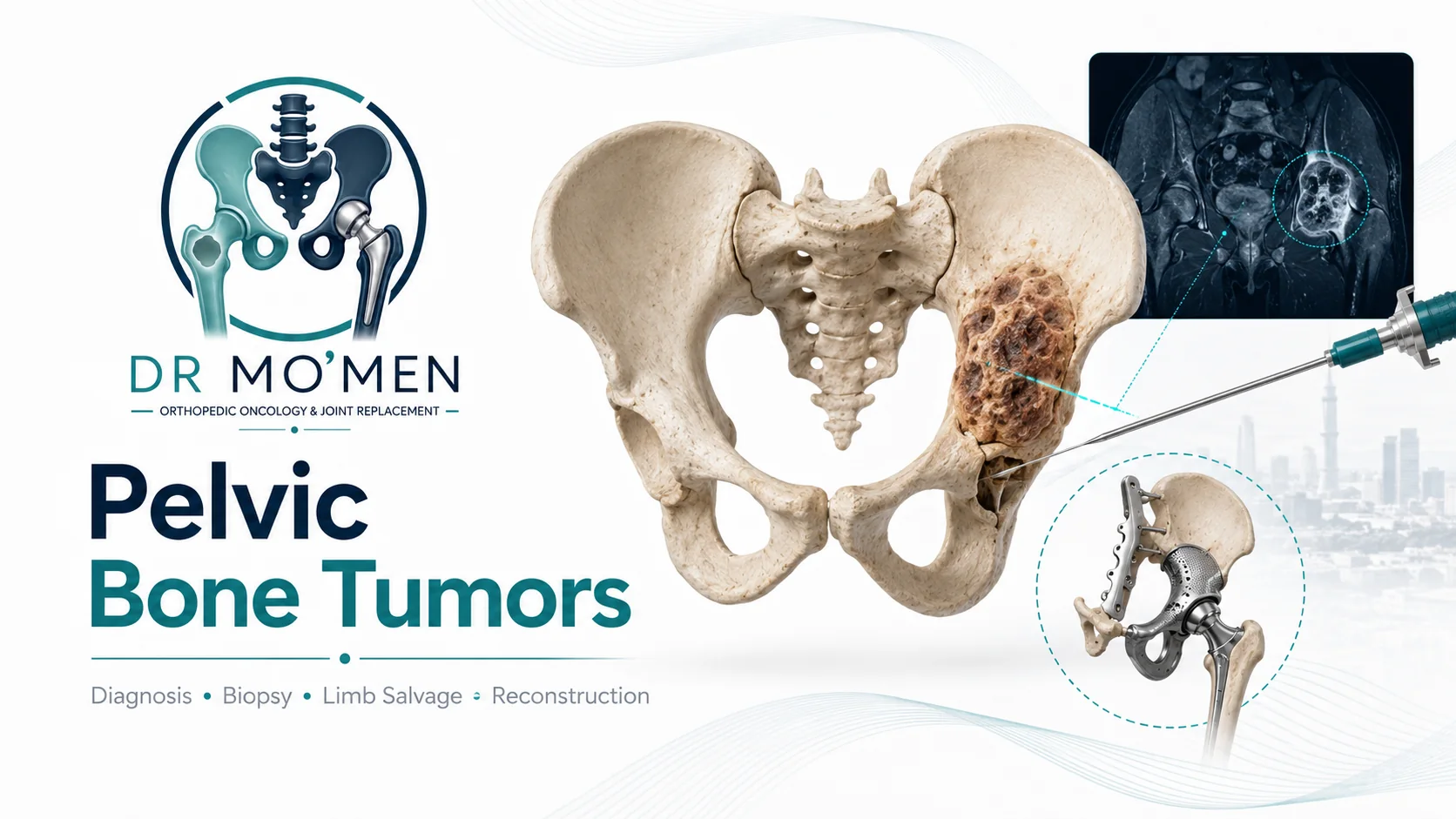
A bone tumor in the pelvis presents a different challenge from a tumor in the arm or leg.
The pelvis contains several major structures within a relatively compact area: the hip joint, pelvic bone, sacrum, major blood vessels, major nerves, muscles responsible for walking, the bladder and bowel, and other abdominal or pelvic structures.
For this reason, patients may hear terms such as pelvic sarcoma, internal hemipelvectomy, pelvic resection, limb salvage, hip reconstruction, custom implant or megaprosthesis.
These terms can sound alarming. The most important point is that treatment is not determined by tumor size alone.
A pelvic bone tumor must first be assessed according to the exact diagnosis, tumor grade, anatomical compartment, relationship to the hip joint, relationship to major nerves and blood vessels, soft-tissue extension, metastatic stage, expected function after surgery, and reconstructive possibilities.
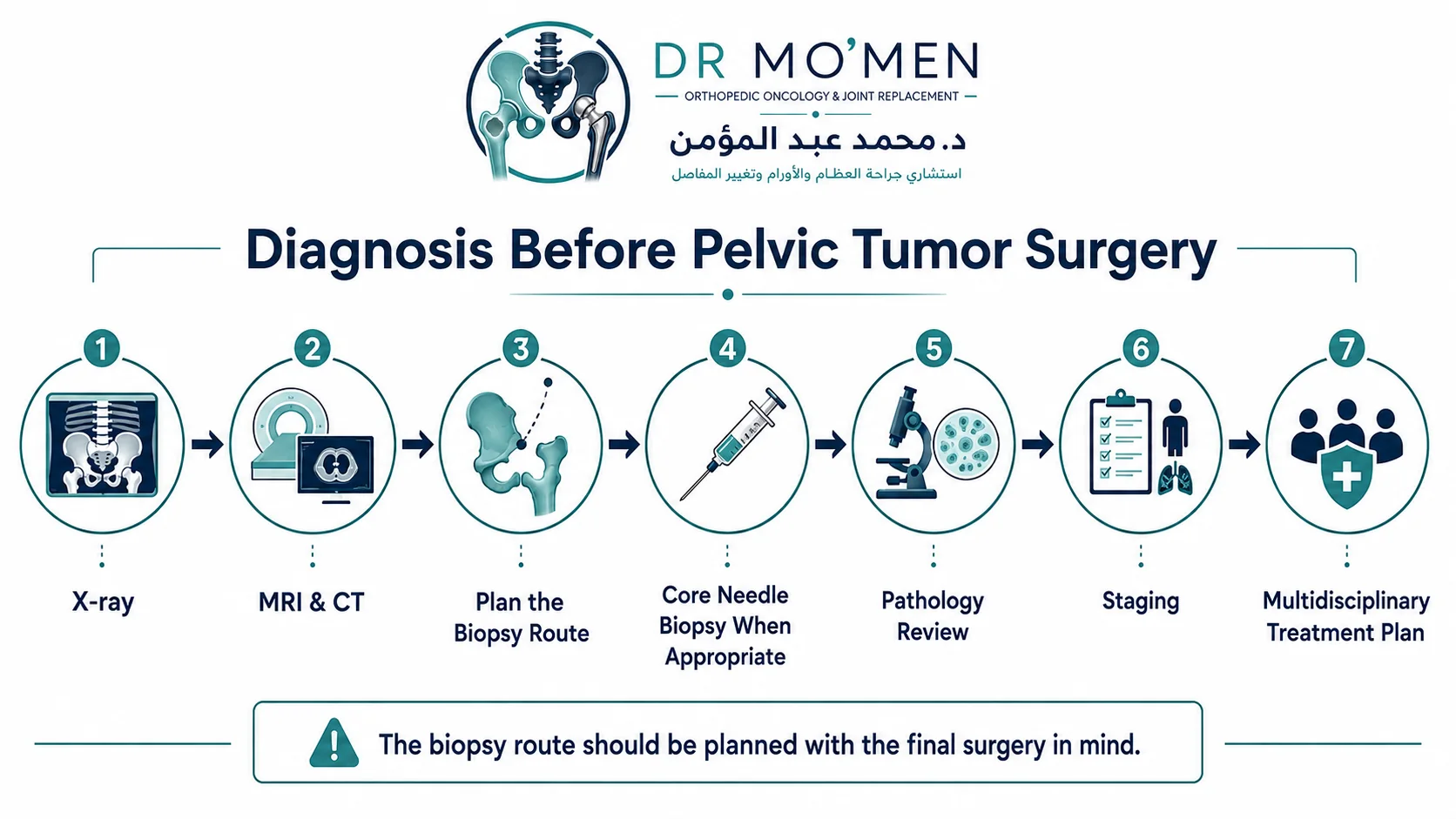
For suspected malignant pelvic tumors, accurate imaging, carefully planned biopsy and multidisciplinary treatment planning should come before definitive surgery.
Why Are Pelvic Bone Tumors More Complex?
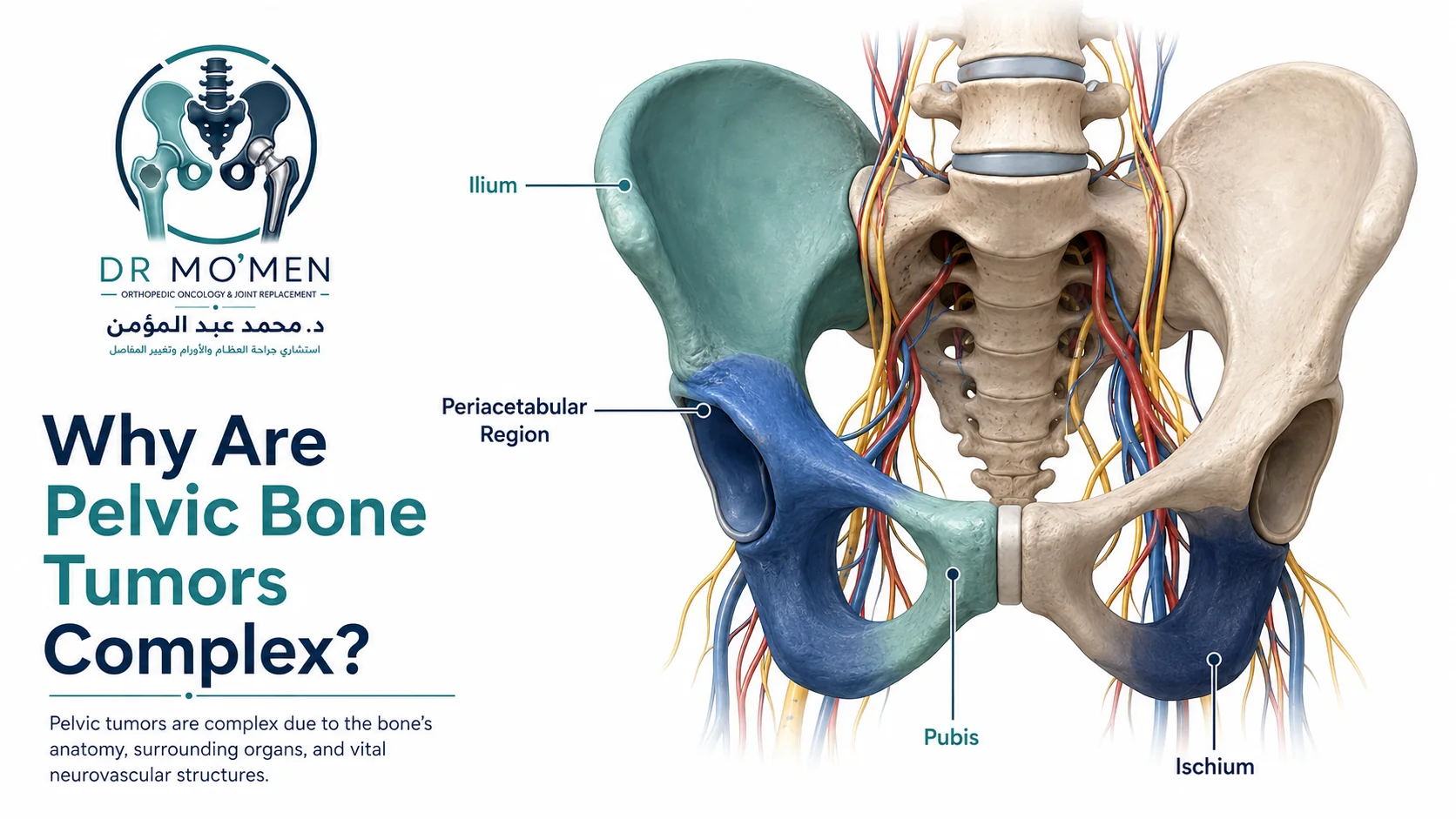
The pelvis is anatomically different from a long bone. A tumor may extend through several regions before causing obvious symptoms.
It may involve or approach the iliac bone, acetabulum, pubis, ischium, sacrum, hip joint, gluteal muscles, iliopsoas, pelvic floor, sciatic nerve, femoral neurovascular structures, or other pelvic structures.
Treatment must therefore consider both oncological clearance and what function will remain after resection.
What Types of Bone Tumors Can Affect the Pelvis?
Several primary and secondary tumors may involve the pelvis, including chondrosarcoma, osteosarcoma, Ewing sarcoma, metastatic bone disease, giant cell tumor in selected pelvic sites, chordoma involving sacral regions, and other rare primary bone tumors.
The pathology matters because different tumors respond differently to chemotherapy, radiotherapy and surgery. Pelvic tumor surgery should not be planned from imaging alone.
What Symptoms Can a Pelvic Bone Tumor Cause?
Symptoms may be less obvious than with a tumor around the knee. Possible symptoms include deep pelvic pain, hip pain, groin pain, buttock pain, lower-back pain, pain while walking, limp, difficulty sitting, night pain, swelling or a palpable mass, nerve-related symptoms, and reduced hip movement.
Some tumors become large before they are detected because the pelvis has substantial internal space.
Can Pelvic Tumors Be Mistaken for Back or Hip Problems?
Yes. Early symptoms may resemble lumbar spine disease, hip arthritis, sacroiliac pain, muscle strain, sciatica or a sports injury.
Persistent or progressive pain that does not follow the expected pattern of routine mechanical disease may justify further imaging.
Why Plain X-Rays Still Matter
Pelvic X-rays can provide important information about bone destruction, mineralized tumor matrix, cortical involvement, acetabular destruction, pathological fracture and overall bone anatomy.
However, because the pelvis is a complex three-dimensional structure, additional imaging is often necessary.
Why MRI Is Essential
MRI is particularly important for determining local tumor extent. It can help define bone involvement, soft-tissue extension, gluteal muscle involvement, iliopsoas extension, hip-joint involvement, proximity to the sciatic nerve, relation to major vessels, pelvic organ relationships and surgical resection planes.
MRI is generally most useful when obtained before biopsy.
What Is the Role of CT?
CT is highly useful for pelvic tumor evaluation. It can show cortical destruction, tumor mineralization, acetabular architecture, pelvic-ring anatomy, pathological fracture and complex bony relationships.
CT can also help guide biopsy in deep pelvic lesions. MRI and CT often provide complementary information.
Why Staging Matters Before Surgery
Pelvic tumor surgery can be extensive. The team needs to understand whether the disease is localized, regionally advanced or metastatic.
Staging may include chest imaging, whole-body or skeletal imaging according to diagnosis, and additional studies depending on tumor type. The treatment plan may change substantially if metastatic disease is already present.
Why Pelvic Tumor Biopsy Must Be Carefully Planned
Biopsy planning is especially important in the pelvis because the wrong route may cross major muscles, abdominal or pelvic compartments, important vessels, nerves or uninvolved anatomical regions.
The biopsy tract may need to be removed with definitive surgery. Therefore, the biopsy route should ideally be planned with the surgeon responsible for definitive pelvic tumor treatment.
Related guide: Bone tumor biopsy: core needle vs open biopsy.
Core Needle or Open Biopsy for a Pelvic Tumor?
A properly planned image-guided core needle biopsy is often useful for deep pelvic lesions when an appropriate route exists. Potential advantages include a smaller tract, image-guided targeting, less tissue disruption and avoidance of large open-biopsy fields.
Open biopsy may still be required in selected cases. The choice should depend on lesion anatomy, tissue requirements, suspected diagnosis, safety and prior biopsy results.
Why the Shortest Biopsy Route May Not Be the Best Route
For a deep pelvic mass, the visually shortest path may pass through structures that the definitive operation would otherwise preserve.
A better biopsy route is one that provides diagnostic tissue, avoids unnecessary compartments, avoids major vessels and nerves, and can be included in future resection when necessary.
This requires coordination between orthopedic oncology, interventional radiology, musculoskeletal radiology and pathology.
Chondrosarcoma of the Pelvis
Chondrosarcoma is one of the important primary malignant bone tumors that can affect the pelvis. Pelvic chondrosarcoma may become large before detection.
Treatment depends on subtype, grade, location, extent and resectability. For many conventional chondrosarcomas, surgery plays a central role when appropriate. The challenge is achieving adequate resection while preserving useful function whenever possible.
Related guide: Chondrosarcoma: diagnosis and treatment.
Osteosarcoma of the Pelvis
Pelvic osteosarcoma is complex because of deep anatomy, large tumor volume, difficult surgical margins and reconstruction challenges.
Treatment generally requires a multidisciplinary pathway. Systemic therapy has an important role in many high-grade conventional osteosarcomas. Surgery, when feasible, should be planned according to oncological resection principles.
Related guide: Osteosarcoma: diagnosis, chemotherapy and limb salvage.
Ewing Sarcoma of the Pelvis
The pelvis is an important site for Ewing sarcoma. Systemic chemotherapy is central to treatment.
Local control may involve surgery, radiotherapy or selected combinations. The choice depends on tumor extent, expected surgical morbidity, response to treatment, anatomical location and multidisciplinary assessment.
Related guide: Ewing sarcoma: diagnosis and treatment.
What Is Limb Salvage in a Pelvic Tumor?
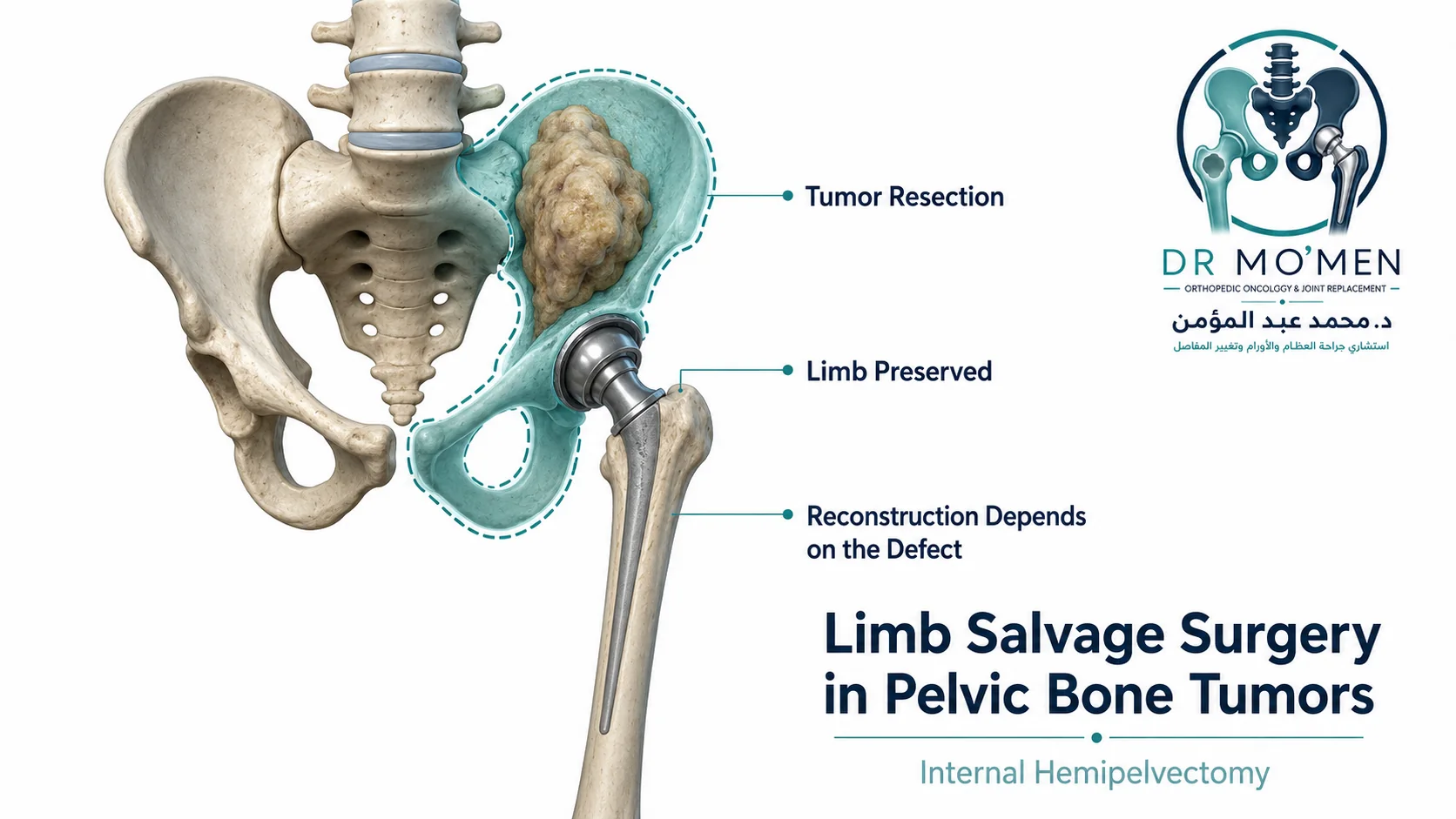
Limb salvage means removing the pelvic tumor while preserving the lower limb. Limb preservation may still require removal of large portions of pelvis, the hip joint, surrounding muscle, part of the acetabulum or selected neurovascular structures where unavoidable.
The question is not simply whether the leg remains attached. The important question is whether the tumor can be removed adequately while preserving a limb with meaningful function.
Related guide: Limb salvage surgery for bone tumors.
What Is an Internal Hemipelvectomy?
An internal hemipelvectomy is a limb-sparing pelvic tumor operation in which part of the pelvis is removed while the lower limb is preserved.
The amount of pelvis removed depends on tumor location. Resections may involve the ilium, periacetabular region, pubic or ischial regions, or combinations of these zones. Terminology may vary between classifications and surgical teams.
What Is the Enneking–Dunham Classification for Pelvic Resection?
The Enneking–Dunham system describes which part of the pelvis is removed during tumor surgery; it is a resection classification, not the Enneking tumor-stage system. Type I involves the ilium, Type II the periacetabular region around the hip socket, Type III the pubis/ischium, and Type IV the sacrum. Combined resections are common when a tumor crosses more than one region.
| Resection type | Main pelvic region | Why the location matters for reconstruction |
|---|---|---|
| Type I | Ilium | The native hip joint can often remain outside the resection, but pelvic-ring continuity, muscle attachments and load transfer may still need reconstruction or protection. |
| Type II | Periacetabular region | This removes bone around the hip socket and can create one of the most demanding reconstructive problems because hip stability and weight transfer may be disrupted. |
| Type III | Pubis and/or ischium | The hip may be preserved, but anterior pelvic-ring and soft-tissue defects still influence stability, wound reconstruction and function. |
| Type IV | Sacrum / sacropelvic region | Sacral involvement can affect lumbopelvic stability, nerve roots and the complexity of fixation or reconstruction. |
The classification is useful for communicating the anatomical defect, but it does not by itself determine treatment. Tumor biology, surgical margins, combined zones, soft-tissue extension, major nerves and vessels, previous surgery and expected function all influence whether reconstruction is needed and which method is appropriate.
Evidence source: a contemporary review of pelvic-girdle reconstruction summarizes the Enneking–Dunham Type I–IV resection framework and its relationship to reconstructive planning. Read the review.
What Is an External Hemipelvectomy?
An external hemipelvectomy involves removal of part of the pelvis together with the lower limb. This is a much more radical operation.
It may be considered in selected situations when adequate resection cannot be achieved with limb preservation, critical structures are extensively involved, infection or previous procedures severely complicate reconstruction, or a preserved limb would have very poor expected function.
It is not automatically required for every large pelvic tumor.
Can the Hip Joint Be Preserved?
Sometimes. Whether the hip can be preserved depends on tumor distance from the acetabulum, articular involvement, periacetabular bone involvement, surrounding soft-tissue disease and the ability to achieve an appropriate resection.
Tumors located away from the acetabulum may allow preservation of the native hip. Periacetabular tumors are generally more challenging.
What Is a Periacetabular Tumor?
A periacetabular tumor involves bone around the hip socket. This creates a difficult reconstructive problem because resection may disrupt the acetabulum, hip stability, pelvic-ring mechanics and muscle attachment.
After resection, reconstruction may be necessary to restore limb length, hip stability, ability to transfer load and walking function.
What Reconstruction Options Are Available?
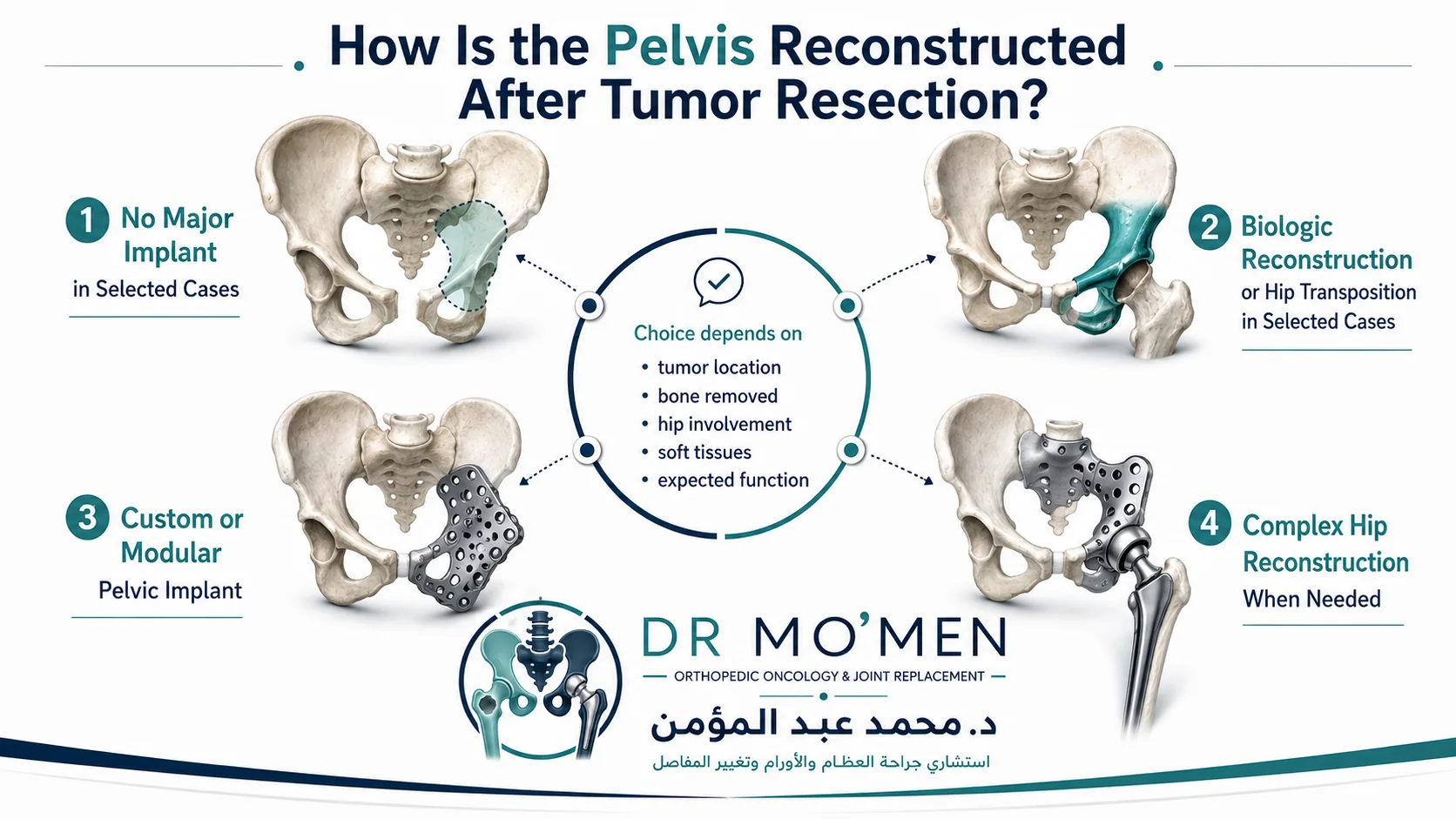
There is no single reconstruction method for all pelvic tumors. Options may include no bony reconstruction in selected resections, hip transposition, custom pelvic prosthesis, modular pelvic implant, 3D-printed implant, structural allograft in selected settings, total hip reconstruction, and combined biological and prosthetic techniques.
The reconstruction must be individualized according to the defect.
Does Every Pelvic Resection Need a Prosthesis?
No. Some pelvic resections do not require a large implant. Depending on location, removal of selected parts of the ilium, pubis or ischium may sometimes be managed without major prosthetic reconstruction.
Periacetabular defects more often require complex reconstruction if the goal is to restore a functioning hip articulation.
What Is a Custom Pelvic Implant?
A custom pelvic implant is designed to match the patient’s reconstructed pelvic anatomy after tumor resection. Modern planning may involve CT-based 3D reconstruction, virtual surgical planning, patient-specific implant design and 3D printing.
These technologies may help in selected complex cases. However, custom implants do not eliminate the fundamental challenges of infection, soft-tissue reconstruction, implant fixation, dislocation and long-term mechanical durability.
Why Soft-Tissue Reconstruction Matters
Pelvic tumor surgery may remove substantial muscle and soft tissue. Successful reconstruction depends not only on bone or implants but also on wound coverage, muscle function, hip stability, protection of implants and vascularized tissue.
Plastic or reconstructive surgery may be involved in selected cases.
Why Major Blood Vessels Matter
Pelvic tumors may approach the iliac vessels, femoral vessels and other major vascular structures. The tumor may displace vessels, contact them, partially surround them or directly invade them.
Selected limb-salvage operations may require vascular surgical input.
Why Major Nerves Matter
Important nerves may include the sciatic nerve, femoral nerve and lumbosacral plexus components. The functional consequences of nerve sacrifice can be substantial.
Preserving the limb at the cost of profound neurological dysfunction may not always represent the best functional result.
What If the Sacrum Is Involved?
Tumors extending into the sacrum may become even more complex. The surgeon must assess sacral level, nerve roots, pelvic stability, bowel and bladder function, relationship to the spine and reconstruction requirements.
Combined pelvic and sacral resections require specialized multidisciplinary planning.
Can Pelvic Tumors Cause Pathological Fracture?
Yes. Pathological fracture may occur through the acetabulum, pelvic ring, iliac bone or proximal femoral extension.
Management depends on tumor diagnosis, fracture pattern, mechanical stability and the overall oncological plan. Routine trauma fixation before diagnosis may complicate definitive treatment if a primary bone malignancy is present.
Why Unplanned Surgery Can Be Particularly Harmful in Pelvic Tumors
Unplanned curettage, fixation or excision may contaminate tissue planes that otherwise would not need to be removed. Because pelvic anatomy is already complex, this can significantly increase the difficulty of definitive surgery.
When a primary pelvic malignancy is suspected, diagnosis and treatment planning should come before irreversible reconstruction whenever clinically possible.
What Are the Main Risks of Pelvic Tumor Surgery?
Potential complications depend heavily on the operation and may include infection, bleeding, thrombosis, wound complications, nerve injury, vascular injury, hip instability, dislocation, implant failure, fracture, leg-length discrepancy, muscle weakness, hernia or abdominal-wall problems in selected resections, local recurrence and need for revision surgery.
No single complication percentage applies to every pelvic tumor operation.
Why Infection Risk Is Important
Pelvic tumor surgery often involves long operations, large surgical fields, extensive reconstruction, substantial implants and complex soft-tissue closure.
These factors can increase the importance of infection prevention and wound management. The risk varies according to the procedure and patient.
Rehabilitation After Pelvic Tumor Surgery
Rehabilitation can be more complex than after many long-bone tumor procedures. Early care may include pain control, wound protection, thrombosis prevention, transfer training, protected weight-bearing and muscle activation.
Later goals may include gait retraining, hip control, balance, strength, endurance, walking aids and return to independent daily activities. Recovery is highly individualized.
When Can the Patient Walk?
There is no universal timeline. Weight-bearing depends on the type of pelvic resection, reconstruction, implant fixation, soft-tissue repair, bone healing, wound condition and surgeon’s protocol.
Some reconstructions require prolonged protection. Others may allow earlier progressive loading.
What Function Can Be Expected?
Functional outcome depends on the amount of pelvis removed, hip preservation, nerve preservation, muscle resection, reconstruction, complications, rehabilitation and patient health.
Some patients regain independent walking. Others may need a cane, crutches, walker or long-term activity modification. Normal function should not be promised before surgery.
Can Pelvic Tumors Recur?
Yes. Local recurrence can occur depending on tumor biology, margin, grade, previous treatment and anatomical complexity.
New symptoms may include increasing pain, new swelling, new neurological symptoms or changes on follow-up imaging. Structured surveillance is therefore important.
What Does Follow-Up Include?
Oncological surveillance monitors for local recurrence and metastatic disease where relevant. Reconstruction surveillance monitors for implant loosening, dislocation, infection, mechanical failure and fracture. Functional surveillance monitors gait, hip stability, nerve function and rehabilitation progress.
When Should You Seek a Pelvic Tumor Second Opinion?
Specialist review is especially useful when biopsy has been recommended, diagnosis is uncertain, internal or external hemipelvectomy has been proposed, periacetabular resection is being considered, custom pelvic reconstruction is proposed, major vascular or nerve involvement is suspected, the tumor has already been operated on, recurrence has developed, or treatment recommendations differ between centers.
Useful pathways: International Patients • Second Opinion
Useful records include pelvic X-rays, MRI, CT, chest imaging, PET/CT or other staging studies when available, biopsy report, pathology report, pathology slides or blocks when appropriate, previous operative notes, oncology treatment summary and previous radiotherapy details.
For patients who have not yet undergone biopsy, specialist review before biopsy can be particularly valuable.
Pelvic Bone Tumor Assessment in Cairo, Egypt
Patients with a suspected pelvic bone tumor who need in-person assessment can be evaluated in Heliopolis, Cairo after prior MRI, CT, pathology and operative records are reviewed when available. For patients travelling from outside Cairo or Egypt, preliminary record review can help identify missing imaging, biopsy-sequencing concerns and whether a specialist visit is likely to add value before travel.
In-person pelvic-tumor assessment is available at the Heliopolis orthopedic clinic. The clinic visit does not replace multidisciplinary sarcoma care when chemotherapy, radiotherapy, vascular, reconstructive or other specialist input is required.
Related pathways: Orthopedic Oncology • International Patients • Second Opinion
Send Your Imaging Before You Travel
A preliminary review may help assess whether imaging is complete, whether biopsy route planning should be reconsidered, whether the hip joint may be preservable, whether limb salvage should be assessed, whether periacetabular reconstruction may be necessary, whether vascular or reconstructive specialists may be required, and whether travel to Cairo is reasonable before definitive intervention.
Remote review does not replace physical examination, pathology confirmation, staging or multidisciplinary surgical planning.
Useful pathways: International Patients • Second Opinion
For appointments or review of pelvic imaging: +20 102 1690693
About Dr. Mohammed Abdelmoemen Abuelhadid
Dr. Mohammed Abdelmoemen Abuelhadid is an Orthopedic Oncology & Joint Replacement Surgeon and Lecturer of Orthopedic Surgery at Ain Shams University.
His clinical areas include pelvic and extremity bone tumors, orthopedic oncology, biopsy planning, limb-salvage surgery, tumor resection and reconstruction, megaprosthetic reconstruction, metastatic bone disease, recurrent tumors, complex orthopedic reconstruction and second opinions for complex tumor cases.
Pelvic tumor treatment should be based on accurate diagnosis, multidisciplinary planning and a realistic balance between oncological safety and expected function.
Frequently Asked Questions
Are all pelvic bone tumors cancer?
No. Benign, locally aggressive and malignant tumors can all affect the pelvis. Imaging and sometimes biopsy are required to establish the diagnosis.
Why are pelvic tumors harder to operate on?
The pelvis contains major nerves, vessels, muscles, the hip joint and pelvic organs in a compact space. Tumor resection can therefore require more complex surgical planning.
What is internal hemipelvectomy?
It is a limb-sparing pelvic tumor operation in which part of the pelvis is removed while the lower limb is preserved.
Does internal hemipelvectomy mean the hip must be removed?
Not always. Whether the native hip can be preserved depends on the tumor location and acetabular involvement.
Does every pelvic tumor need a custom implant?
No. Reconstruction depends on the specific defect. Some resections need no major prosthesis, while others may require complex pelvic reconstruction.
Can pelvic tumors be treated without amputation?
In selected cases, yes. Limb-salvage surgery may be possible when adequate tumor removal and meaningful expected function can be achieved.
Should I seek a second opinion before pelvic tumor biopsy?
It can be particularly useful because biopsy route planning may influence later definitive surgery.
Medical Disclaimer
This article is for patient education and does not replace clinical examination, specialist imaging review, planned biopsy, pathology, staging investigations or individualized multidisciplinary tumor care.
Need specialist review of pelvic imaging?
Before biopsy or a major pelvic operation, specialist review can help assess the imaging, biopsy route, hip preservation, limb-salvage options and reconstructive needs.