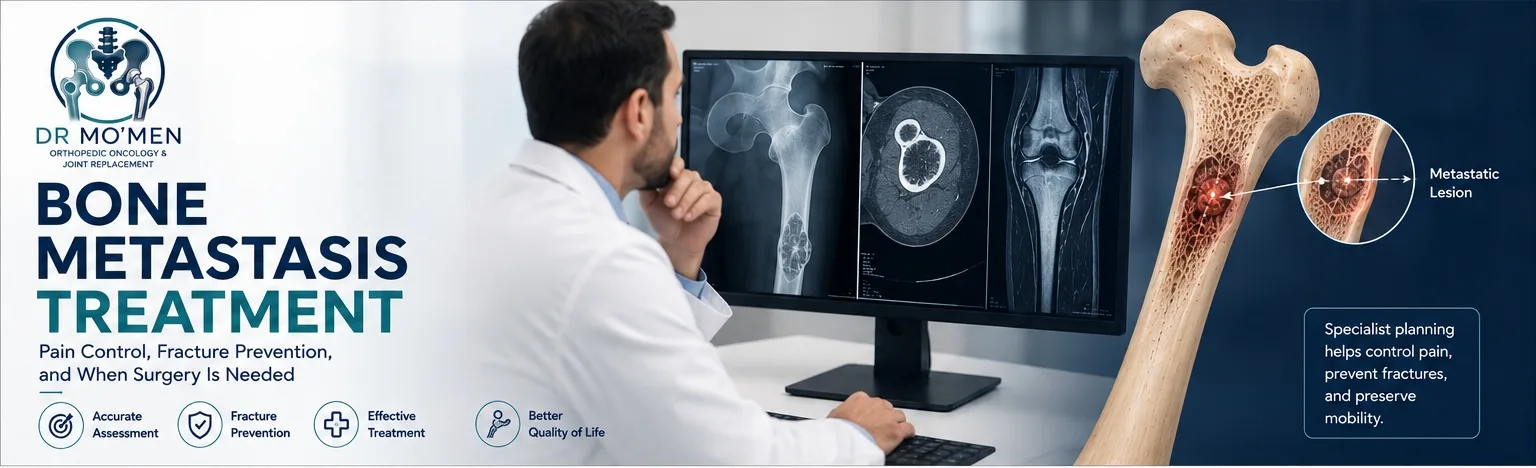
When cancer spreads to bone, patients and families often worry about pain, walking ability, fracture risk, and whether surgery is needed. Bone metastasis does not automatically mean immediate surgery. Some patients are treated with systemic therapy, radiotherapy, bone-modifying medication, analgesia, rehabilitation, or monitoring. Others need orthopedic intervention to stabilize a weakened bone, treat a pathological fracture, decompress nerves, or preserve mobility.
The decision depends on the primary cancer, disease extent, expected response to oncology treatment, general health, life expectancy, neurological status, and the mechanical strength of the affected bone.
What Is Bone Metastasis?
Bone metastasis occurs when cancer cells from another organ spread to the skeleton. This differs from a primary bone sarcoma, which starts in bone. Breast, prostate, lung, kidney, and thyroid cancers are among the malignancies that commonly involve bone.
International case review for metastatic bone disease
If you live outside Egypt and have bone metastasis, fracture risk or complex reconstruction questions, available scans and reports can be reviewed before deciding whether travel is appropriate.
Multiple myeloma and some lymphomas can also produce skeletal lesions, but they are hematologic malignancies involving bone rather than metastases from another organ. Management therefore depends on the exact diagnosis.
Learn more about the specialist pathway for metastatic bone disease treatment.
Symptoms That Need Medical Attention
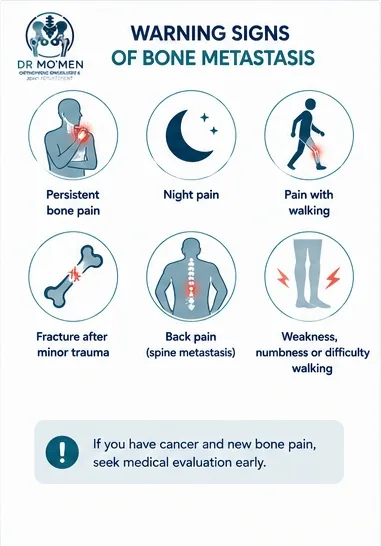
- Persistent or progressive bone pain.
- Pain that worsens on standing, walking, or using the limb.
- Night pain or pain at rest.
- Swelling, limping, or reduced ability to bear weight.
- A fracture after minor trauma.
- Back pain with weakness, numbness, difficulty walking, or bladder/bowel disturbance.
These symptoms are not specific to metastasis, but they should not be assumed to be arthritis or muscle strain without assessment. General warning patterns are reviewed in warning signs of bone tumors.
Why Fracture Risk Matters
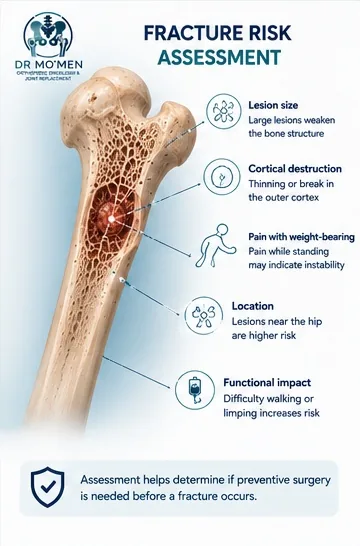
A bone weakened by cancer can break after minor trauma or normal activity. A pathological fracture can cause severe pain, loss of mobility, interruption of cancer treatment, and a more complex operation. In selected long-bone lesions, stabilizing the bone before fracture may be appropriate.
Assessment uses pain pattern, X-rays, CT or MRI when indicated, lesion size and location, cortical involvement, primary tumor biology, and patient function. Mirels’ score may support evaluation of long-bone lesions, but no single score replaces specialist judgment.
How Bone Metastases Are Assessed
Clinical and oncology review
The team reviews the primary cancer, current stage and treatment, pain pattern, mobility, neurological symptoms, performance status, and the overall oncology plan.
Imaging
- Plain X-rays assess cortical destruction, fracture, collapse, and long-bone integrity.
- CT helps define cortical damage and complex pelvic or spinal anatomy.
- MRI is particularly useful for marrow disease, soft-tissue extension, spinal involvement, and neural compression.
- PET-CT or bone scan may show the overall skeletal disease burden, depending on the cancer type and clinical question.
Biopsy in selected cases
Tissue confirmation may be needed when there is no known primary cancer, when the lesion is atypical for the known cancer, when infection or a primary bone tumor remains possible, or when the result will change treatment. In such cases, use a planned bone biopsy.
Treatment Goals
- Relieve pain and restore safe function.
- Prevent or stabilize fracture.
- Protect nerves and the spinal cord.
- Preserve mobility and independence.
- Coordinate surgery, radiotherapy, and systemic treatment.
- Select an intervention durable enough for the patient’s expected needs.
Non-Surgical Treatment Options
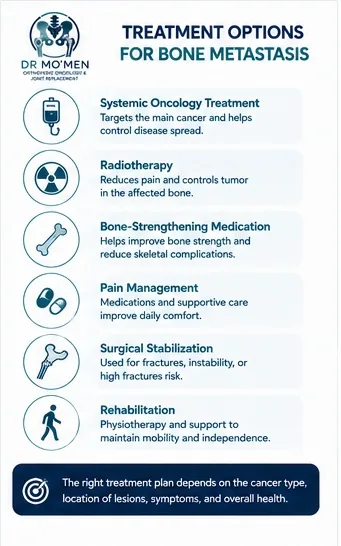
Systemic cancer treatment
Chemotherapy, endocrine therapy, immunotherapy, targeted therapy, or another systemic treatment may control the underlying cancer according to tumor type.
Radiotherapy
External-beam radiotherapy is an established treatment for symptomatic bone metastases and can provide pain relief and local control. Its schedule and technique depend on the site, previous radiation, prognosis, and treatment goals. Radiation does not mechanically stabilize an already fractured or structurally unsafe bone.
Bone-modifying medication
Bisphosphonates or denosumab may be used in selected cancers to reduce skeletal complications. They require oncology supervision, renal or calcium assessment as appropriate, and dental precautions because of recognized adverse effects.
Pain control, rehabilitation, and activity modification
Analgesia, walking aids, bracing, and rehabilitation may help. Exercise and weight-bearing should be adapted to fracture risk; aggressive rehabilitation is unsafe when a major bone is mechanically weak.
Radiotherapy or Surgery — Which Comes First?
| Situation | Main clinical question | Typical direction of assessment |
|---|---|---|
| Painful but mechanically stable bone metastasis | Can symptoms and local disease be controlled without stabilization? | Systemic therapy, radiotherapy, analgesia and activity modification may be considered according to tumor type and oncology goals. |
| Impending long-bone fracture | Is the bone strong enough to remain safe under load? | Orthopedic fracture-risk assessment and possible prophylactic stabilization should be considered before relying on radiotherapy alone. |
| Completed pathological fracture | What reconstruction will restore durable mechanical stability? | Fixation or reconstruction is assessed according to fracture site, bone destruction, implant durability and overall prognosis. |
| Neurological deficit or spinal cord/nerve compression | Is urgent decompression or stabilization needed? | Urgent spine/neural assessment; surgery, steroids and radiotherapy may be combined in selected compression scenarios. |
| Solitary destructive lesion without an established diagnosis | Is this metastasis, a primary bone tumor, myeloma, lymphoma or infection? | Complete the diagnostic pathway and use a planned biopsy when tissue diagnosis will change treatment. |
When Is Surgery Needed?
Surgery is mainly considered when metastatic disease causes or threatens a mechanical or neurological problem:
- An actual pathological fracture.
- An impending fracture in a weight-bearing or functionally important bone.
- Mechanical pain or instability.
- Spinal cord or nerve compression requiring urgent assessment.
- Selected solitary or limited disease where durable local reconstruction is appropriate.
- Failure of appropriate non-surgical management when a structural problem persists.
Options include intramedullary nailing, plate fixation, cement augmentation, endoprosthetic or joint-replacement reconstruction, and spinal stabilization or decompression. The operation should be chosen according to anatomy, tumor biology, remaining bone, prognosis, and the durability required. Complex reconstruction may overlap with limb salvage and reconstruction.
Femur, Hip, and Spine Metastases
Femur and hip
Groin or thigh pain with standing or walking, limping, cortical destruction, or a proximal femoral lesion should prompt fracture-risk assessment. Depending on location and structural damage, treatment may involve protected weight-bearing, radiotherapy, fixation, or arthroplasty-type reconstruction.
Spine
Not all spinal metastases require surgery. Radiotherapy, systemic therapy, analgesia, or bracing may be appropriate. New weakness, progressive difficulty walking, saddle-area numbness, or loss of bladder or bowel control can indicate neural compression and requires urgent assessment.
Why Multidisciplinary Care Is Essential

Multidisciplinary review determines whether pain is primarily oncologic or mechanical, whether the bone is at risk of fracture, whether biopsy is required, and how surgery and radiotherapy should be sequenced. The plan must also account for systemic treatment and the patient’s priorities.
When to Seek an Orthopedic Oncology Opinion
Review is appropriate for new bone pain in a patient with cancer, weight-bearing pain, imaging showing cortical destruction, a fracture after minor trauma, neurological symptoms, uncertainty about biopsy, or planned radiotherapy when fracture risk has not been assessed.
Dr. Mo’men’s Role in Metastatic Bone Disease
Dr. Mohammed Abdelmoemen Abuelhadid focuses on orthopedic oncology, metastatic bone disease, fracture-risk assessment, fixation and reconstruction, and complex orthopedic second opinions. Patients outside Egypt may request an online orthopedic second opinion using scans, reports, pathology, and oncology records before deciding whether travel is required.

Medically reviewed by Dr. Mohammed Abdelmoemen Abuelhadid
Lecturer of Orthopedic Surgery at Ain Shams University, with clinical focus on orthopedic oncology, limb salvage, metastatic bone disease, and complex reconstruction. About the doctor · ORCID profile
How this article was reviewed
This patient-education article was reviewed for clinical accuracy, patient safety, and decision-making clarity by Dr. Mohammed Abdelmoemen Abuelhadid. It is intended to support, not replace, clinical examination and review of the actual imaging and reports.
Authoritative medical sources
- American Academy of Orthopaedic Surgeons: Metastatic Bone Disease — overview of assessment, fracture risk and multidisciplinary treatment.
- MSTS/AAOS Clinical Practice Guideline: Metastatic Carcinoma and Myeloma of the Femur — evidence framework for fracture-risk assessment and prophylactic stabilization decisions in femoral metastatic disease.
- ASTRO 2024 Guideline: External Beam Radiation Therapy for Symptomatic Bone Metastases — supports radiotherapy for symptomatic lesions and multimodality care when surgery is required.
- ESMO Patient Guide: Bone Health in Cancer — patient-level overview of skeletal complications and multidisciplinary management.
Request an appointment or imaging review
For specialist evaluation, a clinic appointment, or preliminary review of available scans and reports, contact the clinic using the appropriate option.